Chapter 13: Disaster Recovery with Multi-Agents in Production
Resilience is not the absence of failures; it is the institutionalized ability to recover from them faster than they occur.
The Problem of Continuity in Systems That Think
Section titled “The Problem of Continuity in Systems That Think”When a traditional distributed system fails, the damage is predictable: a server stops responding, a database becomes inaccessible, a service returns 503 errors. Classic disaster recovery (DR) procedures (standardized by NIST SP 800-34 Rev.1 and ISO 22301:2019) were conceived for this model of discrete, localized failures: detect, isolate, restore, verify.
Multi-agent ecosystems introduce a qualitatively different dimension of complexity. An orchestrator agent doesn’t just fail; it can fail while holding partially consistent distributed state, while coordinating saga transactions with pending compensations, while other agents in the swarm await instructions or have made decisions based on information that is already inconsistent. Recovery, in this context, doesn’t consist of restoring a service; it consists of restoring a coherent cognitive state of a distributed system that has memory, intentions in progress, and unfulfilled commitments.
Patterson et al. (2002), in the Recovery-Oriented Computing (ROC) project at the University of California, Berkeley, argued that modern systems must be designed assuming failure as a normal condition, not an exceptional one. That premise (radical in 2002) is an everyday operational truth in production multi-agent ecosystems. The DORA 2023 report (State of DevOps Report) records that elite organizations recover services in under an hour from incidents of any complexity, while low-performing organizations take more than a week: a gap of 168x that is, to a great extent, a gap in DR maturity.
Academic version: The fundamental distinction between classic DR and agentic DR lies in the nature of the state that must be recovered. In traditional software systems, state is predominantly data persisted in structured storage; its recovery comes down to restoring a snapshot and replaying pending transactions. In multi-agent systems, state incorporates a cognitive dimension (the reasoning context, the intentions in progress, the short- and long-term memories of each agent) that is not directly serializable through the checkpoint mechanisms of conventional databases. This asymmetry imposes the need for specialized DR protocols that treat distributed cognitive state as a first-class artifact in continuity planning.
Operational Definitions: The Vocabulary of Agentic DR
Section titled “Operational Definitions: The Vocabulary of Agentic DR”Before proceeding, it is worth establishing terminological precision the sector uses inconsistently:
| Term | Operational definition | Specific agentic dimension |
|---|---|---|
| RPO (Recovery Point Objective) | Maximum age of data tolerated after recovery | Includes the agents’ cognitive context, not just persisted data |
| RTO (Recovery Time Objective) | Maximum time from failure to service restoration | Includes the time to reconstitute the agents’ state |
| MTTR (Mean Time To Recovery) | Actual observed average recovery time | A performance indicator; RPO and RTO are design objectives |
| Pilot Light | Only the minimal components active in the DR region | Minimal agents (orchestrator + health monitor) on standby |
| Warm Standby | A reduced but functional version in the DR region | The full swarm at low load, without processing production traffic |
| Active-Active | Both regions process traffic simultaneously | The swarm is geographically distributed with distributed consensus |
Taxonomy of Disasters in Agentic Ecosystems
Section titled “Taxonomy of Disasters in Agentic Ecosystems”The failures that affect multi-agent ecosystems fall into five categories with qualitatively distinct DR treatments:
| Category | Description | Specific agentic impact | Recommended RTO |
|---|---|---|---|
| Infrastructure failure | Datacenter, availability zone, cloud region | Agent state lost; coordination broken | 15–60 min |
| Model failure | LLM API unavailable; degraded model | Cognition-dependent agents don’t execute | 5–30 min (deterministic fallback) |
| State corruption | Inconsistent agentic memory; corrupted context | Decisions based on invalid context | 30–120 min |
| Cascading failure | One agent compromises others in the swarm | Propagation of errors through the dependency graph | Variable (≥60 min) |
| Targeted attack during DR | An adversary exploits the chaos of the incident | DR as a vector for exfiltration or ransomware propagation | N/A (prevention) |
Model failures (specific to agentic systems) have no equivalent in traditional DR frameworks. NIST SP 800-34 Rev.1 doesn’t contemplate the scenario in which the inference service the system depends on for reasoning becomes temporarily unavailable or produces degraded outputs. This gap forces extending the classic DR framework with a layer of cognitive resilience: the swarm’s ability to operate in a deterministic degraded mode when the AI models are unavailable.
DR for Pure Cloud Architectures
Section titled “DR for Pure Cloud Architectures”The Dilemma of Geographic Replication
Section titled “The Dilemma of Geographic Replication”In a purely cloud architecture, DR revolves around geographic replication. The most widely adopted cloud providers offer native primitives (RDS Multi-AZ, DynamoDB Global Tables, Azure Cosmos DB global distribution) that solve the replication of structured data. For multi-agent systems, however, data replication is a necessary but not sufficient condition.
An agent’s state (its conversational context, its long-term memories, its decisions in progress) must be replicated with partial order semantics, not the strict transactional semantics applied to financial data. Ongaro and Ousterhout (2014), in “In Search of an Understandable Consensus Algorithm” (USENIX ATC 2014), showed that distributed consensus with ordering guarantees can be achieved with Raft (the basis of systems like etcd (Kubernetes) and Consul), which act as state coordinators for cloud agent swarms.
Three Strategies for the Cloud Swarm
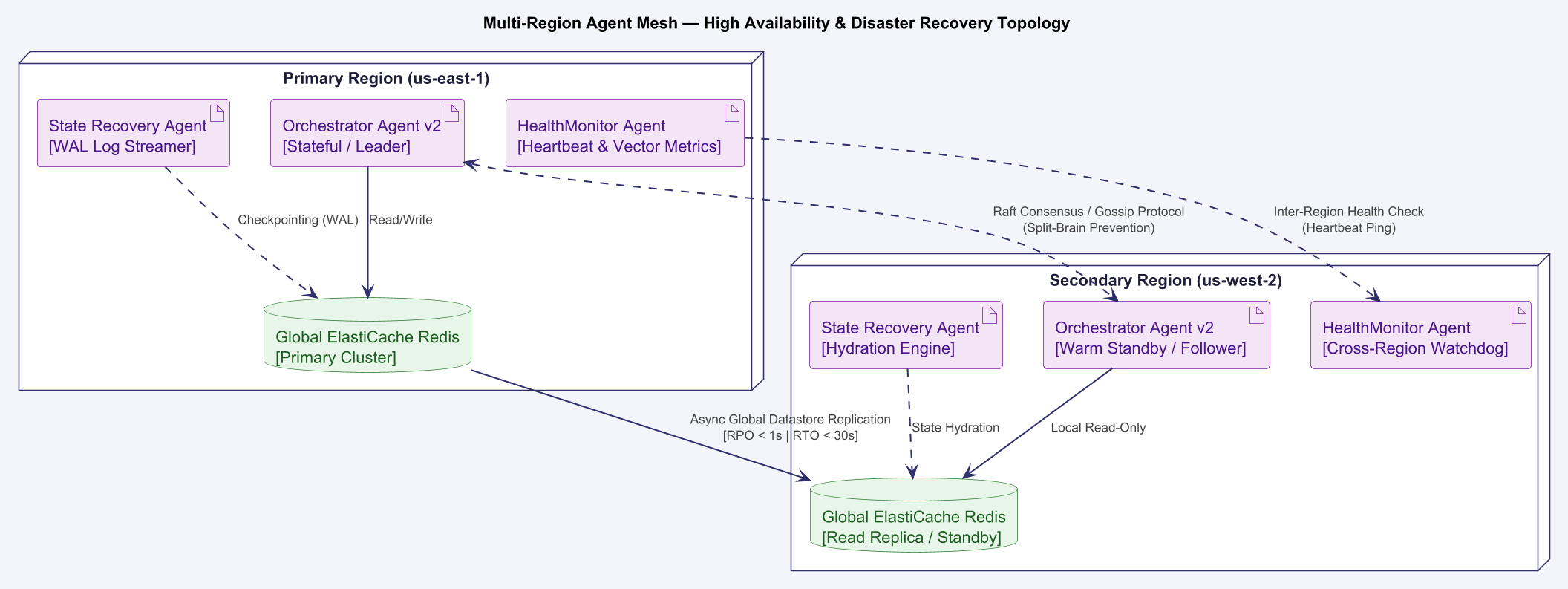
Section titled “Three Strategies for the Cloud Swarm”Strategy 1: Active-Active with a geographically distributed swarm
Both regions process production load. The cost is 2x–2.5x the base infrastructure, but the RTO is theoretically zero: if the primary region fails, the load balancer redirects with no manual intervention. Suitable for organizations with a downtime cost >$1M/hour.
Strategy 2: Active-Passive (Warm Standby)
The DR region keeps agents configured and connected to replicated data but not processing load. When a failure is detected, the DR orchestrator agent activates the secondary region in 10–30 minutes. Cost: ~1.3–1.5x base. RTO: 10–30 min. Recommended for downtime cost of $100K–$1M/hour.
Strategy 3: Pilot Light
Only the minimal indispensable agents run permanently in DR (orchestrator + health monitor). The domain agents start from pre-built images when DR is activated. Cost: ~1.1x base. RTO: 30–90 min. Suitable for non-critical workloads with downtime cost <$100K/hour.
Reference Configuration: EKS + Velero + Argo
Section titled “Reference Configuration: EKS + Velero + Argo”# dr-config.yaml — pure-cloud DR with multi-agentsapiVersion: apps/v1kind: Deploymentmetadata: name: dr-orchestrator-agent namespace: dr-system labels: dr-tier: "critical" dr-role: "orchestrator"spec: replicas: 3 strategy: type: RollingUpdate rollingUpdate: maxUnavailable: 1 maxSurge: 1 template: spec: topologySpreadConstraints: - maxSkew: 1 topologyKey: topology.kubernetes.io/zone whenUnsatisfiable: DoNotSchedule containers: - name: dr-orchestrator image: dr-orchestrator:v2.1.0 env: - name: DR_MODE value: "ACTIVE_PASSIVE" - name: RPO_MINUTES value: "15" - name: RTO_MINUTES value: "60" - name: MEMORY_BACKEND value: "redis-cluster://redis-dr.us-east-1.cache.amazonaws.com:6379" - name: FAILOVER_REGION value: "us-west-2" - name: AGENT_CHECKPOINT_INTERVAL value: "300" # checkpoints every 5 min - name: FAILOVER_CONFIRMATION value: "DUAL_PARTY" # agent + human with MFA resources: requests: memory: "512Mi" cpu: "500m" limits: memory: "2Gi" cpu: "2000m" livenessProbe: httpGet: path: /health port: 8080 initialDelaySeconds: 30 periodSeconds: 10 failureThreshold: 3---apiVersion: policy/v1kind: PodDisruptionBudgetmetadata: name: dr-orchestrator-pdb namespace: dr-systemspec: minAvailable: 2 selector: matchLabels: dr-role: "orchestrator"DR for Hybrid Architectures
Section titled “DR for Hybrid Architectures”The Complexity of the Cloud-Edge Seam
Section titled “The Complexity of the Cloud-Edge Seam”Disaster recovery in hybrid architectures (a combination of cloud and on-premise or edge) is qualitatively more complex because DR must be coherent across two worlds with radically different operational properties.
The CAP Theorem (Brewer, 2000), discussed in Chapter 12 (Vol. 2), establishes that under a network partition the system must choose between consistency and availability. In a hybrid DR scenario, the partition is the disaster itself: the fiber between on-premise and cloud is cut, the on-premise datacenter loses power, or the ISP fails. Helland (2009), in “Life Beyond Distributed Transactions: An Apostate’s Opinion” (CIDR 2009), argued that large-scale systems must be designed to operate correctly in the absence of global distributed transactions. This principle governs the design of hybrid DR: edge agents must be able to keep operating and recover their state autonomously, without cloud coordination, during the partition period.
The Pattern: Edge-Autonomous + Cloud-Consistent
Section titled “The Pattern: Edge-Autonomous + Cloud-Consistent”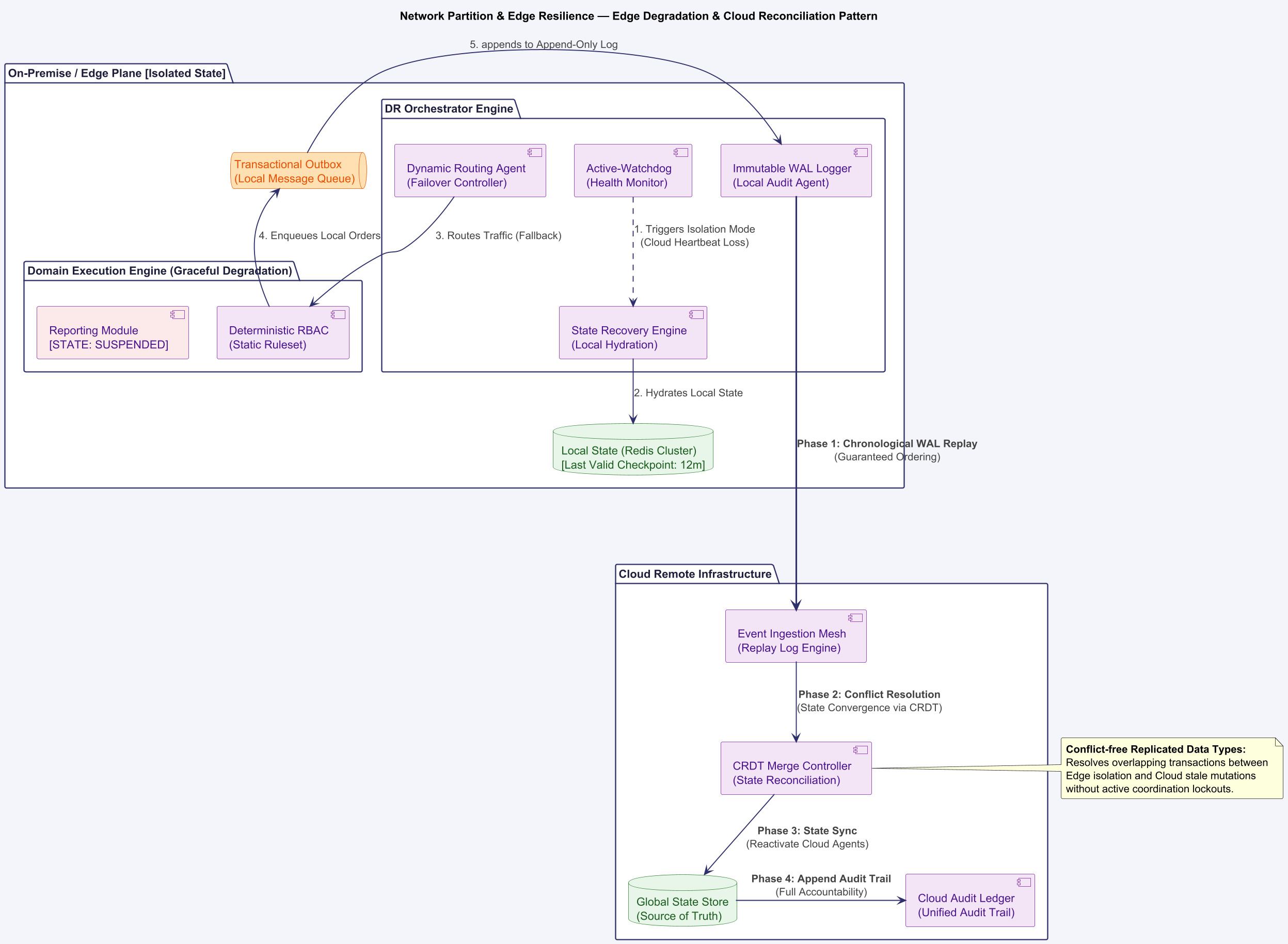
Implementation: An Agent with Event Sourcing for Offline Resilience
Section titled “Implementation: An Agent with Event Sourcing for Offline Resilience”import asyncioimport jsonimport timeimport hashlibfrom dataclasses import dataclass, fieldfrom enum import Enumfrom typing import Optional, List
class OperationMode(Enum): FULL_CONNECTED = "full_connected" # cloud + edge operational DEGRADED_LOCAL = "degraded_local" # edge only, cloud unavailable RECOVERY = "recovery" # reconnecting, synchronizing
class EventSourcingLog: """ Immutable event log with cryptographic chaining. Guarantees integrity and order for post-partition synchronization. """ def __init__(self, storage_path: str): self.storage_path = storage_path self.events: List[dict] = [] self._load_existing()
def _load_existing(self): try: with open(self.storage_path, 'r') as f: self.events = [json.loads(line) for line in f if line.strip()] except FileNotFoundError: self.events = []
def append(self, event_type: str, payload: dict, agent_id: str) -> str: event = { "seq": len(self.events), "timestamp": time.time(), "agent_id": agent_id, "type": event_type, "payload": payload, "prev_hash": self.events[-1]["hash"] if self.events else "genesis", } event["hash"] = hashlib.sha256( json.dumps(event, sort_keys=True).encode() ).hexdigest()[:16]
self.events.append(event) with open(self.storage_path, 'a') as f: f.write(json.dumps(event) + '\n') return event["hash"]
def get_unsynced(self, since_seq: int) -> List[dict]: return [e for e in self.events if e["seq"] >= since_seq]
@dataclassclass HybridDRAgent: """ Hybrid agent with persistent memory and autonomous operation during cloud-edge partitions. Implements Event Sourcing to guarantee eventual consistency when connectivity is restored. """ agent_id: str rpo_minutes: float rto_minutes: float mode: OperationMode = OperationMode.FULL_CONNECTED event_log: Optional[EventSourcingLog] = None last_cloud_sync_seq: int = 0 failure_memory: List[dict] = field(default_factory=list)
def __post_init__(self): self.event_log = EventSourcingLog( f"/var/dr/{self.agent_id}_events.jsonl" )
async def check_cloud_connectivity(self) -> bool: try: await asyncio.wait_for(self._ping_cloud(), timeout=5.0) return True except (asyncio.TimeoutError, ConnectionError): return False
async def execute_with_dr(self, operation: str, payload: dict) -> dict: """ Executes an operation with DR guarantees: if the cloud is available, a normal operation + log; if not, a local degraded operation + log. """ cloud_available = await self.check_cloud_connectivity()
if cloud_available and self.mode != OperationMode.DEGRADED_LOCAL: result = await self._execute_cloud_operation(operation, payload) self.event_log.append("CLOUD_OP", {"op": operation, "result": result}, self.agent_id) return result else: if self.mode == OperationMode.FULL_CONNECTED: self.mode = OperationMode.DEGRADED_LOCAL self.event_log.append("MODE_CHANGE", {"from": "FULL", "to": "DEGRADED"}, self.agent_id) self._record_failure_in_memory(operation)
result = await self._execute_local_fallback(operation, payload) self.event_log.append("LOCAL_OP", {"op": operation, "result": result, "degraded": True}, self.agent_id) return result
async def reconcile_with_cloud(self) -> int: """ Post-partition synchronization: replays local events to the cloud. Resolves conflicts with CRDT last-write-wins by default. """ unsynced = self.event_log.get_unsynced(self.last_cloud_sync_seq) synced = 0 for event in unsynced: try: await self._replay_event_to_cloud(event) self.last_cloud_sync_seq = event["seq"] + 1 synced += 1 except ConflictError as e: resolved = self._resolve_conflict(event, e.cloud_event) await self._apply_resolution(resolved) synced += 1 self.mode = OperationMode.FULL_CONNECTED return synced
def _record_failure_in_memory(self, context: str): self.failure_memory.append({ "timestamp": time.time(), "context": context, "events_pending": len(self.event_log.events) - self.last_cloud_sync_seq, })
def _resolve_conflict(self, local: dict, cloud: dict) -> dict: return local if local["timestamp"] > cloud.get("timestamp", 0) else cloud
async def _ping_cloud(self): await asyncio.sleep(0.1) async def _execute_cloud_operation(self, op, payload): return {"source": "cloud", "op": op} async def _execute_local_fallback(self, op, payload): return {"source": "local", "op": op} async def _replay_event_to_cloud(self, event): pass async def _apply_resolution(self, resolution): pass
class ConflictError(Exception): def __init__(self, message: str, cloud_event: dict): super().__init__(message) self.cloud_event = cloud_eventDR for On-Premise Architectures
Section titled “DR for On-Premise Architectures”The Economic Paradox of Ownership
Section titled “The Economic Paradox of Ownership”Purely on-premise architectures present a radically different DR profile: the cost of DR infrastructure is proportional to the cost of the primary datacenter, not to an elastic fraction of the cloud. The canonical model involves a secondary datacenter (geographically separated for protection against natural disasters) with storage replication (NetApp SnapMirror, EMC SRDF, Zerto) and manual or semi-automatic switchover.
The introduction of multi-agents in on-premise environments transforms this model in two fundamental ways.
First transformation: the DR agent as the switchover orchestrator. Instead of an operations team manually executing a 40–80 step runbook during a situation of maximum stress (with a high risk of human error), the DR orchestrator agent executes the playbook autonomously, with verification at every step, and escalates to the human only for ambiguities that require judgment.
Second transformation: the agent’s memory as a living runbook. The static runbook (a PDF or Confluence document the on-call team consults at 3 AM) is inherently degraded: it may be out of date, it may omit steps that depend on the system’s current state, it may ignore lessons from previous incidents. The DR agent’s memory, by contrast, incorporates the complete history of incidents, the actions that worked and those that didn’t, the observed execution times, and the anomalous states that preceded previous failures.
Reference Configuration: Ansible + Docker On-Premise
Section titled “Reference Configuration: Ansible + Docker On-Premise”# Ansible playbook for deploying an on-premise multi-agent DR system---- name: Deploy DR Multi-Agent System On-Premise hosts: dr_controllers become: true vars: dr_primary_datacenter: "dc-madrid-1" dr_secondary_datacenter: "dc-barcelona-1" rpo_minutes: 30 rto_minutes: 120 agent_memory_backend: "postgresql://dr-db:5432/agent_memory"
tasks: - name: Deploy DR Orchestrator Agent docker_container: name: dr-orchestrator image: "internal-registry/dr-orchestrator:v2.1.0" state: started restart_policy: always env: DR_MODE: "WARM_STANDBY" PRIMARY_DC: "{{ dr_primary_datacenter }}"
SECONDARY_DC: "{{ dr_secondary_datacenter }}" RPO_MINUTES: "{{ rpo_minutes }}" RTO_MINUTES: "{{ rto_minutes }}" MEMORY_BACKEND: "{{ agent_memory_backend }}" CHECKPOINT_INTERVAL: "600" # 10 min on-premise (costly I/O) FAILOVER_CONFIRMATION: "HUMAN_REQUIRED" # mandatory approval on-premise AUDIT_LOG_PATH: "/var/log/dr/immutable.jsonl" volumes: - /var/dr/memory:/app/memory - /var/log/dr:/app/logs network_mode: host
- name: Configure agent health checks (cron) cron: name: "DR Agent Heartbeat" minute: "*/5" job: "curl -sf http://localhost:8080/health || systemctl restart dr-orchestrator"
- name: Immutable audit log rotation copy: dest: /etc/logrotate.d/dr-agent content: | /var/log/dr/immutable.jsonl { daily compress dateext notifempty rotate 365 create 0600 dr-agent dr-agent postrotate kill -USR1 $(cat /var/run/dr-agent.pid 2>/dev/null) 2>/dev/null || true endscript }On-Premise Costs: A Comparative Framework
Section titled “On-Premise Costs: A Comparative Framework”| Component | Initial CAPEX | Annual OPEX | 5-year amortization/year |
|---|---|---|---|
| DR hardware (servers, storage, networking) | $500K–$2M | $50K–$200K | $150K–$600K |
| Alternative colocation (vs. own DC) | $50K–$200K | $100K–$500K | $110K–$540K |
| Multi-agent DR system (development + maintenance) | $100K–$300K | $50K–$150K | $70K–$210K |
| DR software licenses (replication, backup) | $20K–$100K | $20K–$100K | $24K–$120K |
| Total on-premise DR | $670K–$2.6M | $220K–$950K | $354K–$1.47M |
By contrast, an equivalent cloud system in warm standby for the same load can operate for $80K–$300K/year of OPEX with no significant CAPEX. The on-premise vs. cloud-DR decision is not technical; it is strategic and regulatory: data sovereignty, GDPR/HIPAA compliance, geographic latency.
The DR System as a Specialized Swarm
Section titled “The DR System as a Specialized Swarm”Five Agents, Five Responsibilities
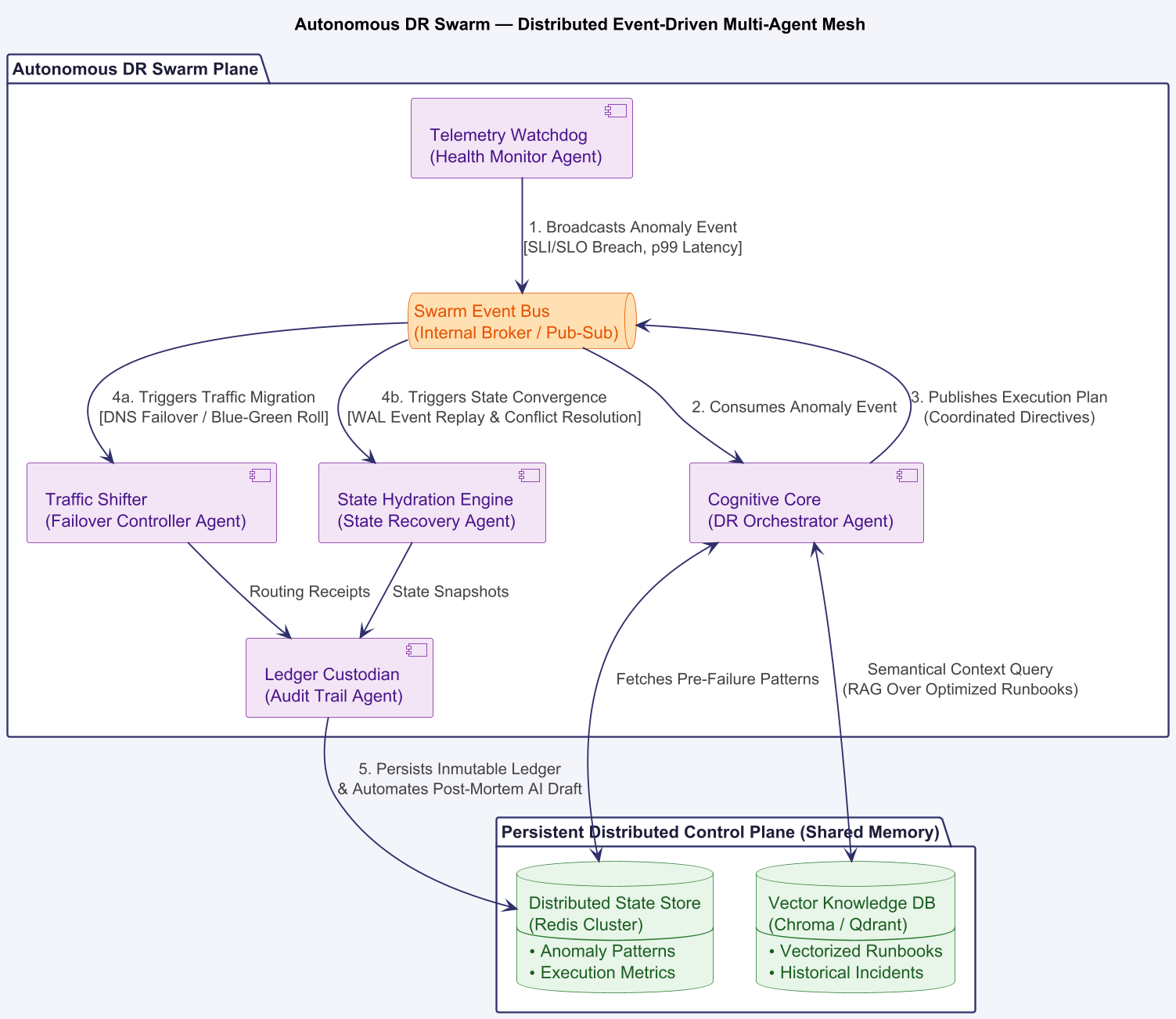
Section titled “Five Agents, Five Responsibilities”The central premise of this chapter is that DR should not be a procedure that happens in the presence of agents, but an agentic system in itself. A DR-specialized swarm features five agents with clearly differentiated roles and non-overlapping responsibilities:
The DR Protocol: A 5-Phase Handshake
Section titled “The DR Protocol: A 5-Phase Handshake”| Phase | Name | Target duration | Responsible agent | Success criterion |
|---|---|---|---|---|
| 1 | Detection & Classification | T+0 → T+5 min | Health Monitor | Failure classified with evidence |
| 2 | Isolation & Stabilization | T+5 → T+15 min | Failover Agent | Traffic isolated, no escalation |
| 3 | Recovery Execution | T+15 → T+60 min | State Recovery | Critical services restored |
| 4 | Validation & Cutover | T+60 → T+75 min | Health Monitor | SLOs met in the DR region |
| 5 | Post-DR & Learning | T+75 → T+90 min | Audit + Orchestrator | Post-mortem and memory updated |
T+0:00 Health Monitor detects degradation (error rate > 5% / 3 consecutive checks)T+0:01 Health Monitor notifies the DR Orchestrator with a full state snapshotT+0:02 DR Orchestrator consults memory: a similar situation in previous incidents?T+0:03 DR Orchestrator classifies: MINOR / MAJOR / CATASTROPHICT+0:04 MINOR → alerts + monitoring. MAJOR/CATASTROPHIC → DR activation.T+0:05 DR Orchestrator activates Failover Agent + State Recovery Agent in parallelT+0:06 Failover Agent verifies data synchronization in the DR regionT+0:07 State Recovery Agent verifies the last valid checkpointT+0:08 Audit Agent records DR start with a state hash (cryptographic chain)T+0:10 DR Orchestrator: final switchover decision (or escalates to a human if CATASTROPHIC)T+0:15 [If approved] Failover executes DNS + LB redirect to the DR regionT+0:20 Health Monitor verifies normal operation in the DR regionT+0:25 Audit Agent records DR end with real metrics (RTO, data loss, events)T+0:30 [Post-DR] State Recovery synchronizes state; the swarm's memory is updatedAgentic Memory: The Hidden Asset of Resilience
Section titled “Agentic Memory: The Hidden Asset of Resilience”The Structural Limit of the Static Runbook
Section titled “The Structural Limit of the Static Runbook”A traditional DR system bases its execution on static runbooks. Those runbooks have four structural limitations that the SRE literature has consistently documented:
-
Temporal degradation: they are accurate at the moment they are written and go stale as the infrastructure evolves. DORA 2023 reports that 34% of low-performing organizations’ DR procedures are out of date at the time of the incident.
-
Absence of context: they don’t know what specific state the system is in when they are executed; they describe generic steps that may not apply to the current state.
-
Forgetting lessons: each incident that reveals a gap in the runbook generates a post-mortem note that may or may not be incorporated into the original document.
-
Executor stress: the engineers who execute the runbook at 3 AM are under maximum pressure; the risk of execution error is high.
Park et al. (2023), in “Generative Agents: Interactive Simulacra of Human Behavior” (CHI 2023), showed that agents with persistent memory exhibit emergent behaviors that agents without memory cannot exhibit. Applied to DR: an agent with memory of 50 previous incidents can recognize pre-failure patterns that an agent without memory (or a human consulting a runbook) cannot detect.
The Three Horizons of DR Memory
Section titled “The Three Horizons of DR Memory”| Horizon | Content | Retention | Use |
|---|---|---|---|
| Short term (active session) | Current state, decisions in progress, incident context | Duration of the incident | Real-time coordination |
| Medium term (weeks) | Recent incidents, runbooks executed, actual vs. target times | 90 days | Continuous playbook improvement |
| Long term (months/years) | Seasonal patterns, failure-cause correlations, benchmarks by architecture | Indefinite | Prediction, prevention, audit |
Implementation: A DR Memory Agent with Multi-Turn Context
Section titled “Implementation: A DR Memory Agent with Multi-Turn Context”from anthropic import Anthropicimport json, time
class DRMemoryAgent: """ A DR agent with long-term memory that learns from every incident. Uses multi-turn context to maintain coherence during crises. """
def __init__(self, memory_store: dict): self.client = Anthropic() self.memory = memory_store # persistent across sessions self.history = [] # active session context
def _build_system_prompt(self) -> str: incidents = self.memory.get("incidents", []) recent = sorted(incidents, key=lambda x: x["timestamp"], reverse=True)[:10] history_lines = "\n".join( f"- [{inc.get('date','?')}] {inc['type']}: " f"actual RTO={inc['actual_rto_min']}min, " f"cause={inc['root_cause']}, " f"resolution={inc['resolution_summary']}" for inc in recent ) if recent else "No historical incidents recorded."
return f"""You are an agent specialized in disaster recovery.Your historical memory of incidents:
{history_lines}
Directives:1. When you detect similarity with a past incident, cite it explicitly.2. Prioritize actions based on what worked before, not generic steps.3. Estimate recovery times with real data, not theoretical.4. If the pattern suggests an attack (ransomware, exfiltration), escalate to a human immediately: do NOT activate automatic failover in the face of security threats.5. Document every decision with an auditable justification."""
async def analyze_and_recommend(self, current_state: dict) -> str: self.history.append({ "role": "user", "content": ( f"Current system state:\n{json.dumps(current_state, indent=2)}\n\n" "Which DR actions do you recommend and in what priority order?" ) })
response = self.client.messages.create( model="claude-opus-4-8", max_tokens=2048, system=self._build_system_prompt(), messages=self.history, )
recommendation = response.content[0].text self.history.append({"role": "assistant", "content": recommendation}) return recommendation
def record_outcome(self, incident: dict): """Updates memory with the incident's outcome for future learning.""" if "incidents" not in self.memory: self.memory["incidents"] = [] self.memory["incidents"].append({ **incident, "recorded_at": time.time(), "conversation_snapshot": self.history.copy(), })Cost Analysis by Architecture and Strategy
Section titled “Cost Analysis by Architecture and Strategy”The Cost of Downtime: A Reference Framework
Section titled “The Cost of Downtime: A Reference Framework”The hourly cost of downtime varies significantly by sector and organizational scale. Consolidated industry references from Gartner, IDC, and 2023 sector reports make it possible to establish indicative ranges:
| Sector | Estimated downtime cost/hour | Notes |
|---|---|---|
| Payment processing | $1M–$10M | Real lost transactions + regulatory fines |
| E-commerce | $100K–$2M | Varies by season (Black Friday = 10x) |
| Healthcare / Hospital | $500K–$2M | Includes legal risk and continuity of care |
| Manufacturing (stopped line) | $200K–$2M | Cost of halting physical production |
| B2B SaaS | $50K–$500K | Proportional to ARR and contractual SLA |
| Telecommunications | $500K–$5M | Cascade onto downstream customers |
ROI of Agentic DR: A Reference Calculation
Section titled “ROI of Agentic DR: A Reference Calculation”With a downtime cost of $500K/hour, an MTTR without agents of 4 hours, and an MTTR with agents of 1 hour:
Major incidents/year (DORA Low-performer): 4–6Savings per incident: $500K/hour × (4h – 1h) = $1.5MEstimated annual savings: 5 incidents × $1.5M = $7.5MAgentic DR system cost/year (median): $400KYear 1 ROI: ($7.5M – $400K) / $400K = 1,775%Payback: ~3 weeks of downtime preventionComparison by Strategy
Section titled “Comparison by Strategy”| DR Strategy | Initial CAPEX | Monthly OPEX | Typical RTO | Tolerable downtime cost |
|---|---|---|---|---|
| Cloud Active-Active + Agents | $50K–$200K | $15K–$80K | 0–5 min | >$1M/hour |
| Cloud Warm Standby + Agents | $20K–$80K | $8K–$30K | 10–30 min | $100K–$1M/hour |
| Cloud Pilot Light + Agents | $10K–$30K | $3K–$10K | 30–90 min | <$100K/hour |
| Hybrid (edge+cloud) + Agents | $100K–$500K | $20K–$60K | 5–30 min | Regulated/critical data |
| On-premise secondary DC + Agents | $500K–$3M | $50K–$200K | 60–240 min | Data sovereignty |
Security During Disaster Recovery
Section titled “Security During Disaster Recovery”DR as an Attack Vector
Section titled “DR as an Attack Vector”A frequently ignored principle: DR procedures are high-priority attack vectors. A sophisticated adversary seeking to compromise a system can find in DR the most effective window: during a crisis, security controls relax, teams are under pressure, and identity checks may be involuntarily skipped.
The OWASP Top 10 for LLM applications (v1.1, 2024), discussed in Chapter 1 (Vol. 2), applies with special severity during DR: agents compromised by prompt injection can execute actions under the guise of recovery procedures. The combination of operational stress and the agents’ greater autonomy during DR creates optimal conditions for exploitation.
Five Non-Negotiable DR Security Principles
Section titled “Five Non-Negotiable DR Security Principles”Principle 1: Zero-Trust persists during DR. Activating DR doesn’t justify privilege elevation without verification. The DR orchestrator agent operates under the principle of least privilege even during the crisis. No agent receives additional permissions by virtue of executing a DR procedure.
Principle 2: Multi-party authorization for DR activations. The decision to activate full DR requires the coincidence of at least two independent factors: the DR agent (based on metrics) and an authorized human (with MFA). The exception: MAJOR without signs of attack may be activated automatically; CATASTROPHIC or any incident with signs of a security compromise always requires human approval.
import hashlib, timefrom typing import Optional
class DRActivationGate:    """    DR activation control with dual agent + human verification.    Immutable audit trail with cryptographic chaining.    """
    def __init__(self, audit_log: 'EventSourcingLog'):        self.audit = audit_log        self.pending: dict = {}
    async def request_activation(        self,        failure_type: str,        agent_evidence: dict,        requesting_agent_id: str,    ) -> str:        activation_id = hashlib.sha256(            f"{failure_type}{time.time()}{requesting_agent_id}".encode()        ).hexdigest()[:16]
        self.pending[activation_id] = {            "failure_type":      failure_type,            "evidence":          agent_evidence,            "requested_at":      time.time(),            "requesting_agent":  requesting_agent_id,            "status":            "PENDING_HUMAN_APPROVAL",            "expires_at":        time.time() + 300,  # 5 min to approve        }        self.audit.append("DR_ACTIVATION_REQUESTED",                          {"id": activation_id, "type": failure_type},                          requesting_agent_id)        return activation_id
    async def human_approve(        self,        activation_id: str,        human_id: str,        mfa_token: str,    ) -> bool:        rec = self.pending.get(activation_id)        if not rec:            return False        if time.time() > rec["expires_at"]:            self.audit.append("DR_ACTIVATION_EXPIRED",                              {"id": activation_id}, human_id)            return False        if not await self._verify_mfa(human_id, mfa_token):            self.audit.append("DR_ACTIVATION_MFA_FAILED",                              {"id": activation_id}, human_id)            return False
        rec.update({"status": "APPROVED", "approved_by": human_id,                    "approved_at": time.time()})        self.audit.append("DR_ACTIVATION_APPROVED", {            "id":           activation_id,            "approved_by":  human_id,            "latency_sec":  rec["approved_at"] - rec["requested_at"],        }, human_id)        return True
    async def _verify_mfa(self, human_id: str, token: str) -> bool:        # Real TOTP / FIDO2 here; simulation:        return len(token) == 6 and token.isdigit()
Principle 3: Immutable DR logs with cryptographic chaining. The audit trail must be append-only, with each entry containing the hash of the previous one (implemented in EventSourcingLog above). This prevents retroactive tampering with logs after the incident.
Principle 4: Separate DR communication channels. If the primary communication channel is compromised (the reason for the DR), the DR swarm’s control channel can’t depend on that same channel. Out-of-band channels are required: satellite link, 4G/5G backup, dedicated dark fiber.
Principle 5: Encryption of agent state. The DR agent’s memory, which may contain information about past vulnerabilities, anomalous states, and configuration details, must be encrypted with AES-256-GCM at rest and TLS 1.3 in transit. Access to the agent’s memory is audited as access to sensitive classified data.
Reference Protocols and Configurations
Section titled “Reference Protocols and Configurations”Agentic Chaos Engineering: DR Tested, Not Assumed
Section titled “Agentic Chaos Engineering: DR Tested, Not Assumed”DR swarms are reliable only if they are regularly tested under controlled failure conditions. Netflix formalized Chaos Engineering with Chaos Monkey (2011); for agentic systems, chaos must extend to the agents themselves, not just to the underlying infrastructure.
import asyncio, random, timefrom typing import Callable, List
class AgenticChaosEngine:    """    Chaos Engineering specialized for DR swarms:    tests the infrastructure AND the swarm's cognitive response.    """
    EXPERIMENTS = [        "agent_kill",            # kill an agent in the DR swarm        "network_partition",     # simulate a cloud-edge partition        "memory_corruption",     # introduce a corrupt entry into memory        "model_api_degradation", # degrade the LLM API (high latency)        "checkpoint_corruption", # corrupt the last state checkpoint    ]
    def __init__(self, dr_swarm: dict, audit_log: 'EventSourcingLog'):        self.dr_swarm = dr_swarm        self.audit    = audit_log        self.results: List[dict] = []
    async def run_experiment(        self,        experiment_type: str,        target: str,    ) -> dict:        start = time.time()        self.audit.append("CHAOS_START", {"type": experiment_type, "target": target},                          "chaos-engine")
        dispatch = {            "agent_kill":            self._kill_agent,            "network_partition":     self._partition_network,            "memory_corruption":     self._corrupt_memory,            "model_api_degradation": self._degrade_llm_api,            "checkpoint_corruption": self._corrupt_checkpoint,        }        chaos_fn = dispatch.get(experiment_type)        if not chaos_fn:            raise ValueError(f"Unknown experiment: {experiment_type}")
        chaos_result  = await chaos_fn(target)        response_time = time.time() - start        recovered     = await self._verify_swarm_recovery()
        result = {            "type":                  experiment_type,            "target":                target,            "dr_response_time_sec":  response_time,            "swarm_recovered":       recovered,            "rto_met":               response_time <= self.dr_swarm.get("rto_seconds", 3600),            "data_events_lost":      chaos_result.get("data_events_lost", 0),        }        self.results.append(result)        self.audit.append("CHAOS_COMPLETE", result, "chaos-engine")        return result
    async def _kill_agent(self, agent_id: str) -> dict:        agent = self.dr_swarm.get(agent_id)        if agent and hasattr(agent, "shutdown"):            await agent.shutdown()        return {}
    async def _partition_network(self, region: str) -> dict:        # iptables / tc netem in real production        return {"partitioned_region": region}
    async def _corrupt_memory(self, agent_id: str) -> dict:        return {"corrupted_agent": agent_id,                "data_events_lost": random.randint(0, 5)}
    async def _degrade_llm_api(self, endpoint: str) -> dict:        return {"degraded_endpoint": endpoint, "simulated_latency_ms": 8000}
    async def _corrupt_checkpoint(self, agent_id: str) -> dict:        return {"corrupted_checkpoint": agent_id}
    async def _verify_swarm_recovery(self) -> bool:        await asyncio.sleep(1)  # detection + response time        return True             # verify real metrics in production
Recommended DR Testing Calendar
Section titled “Recommended DR Testing Calendar”| Frequency | Type of test | Objective | Participants |
|---|---|---|---|
| Weekly | Automatic health check of the DR swarm | Verify that the DR agents are operational | Automatic (no intervention) |
| Monthly | Chaos experiment: agent_kill | Verify failover of an individual agent | Engineering team |
| Quarterly | Full DR drill (Pilot Light → Warm Standby) | Measure real RTO/RPO vs. objectives | Engineering + Operations |
| Semiannual | Full DR with real failover to the secondary region | Validate the procedure end-to-end | Engineering + Business |
| Annual | DR with an attack scenario (simulated ransomware) | Validate that DR doesn’t propagate the attack | Engineering + Security |
Simulations and Real Scenarios (Anonymized)
Section titled “Simulations and Real Scenarios (Anonymized)”The following collection of scenarios is based on patterns documented in real industrial incidents, with identifying details anonymized enough to preserve the confidentiality of the organizations. The times, costs, and metrics are representative of their respective categories.
Scenario A: Payment Processor, Availability Zone Failure
Section titled “Scenario A: Payment Processor, Availability Zone Failure”Profile: A B2B processor with a transaction volume in the range of billions annually. Pure cloud multi-AZ architecture. Four AI agents in production: fraud validation, reconciliation, risk alerts, transaction orchestrator.
The incident: A hardware failure affects one availability zone, leaving 35% of the swarm’s nodes inaccessible, including the primary orchestrator agent.
Without agentic DR (pre-implementation situation):
- T+8 min: On-call engineer notified (CloudWatch alerts)
- T+25 min: Runbook started manually
- T+90 min: Services restored in an alternate AZ
- Data loss: 12 transactions in an inconsistent state
- Total cost of the incident: ~$1.8M (downtime + reconciliation + regulatory fines)
With agentic DR (post-implementation):
- T+0:30: Health Monitor detects degradation (error rate: 38%, latency p99: 8,000ms)
- T+1:00: DR Orchestrator consults memory, a pattern similar to an incident 6 months earlier
- T+2:00: Classifies MAJOR; activates Failover Agent + State Recovery Agent in parallel
- T+3:30: State Recovery verifies the last checkpoint (4 min ago → within the 15 min RPO)
- T+5:00: DR Orchestrator requests human approval (dual-party authorization)
- T+7:00: The authorized human approves via MFA
- T+10:00: Failover Agent redirects traffic to the secondary AZ; DNS TTL updated
- T+15:00: Health Monitor confirms normal operation in the alternate AZ
- T+16:00: State Recovery reconciles 3 pending transactions via the Event Sourcing log
- T+20:00: Audit Agent generates an automatic post-mortem; the swarm’s memory is updated
- Actual RTO: 15 min (vs. 30 min target; vs. 90 min without agents: 6x improvement)
- Data loss: 0 (checkpoint 4 min ago; 15 min RPO satisfied)
- Cost of the incident: ~$180K (only 15 min of lost revenue)
Operational lesson: The DR agent identified the failure pattern as similar to a previous incident and prioritized the failover before completing the exhaustive diagnosis. Memory shortened the decision time by approximately 4 minutes.
Complexity assessed: High–Very High. PCI-DSS regulation demands immutable audit trails for every decision made during the incident, which adds complexity to the Audit Agent’s design. The greatest friction in adoption was the approval process for dual-party authorization by the security teams: 3 months of legal and compliance review before the pattern was approved.
Scenario B: Hospital System, On-Premise DR with HIPAA Regulation
Section titled “Scenario B: Hospital System, On-Premise DR with HIPAA Regulation”Profile: A hospital network, multiple centers, thousands of beds, a critical EHR (Electronic Health Records) system. On-premise architecture by HIPAA regulatory requirement. AI agents: assisted diagnosis, bed management, pharmacology, and emergency triage.
The incident: A fire in the primary datacenter’s server room destroys 40% of the hardware. The secondary datacenter (80 km away) is operational but with data replicated 45 minutes old (RPO violated).
Without agentic DR:
- Actual RTO: 6 hours (a manual 120-step runbook)
- Data loss: 45 minutes of medical records → potentially hundreds of patients affected
- Cost: $4.5M+ (downtime + possible HIPAA breach + manual reconciliation)
- Critical state: for 6 hours the EHR unavailable; doctors on paper
With agentic DR (improved on-premise architecture with predictive agents):
- Pre-incident: temperature/smoke sensors integrated with the Health Monitor
- DR agents in each datacenter with a checkpoint every 10 minutes (vs. 45 min replication)
- T+1: DR Orchestrator detects an anomalous temperature pattern, historical memory indicates an 85% probability of total failure within 15 minutes
- T+3: DR Orchestrator activates a preventive failover to the secondary DC BEFORE total failure
- T+5: Failover completed with data loss: 0 (last checkpoint: 8 min)
- T+8: Health Monitor confirms all AI agents are operational in the secondary DC
- Actual RTO: 8 min (vs. 6 hours without agents; vs. 60 min target: 45x improvement)
- Data loss: 0 (preventive failover before total failure)
- Cost: ~$150K (DR activation + 8 minutes of additional latency)
Critical operational lesson: The agent’s predictive capability (detecting the thermal pattern as a precursor to failure based on historical memory) made preventive failover possible. Without historical memory, the agent would have waited for confirmed failure (T+10), losing the most recent checkpoint and violating the RPO.
Complexity assessed: Very High. The hospital scenario presented the greatest complexity of all those analyzed: HIPAA regulation, life-and-death criticality, the medical staff’s cultural resistance to AI systems making DR decisions, and the need to validate that the EHR was fully operational before doctors returned from paper to the system. Adoption time was 18 months, triple the average in organizations without healthcare regulation.
Scenario C: Logistics Operator, Hybrid Architecture Under a Ransomware Attack
Section titled “Scenario C: Logistics Operator, Hybrid Architecture Under a Ransomware Attack”Profile: A logistics operator with a fleet of thousands of vehicles equipped with edge devices (tablets + NPU), a central cloud system, and hundreds of depots with on-premise servers. AI agents: real-time routing, traffic prediction, inventory management.
The incident: A ransomware attack encrypts the central cloud servers. The edge in the vehicles remains operational but without cloud synchronization capability.
With agentic DR:
- T+0: Audit Agent detects anomalous access (a mass file encryption pattern)
- T+0:30: DR Orchestrator classifies: CATASTROPHIC with signs of a security attack
- T+1: DR Orchestrator does not activate automatic failover; the ransomware may be dormant in the DR region; it escalates to a human with detailed evidence
- T+3: The security team confirms: the attack is contained in the primary cloud
- T+5: Failover to a clean cloud DR region; the vehicles continue in autonomous offline mode
- T+30: Fleet state synchronized from the vehicles’ local event logs
- T+45: System operating with cloud data up to T-5 min before the attack
- RTO for basic operation: 45 min. For full cloud state: 4 hours.
- Data loss: 0 in vehicles (complete local event logs)
Critical operational lesson: The DR agent made the right decision NOT to activate automatic failover in the face of ransomware. Activating failover could have propagated the ransomware to the DR region, compromising the only resource available for recovery. The rule “CATASTROPHIC + security signs → escalate to human” was the key distinction. The edge agents operated autonomously for 45 minutes with their local event logs, with no loss of operational data.
Complexity assessed: High. The intersection of security and DR is the most complex scenario: the same failover mechanism that saves you in infrastructure failures can be the propagation vector in attacks. The rule “catastrophic+security → human required” was the most debated during design: the operations team wanted automatic failover always; the security team wanted human approval always; the compromise (based on the classification of the failure type) took 6 weeks of deliberation.
Scenario D: Critical Energy Infrastructure, On-Premise with Predictive Agents
Section titled “Scenario D: Critical Energy Infrastructure, On-Premise with Predictive Agents”Profile: An electrical distribution network operator, regulated critical infrastructure. On-premise architecture by data sovereignty requirement and sector regulation. AI agents: demand prediction, grid anomaly detection, failure response coordination.
The incident: A cascading failure of transmission equipment in the middle of a heat wave causes cascading overload that threatens to collapse multiple substations.
With agentic DR (response simulation):
- T+0: Health Monitor detects anomalies in 3 substations simultaneously
- T+0:30: DR Orchestrator consults memory, a pattern identical to a drill 4 months ago
- T+1: Classifies as an imminent cascading failure; activates the preventive isolation protocol
- T+2: Failover Agent redirects load to alternate routes before the failure cascades
- T+5: The cascading collapse is avoided; only 2 substations temporarily offline
- T+30: Substations restored with nominal operation
Without agentic DR (alternate response simulation):
- T+0: Alerts across multiple different systems; operators receive dozens of notifications
- T+5: First operator starts manual diagnosis
- T+15: The cascading failure is identified as the root cause
- T+25: Isolation protocol started, too late; 8 substations offline
- Impact: a metropolitan area without electricity for 4 hours
Complexity assessed: Extreme. Critical energy infrastructure has the most severe constraints: regulatory certifications for each software component (including AI agents), validation procedures lasting years, and failure consequences with public safety impact. Adopting AI agents in this sector is a 3–7 year process with extensive validation phases.
Advantages and Disadvantages of Agentic DR
Section titled “Advantages and Disadvantages of Agentic DR”Documented Advantages
Section titled “Documented Advantages”| Advantage | Observed magnitude | Source / Evidence |
|---|---|---|
| Reduced MTTR | 60–80% | Scenarios A–D: 8–45 min vs. 90–360 min |
| Improved RPO | 40–60% | Adaptive vs. fixed static checkpoints |
| DR false positives | –40% | Memory-based classification vs. static threshold |
| Human execution errors | –90% | Automation vs. manual runbook |
| Accumulated learning | Monotonically increasing | Each incident improves the next |
| Predictive pre-failure detection | New (not available in classic DR) | Scenarios B and D: preventive failover |
| Availability outside business hours | +99.9% | No dependence on the on-call engineer |
Disadvantages and Risks to Manage
Section titled “Disadvantages and Risks to Manage”| Disadvantage | Severity | Mitigation strategy |
|---|---|---|
| Complexity of initial adoption | High | A 6–18 month roadmap; start with low autonomy |
| The DR swarm can also fail | Medium | HA for the DR swarm itself (3 replicas minimum) |
| Significant initial CAPEX | Medium | Positive ROI in 3–8 weeks of prevention |
| Explainability in regulatory audits | Medium | Immutable audit log + justification at every step |
| Ransomware can compromise the DR agent | Low–Medium | Zero-trust + isolated infrastructure + OOB channel |
| Regulation may require human approval | High | Dual-party design from the start |
| Cultural resistance to agent autonomy | High | An incremental trust strategy |
The Fundamental Tradeoff: Autonomy vs. Control
Section titled “The Fundamental Tradeoff: Autonomy vs. Control”The most important tradeoff in agentic DR is organizational, not technical: how much autonomy is delegated to the swarm without human intervention.
| Autonomy level | DR activates when… | Advantage | Risk |
|---|---|---|---|
| Fully manual | A human always decides | Maximum control | High MTTR (especially at night) |
| Agent recommends | A human approves the recommendation | Control with speed | Friction in a crisis |
| Agent activates MAJOR; human for CATASTROPHIC | Automatic for infrastructure; manual for attacks | Proven balance | Misclassification infrequent but possible |
| Fully autonomous | The agent always decides | Maximum speed | Inappropriate for irreversible actions |
Most mature organizations converge on the third level: the agent activates for MINOR/MAJOR without signs of attack; a human is required for CATASTROPHIC or any sign of a security threat. This is the rule observed in the documented Scenarios A and C.
Executive Perspective
Section titled “Executive Perspective”■ EXECUTIVE TRACK
The pitch to the executive committee for implementing agentic DR requires an argument in three dimensions: quantified risk, justified cost, and competitive advantage.
Quantified risk: The expected risk of downtime is the product of incident probability × cost per hour × hours of MTTR. With an MTTR of 4 hours, 4 incidents/year, and $500K/hour in cost, the expected annual risk is $8M. Reducing the MTTR to 1 hour reduces the risk to $2M/year. The expected risk savings are $6M/year: before considering the costs of regulatory fines, reputational damage, or impact on contractual SLAs.
Justified cost: A well-sized agentic DR system for a mid-sized organization costs $300K–$700K/year (amortized CAPEX + OPEX). Payback is 3–8 weeks of preventing a major incident. The right question is “how many major incidents can we afford without it?”, not “can we afford the agentic DR system?”.
Competitive advantage: In sectors where uptime is a differentiator (financial services, healthcare, logistics, e-commerce), a documented MTTR of 15 minutes is a quantifiable contractual advantage. B2B customers examine RTO and RPO in RFPs. An RTO of 15 minutes against the sector standard of 4 hours can be the deciding criterion in high-value contracts.
The Product Owner’s risk: The biggest threat to the agentic DR project is not technical; it is organizational resistance. Security teams fear the agent’s autonomy; operations teams fear losing control; legal teams question explainability in regulatory audits. The adoption strategy must begin with low autonomy (the agent recommends, the human approves) and scale to greater autonomy as institutional trust is built. The incremental trust model is not a concession; it is the only sustainable path to full autonomy in critical systems.
Key Takeaways from Chapter 13
Section titled “Key Takeaways from Chapter 13”- DR for multi-agent systems is qualitatively different from traditional DR: it must recover not only services but distributed cognitive state with eventual consistency; classic tools and standards (NIST SP 800-34, ISO 22301) are a necessary but not sufficient condition.
- The three architectural models require distinct DR strategies: Active-Active cloud for critical RTO/RPO (cost 2x, RTO ~0); Edge-Autonomous + Cloud-Consistent in hybrid for regulated data; a dedicated on-premise DR swarm for data sovereignty with RTO of 60–240 min.
- Agentic memory is the most valuable asset of agentic DR: it enables predictive pre-failure detection, runbooks that adapt to the system’s real state, and accumulated learning that improves monotonically with each incident.
- ROI is positive in weeks: for organizations with a downtime cost >$500K/hour, a $400K/year agentic DR system pays for itself in approximately 3 weeks of downtime prevention.
- Security and DR intersect dangerously: automatic failover in the face of ransomware can propagate the attack to the DR region. The rule “CATASTROPHIC + security signs → mandatory human approval” is non-negotiable.
- The DR swarm’s autonomy level is an organizational decision, not a technical one: the proven trajectory is to start with “agent recommends, human approves” and scale as institutional trust grows, a process that typically takes 12–24 months in organizations with critical systems.