Chapter 13: Functionality or Structure in Your Intelligent AI Systems and Orchestrated Multi-Agents?
Functionality is what the system accomplishes today; structure is what allows it to keep accomplishing it tomorrow.
The Eternal Dilemma, Reignited by AI
Section titled “The Eternal Dilemma, Reignited by AI”The author confronts a foundational tension in software architecture: architecture and structure versus the realization that agility is not mere velocity. The question is perennial: Do we prioritize shipping functional capabilities immediately, or investing in robust structural scaffolding capable of sustaining future scale? Across AI agent systems, this classic dilemma has not been resolved; it has intensified exponentially. Because autonomous agents make generating superficial functionality so frictionless, the temptation to abandon architectural discipline is more seductive than ever—and the compounding consequences strike with unprecedented velocity.
Robert C. Martin formulated this trade-off with mathematical clarity: urgent functionality is visible to end users, yet underlying structure dictates the marginal cost of all future feature development. A software system with rich functionality and compromised structure delivers rapidly at inception, then ossifies into complete unmaintainability. Ward Cunningham (1992) originally coined the technical debt metaphor to formalize this dynamic: borrowing near-term velocity at the price of compounding future friction.
Academic Formulation: The structural tension between immediate functional throughput and long-term architectural sustainability constitutes a central problem within software engineering. Kruchten et al. (2019) conceptualize this tension through technical debt theory: immediate functionality yields observable near-term economic returns while injecting latent architectural liabilities that materialize as incremental marginal costs across all subsequent engineering cycles. Within probabilistic multi-agent systems, these liabilities compound aggressively: the absence of formal structure not only induces brittle coupling (the classical pathology), but triggers emergent non-deterministic instability (a specifically agentic failure mode).
Why Architectural Structure Inevitably Wins in the Long Run
Section titled “Why Architectural Structure Inevitably Wins in the Long Run”Martin’s thesis is fundamentally algebraic. If we model functionality as the discrete capabilities a software system executes, and structure as the ease with which that system undergoes mutation, their economic divergence over time is definitive:
Without Architecture (Coupling scales linearly with $N$ agents): Every incremental agent feature costs strictly more than the preceding one because implicit dependencies multiply combinatorially. If every novel agent injects $\mathcal{O}(n)$ implicit coupling with pre-existing agents, the engineering cost of the $n$-th feature scales proportionally to $n$. A swarm containing 40 unstructured agents exhibits a change-friction coefficient 40 times higher than a single isolated agent.
With Architecture (SOLID principles, clean interfaces, discrete bounded contexts): Every incremental feature maintains a near-constant marginal cost, because coupling is strictly contained behind architectural abstractions. Complexity scales at $\mathcal{O}(\log n)$ rather than $\mathcal{O}(n)$.
Capital invested in structure is fully amortized the moment the cumulative cost of unstructured development surpasses the initial overhead of architectural design. In a 20-agent enterprise swarm, this inflection point arrives remarkably early—typically between the fourth and fifth major feature increments. Beyond that threshold, every capability built upon solid architectural scaffolding ships significantly cheaper than the identical capability bolted onto an ad hoc swarm.
Within agentic swarms, this law is merciless: a multi-agent system lacking explicit structural boundaries, devoid of SOLID design (Vol. 3, Ch. 24), lacking formal role definitions (Vol. 3, Ch. 23), and ignoring domain boundaries rapidly devolves into a tangled swamp of overlapping prompts where every code change triggers cascading regressions. Architectural structure, far from impeding progress, is the sole mechanism that keeps software delivery economically viable over time.
Agentic Technical Debt: A Taxonomy
Section titled “Agentic Technical Debt: A Taxonomy”Technical debt within agent swarms is not monolithic. Lenarduzzi et al. (2024), writing in IEEE Transactions on Software Engineering, propose a taxonomy of technical debt in LLM-based architectures that, when mapped to multi-agent swarms, reveals five distinct failure modes:
Contextual Debt: Agent system prompts expand organically without rigorous architectural oversight, gradually accumulating contradictory constraints, deprecated instructions, and semantic ambiguities that induce non-deterministic reasoning drift. This debt remains completely invisible until the swarm catastrophically fails on an edge case the engineering team never tested.
Coupling Debt: Agents depend directly on concrete implementations—a specific closed-source model checkpoint, the private JSON payload of an upstream peer, or brittle proprietary tool schemas—rather than strictly typed abstract contracts. When the underlying model weights or external APIs update, tight coupling triggers a cascade of breaking failures demanding coordinated refactoring across dozens of disparate prompts.
Observability Debt: The swarm operates devoid of end-to-end distributed tracing. When a multi-hop reasoning chain fails, engineers cannot forensically reconstruct which agent rendered which decision, at what timestamp, under what specific context window. Debugging degenerates into software archeology: attempting to reconstruct distributed causality from fragmented, disparate logs. Li et al. (2024) estimate that the absence of distributed tracing inflates mean time to resolution (MTTR) by 4x to 8x.
Knowledge Debt: No individual engineer on the team fully understands why the agent swarm arrives at specific decisions—merely that it “seems to work.” When an agent exhibits anomalous emergent behavior, leadership cannot determine whether it represents an operational defect or an emergent heuristic until evaluating hundreds of production interactions. This debt accumulates silently, detonating when a foundation model upgrade subtly alters inference dynamics in ways the team cannot diagnose because they never understood the baseline.
Governance Debt: Total absence of formal organizational policy defining when an autonomous agent is authorized to execute state mutations, when it must escalate to a human operator, and who holds cryptographic authority to alter an agent’s prompt in production. This debt precipitates security incidents where an agent commits an irreversible transaction that no human administrator would have approved, with post-mortems revealing that zero authorization policies had ever been codified.
The Mirage of Agentic Velocity
Section titled “The Mirage of Agentic Velocity”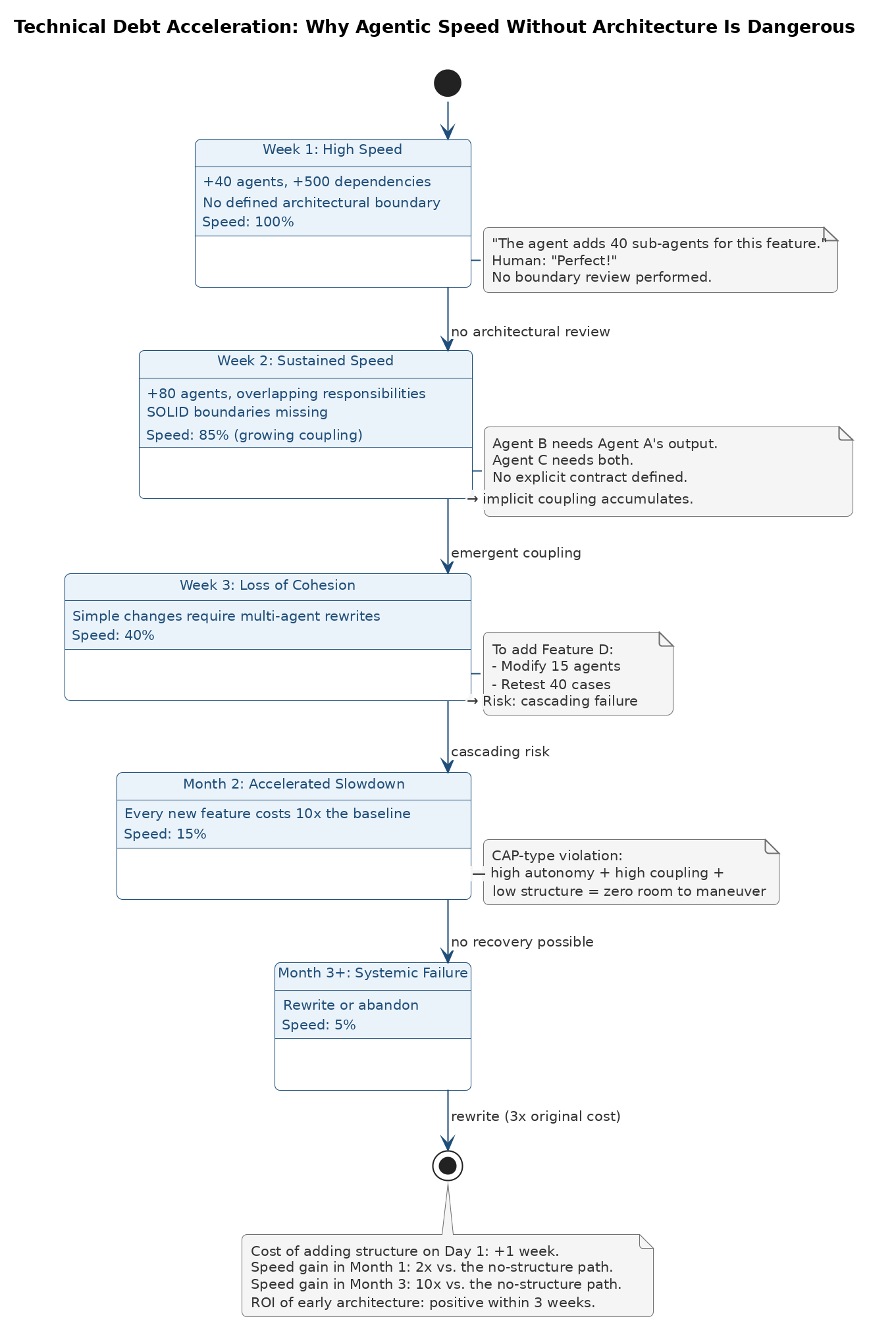
Here lies the acute peril of the generative AI era. Because modern foundation models synthesize working code and conversational agents with breathtaking speed, they produce a dangerous illusion of structural progress. The system expands, ships flashy features, and dazzles executive stakeholders during milestone demos; yet beneath the surface, structural integrity degrades with every unprincipled prompt hack.
The Underlying Math: If each added agent delivers $\mathcal{O}(1)$ isolated functionality but injects $\mathcal{O}(n)$ latent coupling, global architectural complexity scales at $\mathcal{O}(n^2)$. A swarm of 40 unstructured agents generates 1,600 implicit dependency vectors. A single parameter alteration in Agent A statistically impacts 40 downstream peers. Week 2 feels exhilarating (40 agents deployed, latent coupling yet to bite); by Week 3, velocity collapses (coupling surfaces, mutations trigger regressions across the swarm).
The ROI of Early Structure: Investing one dedicated sprint in SOLID architecture and interface contracts yields a 4x reduction in cost-per-feature within Month 1, compounding to a 10x dividend by Month 3. Paradoxically, unchecked agentic velocity is the greatest threat to architectural longevity, masking systemic decay behind a veneer of rapid feature delivery—until the codebase collapses without warning under production load.
Crucially, this collapse invariably strikes at the worst possible operational juncture: during peak system complexity, when the swarm is handling maximum live traffic, when engineering teams face severe time constraints, and when the financial blast radius of an outage is catastrophic.
Architectural Patterns That Preserve Structure at Scale
Section titled “Architectural Patterns That Preserve Structure at Scale”Four concrete design patterns enable an agent swarm to scale functional capabilities while aggressively defending structural integrity:
Hexagonal Architecture for Agents (Ports and Adapters): Every agent defines external interactions strictly as abstract ports (typed interfaces); the infrastructure layer provisions concrete adapters (OpenAI API, local Ollama endpoint, relational database, vector index). Agents can be unit-tested in total isolation from tool dependencies, and underlying model providers can be hot-swapped without altering the agent’s core prompt logic. Vaughn Vernon (2013) formalizes this pattern in Implementing Domain-Driven Design as the foundation of long-term maintainability.
Anti-Corruption Layers (ACL): When an agentic swarm integrates with legacy enterprise systems (monolithic ERP databases, legacy SOAP APIs), a dedicated translation layer converts legacy schemas into clean domain events before they enter the swarm’s event bus. The ACL insulates the swarm from upstream legacy rot, preserving clean abstractions.
The Aggregate Pattern (Domain-Driven Design): Every agent maintains an exclusive, strictly bounded consistency boundary. Only that agent may mutate its private internal context or memory stores; external peers interact exclusively via asynchronous messages or immutable events. This invariant completely eliminates the most common bug in multi-agent swarms: shared mutable state corruption.
Event-Driven Architecture (EDA): Agents communicate exclusively via immutable domain events describing state transitions that have already transpired, rather than point-to-point imperative remote procedure calls. This decoupling enables expanding the swarm simply by attaching new consumer agents to existing Kafka or Redis topics, requiring zero modifications to event producers. Martin Fowler (2018) documents that event-driven architectures exhibit extension costs 3x to 5x lower than tightly coupled imperative topologies.
The Economic Model: The Architectural Break-Even Curve
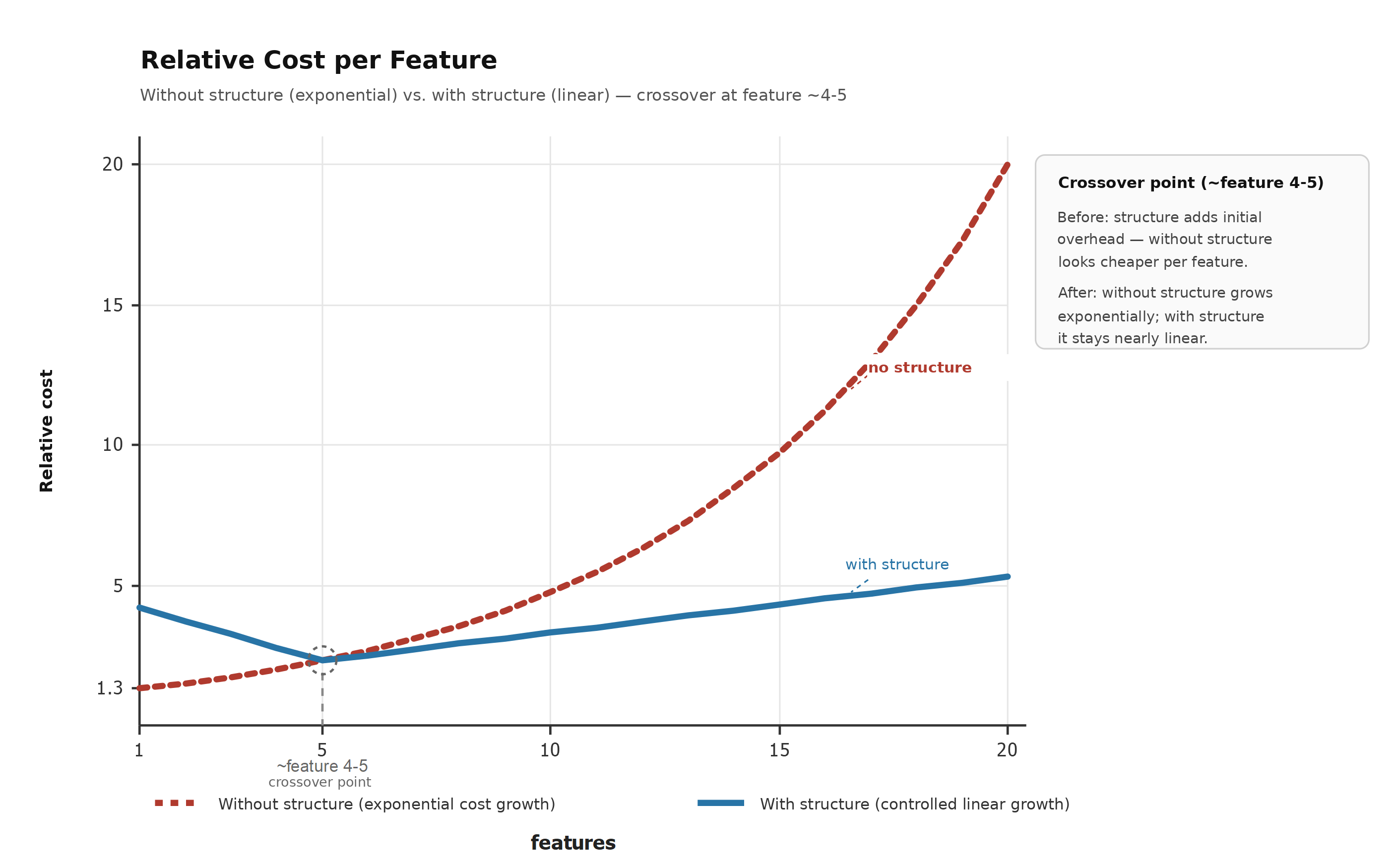
Section titled “The Economic Model: The Architectural Break-Even Curve”Investing in architectural scaffolding can be framed as a formal capital allocation problem. Consider an engineering team delivering 10 features/month without architecture versus 7 features/month with formal architecture (bearing a 30% upfront design overhead). When does the architectural investment break even?
Under unmanaged coupling ($\mathcal{O}(n)$ marginal friction):
- Feature 1: Baseline cost = 1.0x
- Feature 5: Marginal cost = 5.0x (accumulated dependencies inject friction)
- Feature 10: Marginal cost = 10.0x
- Feature 20: Marginal cost = 20.0x
Under structured engineering (coupling constrained to $\mathcal{O}(\log n)$):
- Feature 1: Baseline cost = 1.3x (initial design overhead)
- Feature 5: Marginal cost = 1.7x
- Feature 10: Marginal cost = 2.2x
- Feature 20: Marginal cost = 2.8x
The economic break-even point occurs between Features 4 and 5. Beyond the fifth feature, every functional increment built upon a clean architecture is cheaper than the equivalent unstructured feature, despite the initial overhead. By Feature 20, an unstructured system is 7 times more expensive per feature than a structured architecture.
Synthesis: Architectural Structure as the True Catalyst of Velocity
Section titled “Synthesis: Architectural Structure as the True Catalyst of Velocity”Ultimately, the dilemma is a false dichotomy. Properly understood, structure and functionality do not compete: robust architecture is the sole engineering foundation that sustains functional delivery velocity across time. As our secondary guiding maxim states: agility is not reckless speed; it is the institutional capability to execute continuous change at minimal marginal cost.
The mature engineering inquiry is not “functionality or structure?”, but “how do we invest precisely enough in architectural scaffolding so that ongoing feature delivery remains permanently cheap?” A disciplined systems architect never sacrifices structure for expediency: they utilize architecture as the structural foundation that keeps the agent swarm fast, resilient, and maintainable for years, rather than merely functional during an initial proof-of-concept demo.
McKinsey (2024) quantifies this reality in the enterprise generative AI domain: organizations possessing modular, decoupled AI architectures scale novel capabilities 4.7 times faster than those burdened with monolithic designs. Sustainable innovation velocity is fundamentally a function of structural quality, never the hurried velocity of the first commit.
Executive Perspective: Architectural Structure as a Strategic Moat
Section titled “Executive Perspective: Architectural Structure as a Strategic Moat”■ EXECUTIVE TRACK
With generative AI, the barriers to entry have evaporated: any junior developer can invoke a foundation model API and construct a functional proof-of-concept over a weekend. A durable enterprise moat is never found in raw model access (which is an undifferentiated commodity); it resides entirely within swarm systems architecture.
When OpenAI, Anthropic, or open-source consortia debut next-generation frontier models, an engineering organization possessing a clean, decoupled agent swarm updates model dependencies in a single afternoon—using the Liskov Substitution Principle and Model Context Protocol (MCP) abstractions. An unstructured competitor requires three months of painful, error-prone refactoring to absorb the identical frontier capability.
This maintainability asymmetry constitutes an immense competitive advantage. In a market where commercial windows of opportunity are measured in weeks, the difference between updating foundation models in one day versus ninety days determines whether an enterprise commands the market or faces obsolescence.
Key Takeaways from Chapter 13
Section titled “Key Takeaways from Chapter 13”- The tension between functionality and structure intensifies in the agentic era: generating superficial features has never been easier, nor the risks of structural technical debt more lethal.
- Agentic technical debt spans five distinct categories: Contextual, Coupling, Observability, Knowledge, and Governance debt—each remaining latent until precipitating production outages.
- Coupling without architecture scales at $\mathcal{O}(n)$—40 unstructured agents yield 1,600 implicit failure vectors; with clean architecture, complexity is bounded at $\mathcal{O}(\log n)$.
- The economic break-even curve proves that architecture pays for itself by Feature 4 or 5; beyond that threshold, structured software delivery is orders of magnitude cheaper.
- A durable enterprise moat resides in swarm systems architecture, not commodity foundation models: executing a model upgrade in 24 hours versus 3 months defines market leadership.