Chapter 19: Ideas for Generating Revenue with AI Agents and Multi-Agent Systems
The money isn’t in building agents but in using them to solve a problem someone already pays for.
The Mistake of Starting from the Technology
Section titled “The Mistake of Starting from the Technology”The most common temptation when looking for revenue with AI is to start from the technology at hand: “I have agents, so what do I sell?” It’s the wrong order, and the history of software is full of companies that built technically brilliant solutions to problems nobody was paying to solve. The right starting point is the reverse: you start with the problem, then determine whether a swarm of agents is the right instrument to solve it.
The right question is “what pain is someone paying for today, and could my swarm solve it better, cheaper, or faster?”, not “what can my agent do?” That reversal is not trivial. It imposes the discipline of going to the market before building, of validating willingness to pay before automating, and of designing the solution from the customer’s problem rather than from the comfort of the available technology. Christensen (1997) documented this precisely in the context of disruptive technologies: market-creating innovations don’t come from improving what exists but from solving problems the incumbents ignored because their current customers didn’t suffer from them.
Four Monetization Archetypes: Defensibility as the Central Criterion
Section titled “Four Monetization Archetypes: Defensibility as the Central Criterion”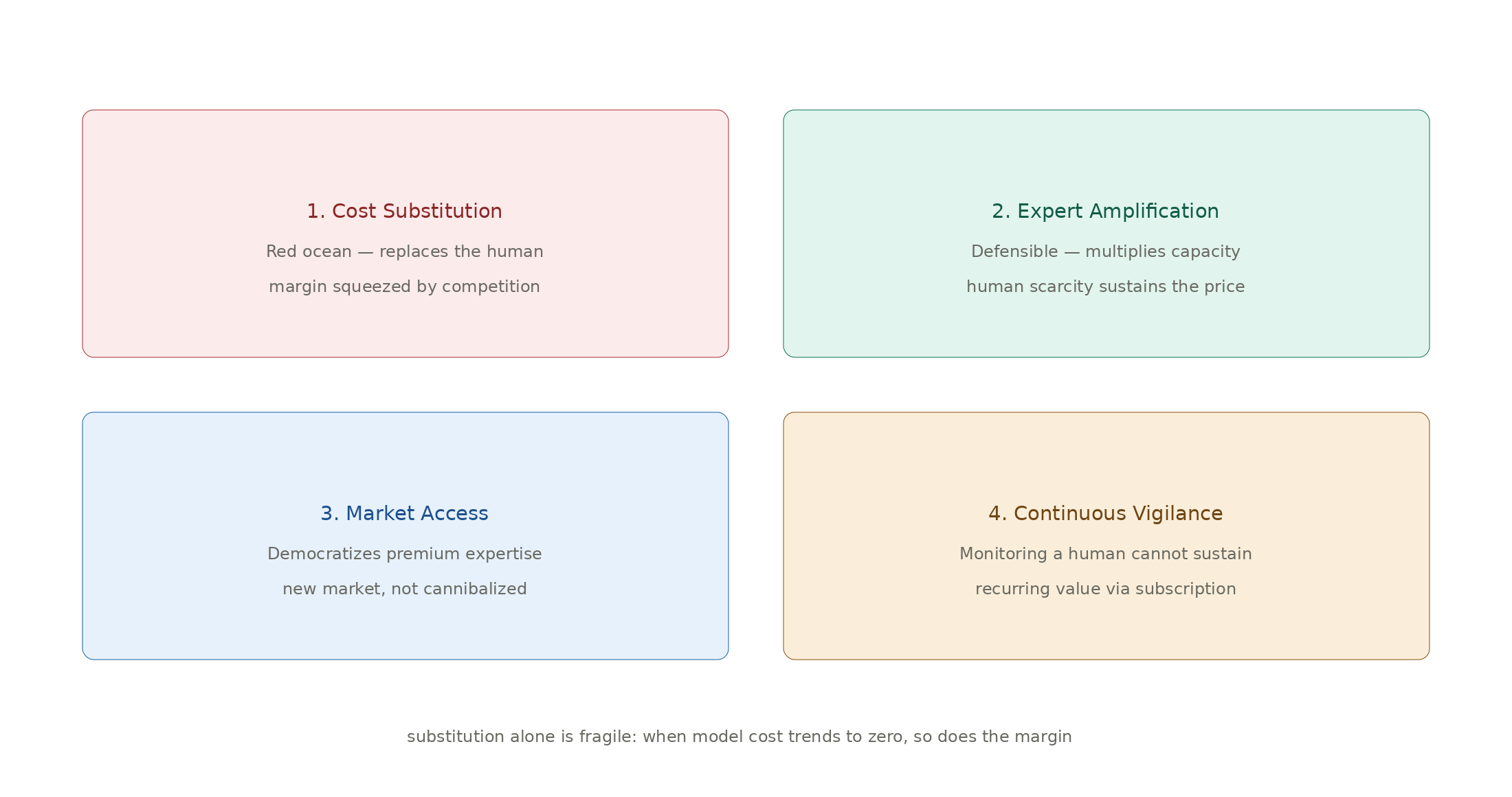
From the principle above, four distinct business patterns emerge. What sets them apart, more than the revenue generation mechanism, is their long-term defensibility: the ability to hold margin when models get cheaper and competitors replicate the solution.
Archetype 1: Automating the Tedious (Cost Savings)
Section titled “Archetype 1: Automating the Tedious (Cost Savings)”Value proposition: you sell recovered time and reduced error on repetitive tasks: email triage, documentation updates, routine report generation, alert monitoring, data extraction from forms. The swarm does in minutes what the team would do in hours, at a fraction of the cost.
Defensibility: LOW. This is the easiest archetype to build and the hardest to defend. The economic equation converges inexorably: as the cost of models falls following Moore’s law applied to AI compute (as GPT-4’s price curve down to GPT-3.5’s illustrated), the automation provider’s margin compresses. Amazon, Google, and Microsoft are already in this space with native solutions. A competitor arriving in 18-24 months can replicate the solution at the same cost or lower. Without differentiation based on proprietary data or deep integration into the customer’s workflow, this archetype is a seasonal business, not a company.
When it makes sense: as an entry point for a customer, not as the final business model. It is the Trojan horse that, once inside, lets you build the higher-defensibility archetypes.
Archetype 2: Amplifying the Expert (Leverage)
Section titled “Archetype 2: Amplifying the Expert (Leverage)”Value proposition: you don’t replace the professional; you multiply their capacity. A lawyer with a supporting swarm can serve 10x more clients at the same quality. A physician with an image analysis agent can review twice the cases in the same working day. An architect with a documentation swarm can manage projects that used to require a team of five.
Defensibility: HIGH. The economic model is robust: the scarcity of domain expertise is greater than the cost of AI models. The swarm doesn’t replace the expert; it needs the expert to work well. That creates a double barrier to entry: you need both the technology and access to the expert. Brynjolfsson and McAfee (2014) documented this phenomenon as “racing with machines” as opposed to “racing against machines”: workers who use AI are more productive, not obsolete.
Example economics: solo lawyer → $40k/year revenue → lawyer + swarm → $100k/year (2.5x margin over the cost of the AI). Radiologist + image analysis swarm → 3x the analysis capacity without hiring more physicians.
Archetype 3: Access to the Inaccessible (Market Creation)
Section titled “Archetype 3: Access to the Inaccessible (Market Creation)”Value proposition: services once reserved for those who could pay a human expert (legal consulting, personalized financial advice, executive coaching, specialized medical diagnosis) become accessible to a mass market through agents operating at the marginal cost of inference.
Defensibility: HIGH, with nuances. The TAM (Total Addressable Market) expands more than 100x because the price drops from $5,000/year (expert consulting) to $50/month (agentic SaaS). Gross margin on well-built SaaS exceeds 80%. Compression is slow (more than 10 years) because the market grows faster than the competition. The vulnerability is commoditization if the differentiation reduces to the underlying model: any competitor with access to the same model can replicate the offering. The right defense is accumulating proprietary domain data and integrating deeply with the customer’s workflows.
Historical reference example: the financial calculator democratized basic financial analysis without eliminating advanced financial advisors. The AI agent follows the same pattern: it democratizes access without eliminating top-tier expertise.
Archetype 4: Continuous Intelligence (Subscription)
Section titled “Archetype 4: Continuous Intelligence (Subscription)”Value proposition: permanent monitoring and continuous analysis of signals that no human could sustain given the opportunity cost: real-time competitor surveillance, regulatory risk monitoring, market trend tracking, anomaly detection in production systems. You sell tireless vigilance, not a deliverable.
Defensibility: MEDIUM-HIGH. The subscription model creates loyalty because switching costs are high: customers integrate the swarm’s alerts into their decision processes, and migrating requires reconfiguring those processes. The risk is commoditization if monitoring becomes fully automated and competitors match the coverage. The defense is deep specialization in the domain: a swarm that monitors the pharmaceutical sector with regulatory precision is more valuable than a generic one.
The Defensive Moat: Why the Model Is Not Enough
Section titled “The Defensive Moat: Why the Model Is Not Enough”A first-order strategic warning before closing this analysis. Since AI models are a resource converging toward commoditization (cf. Vol. 2, Chapter 4) (Claude, GPT, Gemini, and Llama get closer in capability with each iteration), building a business whose only competitive advantage is “I have access to a good model” is building on sand. The durable moat is what surrounds the model, not the model:
- Proprietary data: the domain- and customer-specific data the swarm has processed and that no competitor has access to.
- Deep integration: the swarm’s connection to the customer’s workflows (their ERP, their CRM, their compliance systems), which takes months to build and which no newcomer can replicate in weeks.
- Accumulated trust: the customer’s willingness to give the swarm access to their sensitive data, built through a track record of getting it right and an ongoing relationship.
- Domain knowledge: the sector-specific expertise that makes the swarm’s answers precise where a generic swarm would be imprecise.
Porter (1985) identified these elements as sources of sustainable competitive advantage. Applied to the agentic context, they confirm that the defense lies not in AI per se but in the assets that AI makes more valuable.
From Idea to Revenue: Validate Cheaply with the Agentic MVP
Section titled “From Idea to Revenue: Validate Cheaply with the Agentic MVP”The discipline of the MVP (Vol. 3, Chapter 22) governs revenue generation with agents too. Before building the perfect swarm, validate that someone pays for the result that swarm will produce. The manual agentic pilot is the instrument: during the first weeks, “the agent” is actually a human running the process manually, delivering the same output the automated swarm would deliver. That pilot tests willingness to pay without the cost of building the technology.
Only when the pain and the payment are confirmed is it justified to automate at scale. Generating revenue with agents is, in short, less an AI problem than a well-posed business problem: find the pain, validate the payment, build the moat.
Advanced Technical Perspective
Section titled “Advanced Technical Perspective”► TECHNICAL TRACK
Cost Architecture: Modeling Unit Economics by Archetype
Section titled “Cost Architecture: Modeling Unit Economics by Archetype”From the Senior Architect’s perspective, each archetype calls for a different cost architecture. The most common technical mistake is to treat inference cost as marginal and leave it out of the system design; when volume scales, token cost can destroy the margin.
from dataclasses import dataclassfrom enum import Enum
class Archetype(Enum):    TEDIOUS_AUTOMATION  = "tedious_automation"    EXPERT_AMPLIFICATION = "expert_amplification"    MARKET_CREATION     = "market_creation"    CONTINUOUS_INTEL    = "continuous_intelligence"
@dataclassclass UnitEconomicsModel:    """    Unit economics model per agentic monetization archetype.    Makes it possible to compute gross margin and the profitability breakpoint.    """    archetype:              Archetype    revenue_per_unit_usd:   float    # Revenue per unit (customer/month or transaction)    llm_cost_per_unit_usd:  float    # LLM token cost per unit    infra_cost_per_unit_usd: float   # Infrastructure cost (compute, storage)    human_review_cost_usd:  float    # Human review cost (if applicable)    cac_usd:                float    # Customer acquisition cost    churn_monthly:          float    # Monthly churn rate (0-1)
    @property    def gross_margin(self) -> float:        variable_cost = (self.llm_cost_per_unit_usd                         + self.infra_cost_per_unit_usd                         + self.human_review_cost_usd)        if self.revenue_per_unit_usd == 0:            return 0.0        return round((self.revenue_per_unit_usd - variable_cost)                      / self.revenue_per_unit_usd, 4)
    @property    def ltv_usd(self) -> float:        """Lifetime Value = (Monthly margin) / Monthly churn rate."""        if self.churn_monthly == 0:            return float("inf")        monthly_margin = self.revenue_per_unit_usd * self.gross_margin        return round(monthly_margin / self.churn_monthly, 2)
    @property    def ltv_cac_ratio(self) -> float:        """LTV/CAC ratio. > 3x: healthy business. < 1x: unsustainable business."""        if self.cac_usd == 0:            return float("inf")        return round(self.ltv_usd / self.cac_usd, 2)
    def sustainability_assessment(self) -> str:        ratio = self.ltv_cac_ratio        if ratio >= 3.0:   return f"HEALTHY (LTV/CAC={ratio:.1f}x)"        if ratio >= 1.0:   return f"MARGINAL (LTV/CAC={ratio:.1f}x) — optimize costs"        return f"UNSUSTAINABLE (LTV/CAC={ratio:.1f}x) — revisit the model"

# Example: comparative modeling of the archetypesdef compare_archetypes() -> list[dict]:    models = [        UnitEconomicsModel(            archetype=Archetype.TEDIOUS_AUTOMATION,            revenue_per_unit_usd=200,    # $200/month per customer            llm_cost_per_unit_usd=80,    # high token volume            infra_cost_per_unit_usd=40,            human_review_cost_usd=0,            cac_usd=500,            churn_monthly=0.08,          # 8% churn — low switching cost        ),        UnitEconomicsModel(            archetype=Archetype.EXPERT_AMPLIFICATION,            revenue_per_unit_usd=500,    # $500/month per amplified expert            llm_cost_per_unit_usd=50,            infra_cost_per_unit_usd=20,            human_review_cost_usd=30,    # the expert reviews the outputs            cac_usd=2000,            churn_monthly=0.02,          # 2% churn — high switching cost        ),        UnitEconomicsModel(            archetype=Archetype.MARKET_CREATION,            revenue_per_unit_usd=50,     # $50/month mass-market SaaS            llm_cost_per_unit_usd=3,     # low cost through optimization            infra_cost_per_unit_usd=2,            human_review_cost_usd=0,            cac_usd=30,                  # low CAC through PLG            churn_monthly=0.05,        ),        UnitEconomicsModel(            archetype=Archetype.CONTINUOUS_INTEL,            revenue_per_unit_usd=1500,   # $1500/month enterprise continuous monitoring            llm_cost_per_unit_usd=200,            infra_cost_per_unit_usd=100,            human_review_cost_usd=50,            cac_usd=8000,            churn_monthly=0.015,         # 1.5% churn — very high switching cost        ),    ]    return [        {            "archetype":    m.archetype.value,            "gross_margin": f"{m.gross_margin:.1%}",            "ltv_cac":      f"{m.ltv_cac_ratio:.1f}x",            "verdict":      m.sustainability_assessment(),        }        for m in models    ]
Agentic MVP Architecture: The Manual Pilot First
Section titled “Agentic MVP Architecture: The Manual Pilot First”The Senior Engineer implements the agentic MVP in two explicit phases. Phase 1 is the manual pilot: the “agent” is a human following a documented process. Phase 2 is progressive automation, only after willingness to pay is confirmed:
from enum import Enumfrom dataclasses import dataclass
class MVPPhase(Enum):    MANUAL_PILOT    = "manual_pilot"    # A human runs the process    SEMI_AUTOMATED  = "semi_automated"  # Agent + human review    FULL_AUTOMATED  = "full_automated"  # Autonomous agent with guardrails
@dataclassclass AgenticMVP:    name:        str    archetype:   Archetype    phase:       MVPPhase    wtp_validated: bool    # Willingness To Pay validated with real users?    pain_validated: bool   # Pain validated with ≥5 user interviews?
    def ready_to_automate(self) -> bool:        """Only automate when pain AND payment are validated."""        return self.wtp_validated and self.pain_validated
    def next_phase(self) -> MVPPhase:        if not self.ready_to_automate():            return self.phase   # Don't advance until validated        phases = [MVPPhase.MANUAL_PILOT, MVPPhase.SEMI_AUTOMATED, MVPPhase.FULL_AUTOMATED]        idx = phases.index(self.phase)        return phases[min(idx + 1, len(phases) - 1)]
QA Strategy: Testing the Defensive Moat
Section titled “QA Strategy: Testing the Defensive Moat”The Senior QA designs tests that verify the moat mechanisms are implemented correctly, especially the non-portability of the customer’s proprietary data:
def test_proprietary_data_not_accessible_without_authentication() -> None:    """The customer's proprietary data is the moat — it must be protected."""    response = client.get("/api/client-data/proprietary", headers={})    assert response.status_code == 401, \        "Proprietary data accessible without authentication: moat compromised."
def test_unit_economics_gross_margin_above_threshold() -> None:    """The archetype's gross margin must exceed 50% to be defensible."""    model = UnitEconomicsModel(        archetype=Archetype.EXPERT_AMPLIFICATION,        revenue_per_unit_usd=500, llm_cost_per_unit_usd=50,        infra_cost_per_unit_usd=20, human_review_cost_usd=30,        cac_usd=2000, churn_monthly=0.02    )    assert model.gross_margin >= 0.50, \        f"Gross margin {model.gross_margin:.1%} < 50%: model not defensible."
Executive Perspective
Section titled “Executive Perspective”■ EXECUTIVE TRACK
The Product Owner’s View: A Phased Monetization Roadmap
Section titled “The Product Owner’s View: A Phased Monetization Roadmap”The Product Owner manages revenue generation with agents as a phased monetization roadmap, not a single launch. The phases correspond to the archetypes ordered by increasing defensibility:
Phase 1: Market entry (months 1-6): the automating-the-tedious archetype. Objective: acquire the first 50 customers, validate the swarm’s operational process, and build the track record that underpins trust. Low margin, but data accumulates.
Phase 2: Building the moat (months 6-18): migrate the best Phase 1 customers to the expert amplification archetype. The data accumulated in Phase 1 is the input that makes the swarm an expert in the customer’s domain. The moat starts to form.
Phase 3: Defensible scale (months 18+): introduce continuous intelligence or market creation based on the proprietary data and deep integration built in the earlier phases. At this point, a newcomer can’t replicate the offering without years of accumulating data and relationships.
P.O. metric: LTV/CAC ratio per archetype. Target: > 3x in Phases 2 and 3. A ratio < 1x in any active phase is a sign that the business model needs revision before scaling.
The Scrum Master’s View: The Validation Sprint Before the Build Sprint
Section titled “The Scrum Master’s View: The Validation Sprint Before the Build Sprint”The Scrum Master institutionalizes a rule that protects the team from the premature development trap: before the team builds a new swarm, there must be at least one round of problem validation with real users. This rule is operationalized as a “validation sprint” that precedes the first development sprint:
- Week 1: 5 interviews with potential users in the domain.
- Week 2: a manual pilot of the process (no agentic code).
- Advancement criterion: ≥ 3 of 5 interviewees express willingness to pay for the pilot’s result.
If the advancement criterion isn’t met, the swarm doesn’t get built, no matter how technically elegant the solution would be. This protocol, inspired by Lean Startup practices (Ries, 2011), avoids the costliest mistake in the agentic ecosystem: building a brilliant swarm for a market that doesn’t exist.
Alternative Academic Version (Higher Formal Density)
Section titled “Alternative Academic Version (Higher Formal Density)”Revenue generation with multi-agent artificial intelligence systems can be analyzed through the framework of platform economics and network externalities (Rochet & Tirole, 2003). In the high-defensibility archetypes (expert amplification and continuous intelligence), network effects operate indirectly: the more interactions the swarm has with the customer’s domain, the greater the precision of its answers, the greater the value the customer perceives, and the lower the propensity to churn. This mechanism, called the “data network effect” (Schrage, 2017), constitutes a barrier to entry that grows over time: a competitor entering with the same AI model but without the accumulated proprietary data cannot match the incumbent’s quality, regardless of the capabilities of the underlying model. Porter’s (1985) theory of sustainable competitive advantage applies precisely to the agentic context: the advantage lies not in the technology per se (a factor any competitor with access to the same model providers can match) but in the complementary assets the technology makes more valuable: data, integration, trust, and domain knowledge. Brynjolfsson and McAfee’s (2014) research confirms empirically that the organizations that derive the most value from AI are those that combine it with hard-to-replicate organizational capabilities, not those that merely have access to superior models.
Key Takeaways from Chapter 19
Section titled “Key Takeaways from Chapter 19”- The right starting point is the customer’s pain (one someone already pays for), not the available technology.
- The four monetization archetypes have radically different defensibility: automating the tedious (LOW), amplifying the expert (HIGH), access to the inaccessible (HIGH), continuous intelligence (MEDIUM-HIGH).
- The defensive moat is proprietary data, deep integration, accumulated trust, and domain knowledge, not the model (a converging commodity).
- Unit economics must be modeled per archetype: LTV/CAC > 3x is the threshold for a healthy business; < 1x is a signal for urgent review of the model.
- The optimal monetization strategy is a phased roadmap: enter with automating the tedious to accumulate data, migrate to expert amplification to build the moat, and scale with continuous intelligence once the moat is solid.
- The P.O. manages the LTV/CAC ratio per archetype; the Scrum Master institutionalizes the validation sprint before the build sprint.