Chapter 8: Multi-Agent Orchestration Patterns
Orientation Note: This is the second densest chapter of the volume and contains the highest concentration of production code (Python, TypeScript, and Java). The five canonical orchestration patterns are best digested as an architectural catalog rather than read strictly linearly: if you are transitioning from earlier theory to implementation, scan the headers of the five patterns, identify the topology your architecture requires, and study that section in depth; retain the remaining implementations as production reference. See “How to Read the Code in This Volume” in the preliminary Reading Guide.
The Architecture of Distributed Intelligence
Section titled “The Architecture of Distributed Intelligence”A multi-agent system represents the culmination of all preceding primitives: multiple specialized autonomous agents, coordinated by an orchestrator, delivering architectural outcomes that no individual agent could synthesize in isolation. Wooldridge (2009) defines the emergent properties of multi-agent systems: behaviors that arise dynamically from agent interactions that were never explicitly hardcoded into any single constituent node. In software engineering, the emergent properties we deliberately cultivate are correctness, distributed resilience, and multi-perspective verification; the emergent pathologies we must architecturally eliminate are circular agreement loops, error amplification cascades, and runaway token burn.
Prior to cataloging the patterns, empirical evidence demands an explicit warning: adding more agents is not automatically superior. Rigorous empirical benchmarking demonstrates that reported gains across multi-agent benchmarks frequently stem from uncontrolled compute budgets, and that single-agent baselines granted equivalent inference budgets routinely match or exceed complex multi-agent architectures Kapoor et al., 2024. Anthropic’s engineering guidelines (2024) enforce identical caution: production success does not consist of building the most complex swarm, but rather the minimal sufficient architecture. Consequently, every pattern below is presented alongside its unit cost profile and concrete selection criteria, with Volume 4, Chapter 3 detailing how to assert via automated evals whether added complexity justifies its compute premium.
The Five Canonical Orchestration Patterns
Section titled “The Five Canonical Orchestration Patterns”Design Justification: Component Diagrams for Systems Architecture
A multi-agent topology is, above all, an architectural definition of how specialized modules interact: who communicates with whom, how interfaces connect, and where data flows. A component diagram (featuring typed ports and dependencies) models precisely that: the topological architecture of the distributed system.
A class diagram models internal object composition; a state diagram models temporal lifecycle transitions. Here, systems design demands the integration topology across multiple autonomous agents—the structural pattern governing distributed coordination.
Component diagrams reappear in Chapter 9 (the Model Context Protocol ecosystem), where specialized modular integration again represents the central architectural concept.

Pipeline (Sequential Chain). Ideal use case: Deterministic workflows with linear dependencies. Advantages: Structurally simple, easily audited, and straightforward to debug; each stage can be validated by automated assertions before handing off to the next. Trade-offs: Latency accumulates linearly, and an unhandled failure halts the entire sequence. Example: Formal Specification → Code Implementation → Automated Review → Documentation Synthesis. This represents the pattern with the highest quality-to-complexity ratio and should always serve as your default architecture.
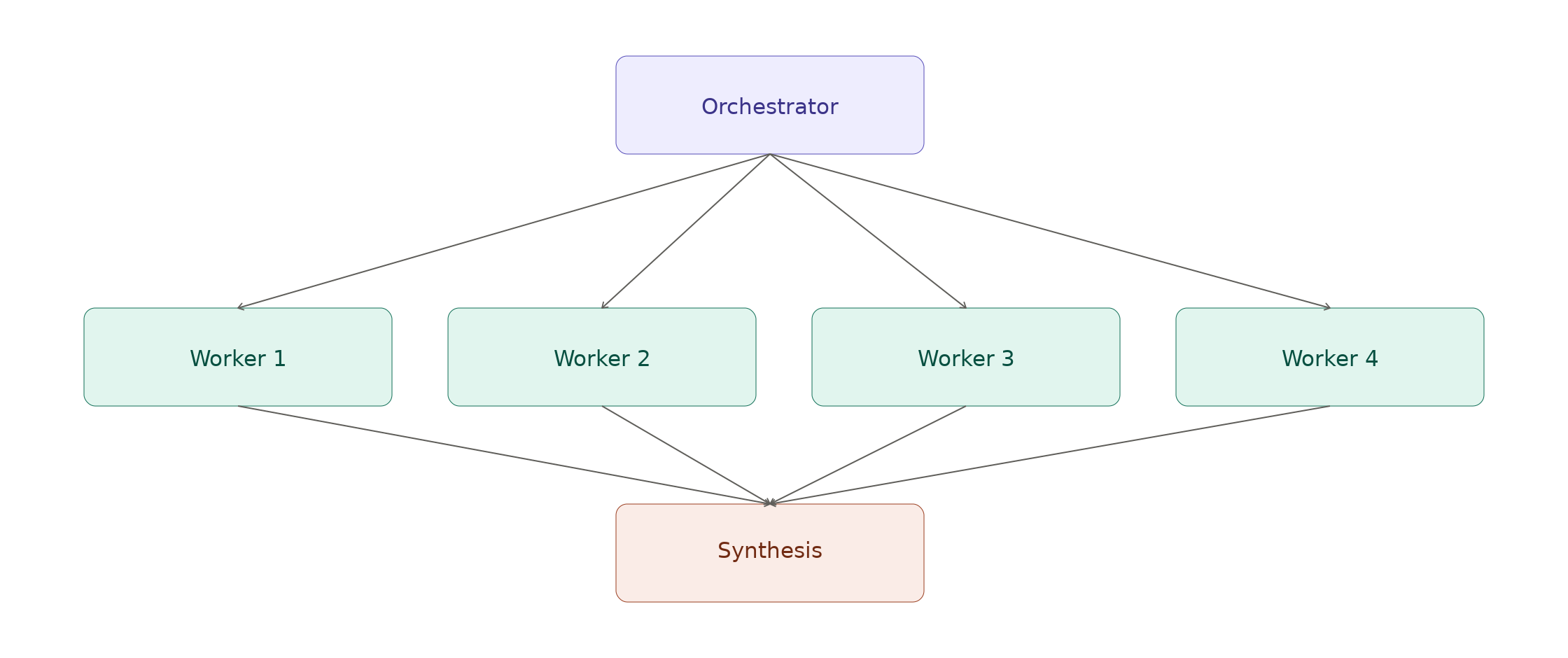
Parallel Fan-Out (Sectioning). Ideal use case: Decoupled, independent tasks executable concurrently. Advantages: Collapses end-to-end wall-clock latency proportionally to available concurrency limits. Trade-offs: Demands an aggregation/merge phase that itself represents a complex reasoning task; concurrent outputs may introduce semantic contradictions. Example: Concurrently generating frontend, backend, and integration test suites against an invariant API schema—the pre-existing typed contract is the exact invariant that makes the pattern viable.
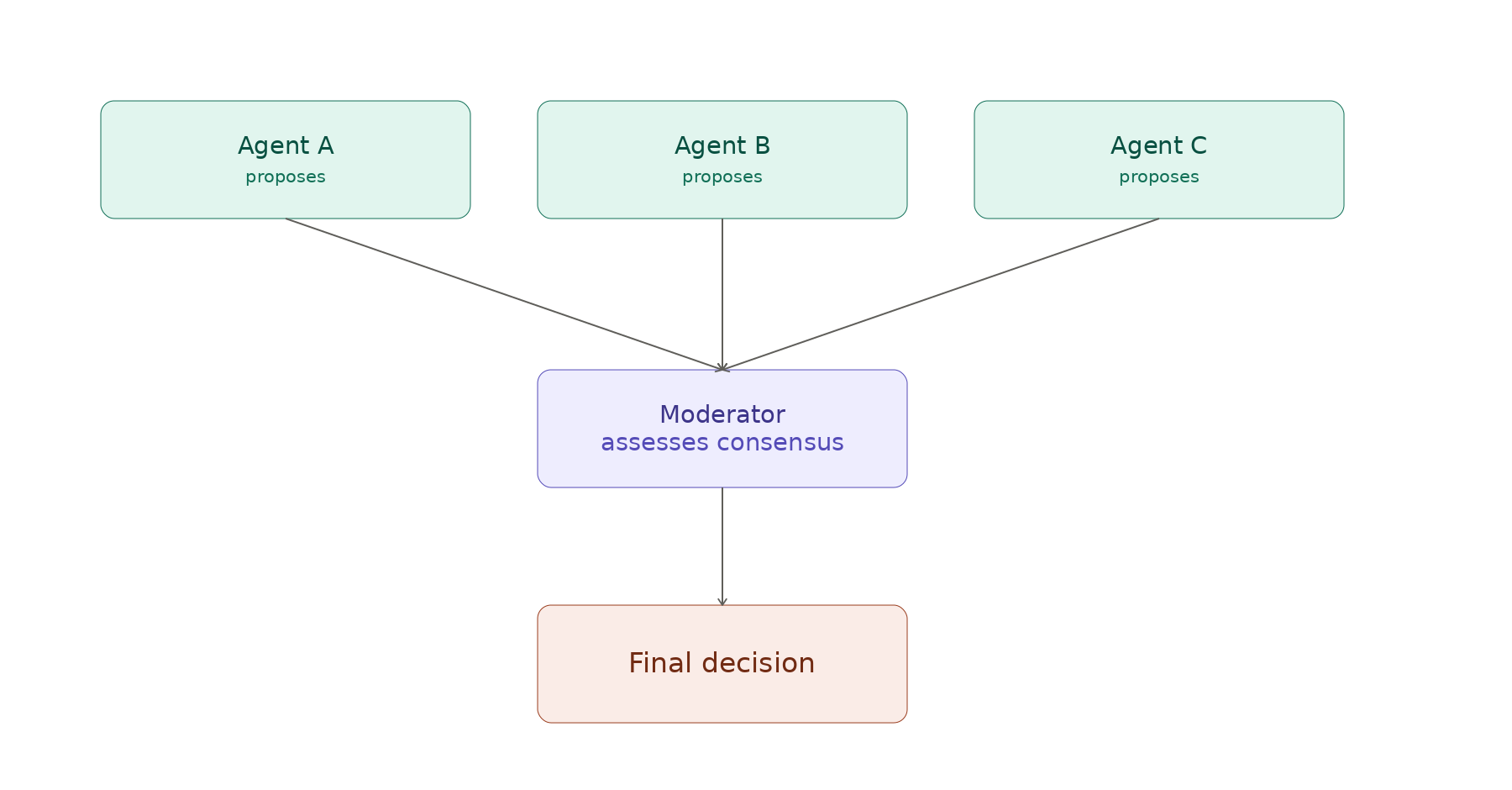
Debate and Consensus (Council). Ideal use case: High-consequence decisions, architectural trade-offs, and critical security audits. Multiple specialized agents with competing perspectives evaluate an artifact; an authoritative synthesizer renders a final verdict. Empirical foundation: Multi-agent debate demonstrably elevates factual accuracy and complex reasoning compared to isolated agents Du et al., 2023. Trade-offs: Multiplies token spend by the count of participating counselors; reserve strictly for decisions where the blast radius of an error dwarfs the compute cost of the debate.
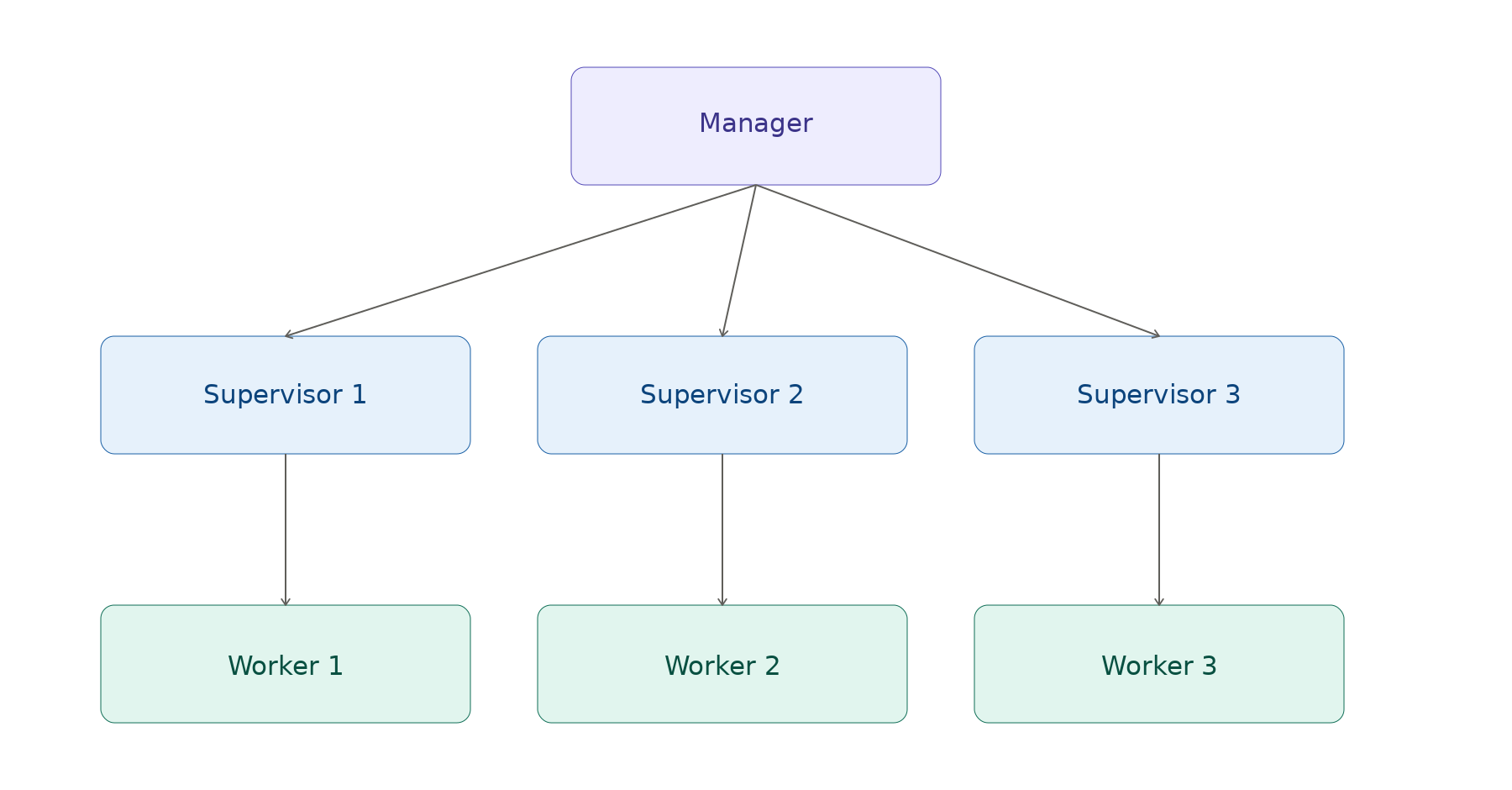
Hierarchical (Orchestrator-Workers). Ideal use case: Broad, multi-domain initiatives. A high-level orchestrator decomposes goals, dispatches sub-tasks to specialized domain agents, and aggregates outputs. Advantages: Scales naturally across bounded contexts and directly mirrors enterprise team topologies Conway, 1968. Trade-offs: Orchestration overhead introduces latency and token spend; the central orchestrator represents a cognitive single point of failure. This topology powers ChatDev and MetaGPT (Qian et al., 2024; Hong et al., 2024).
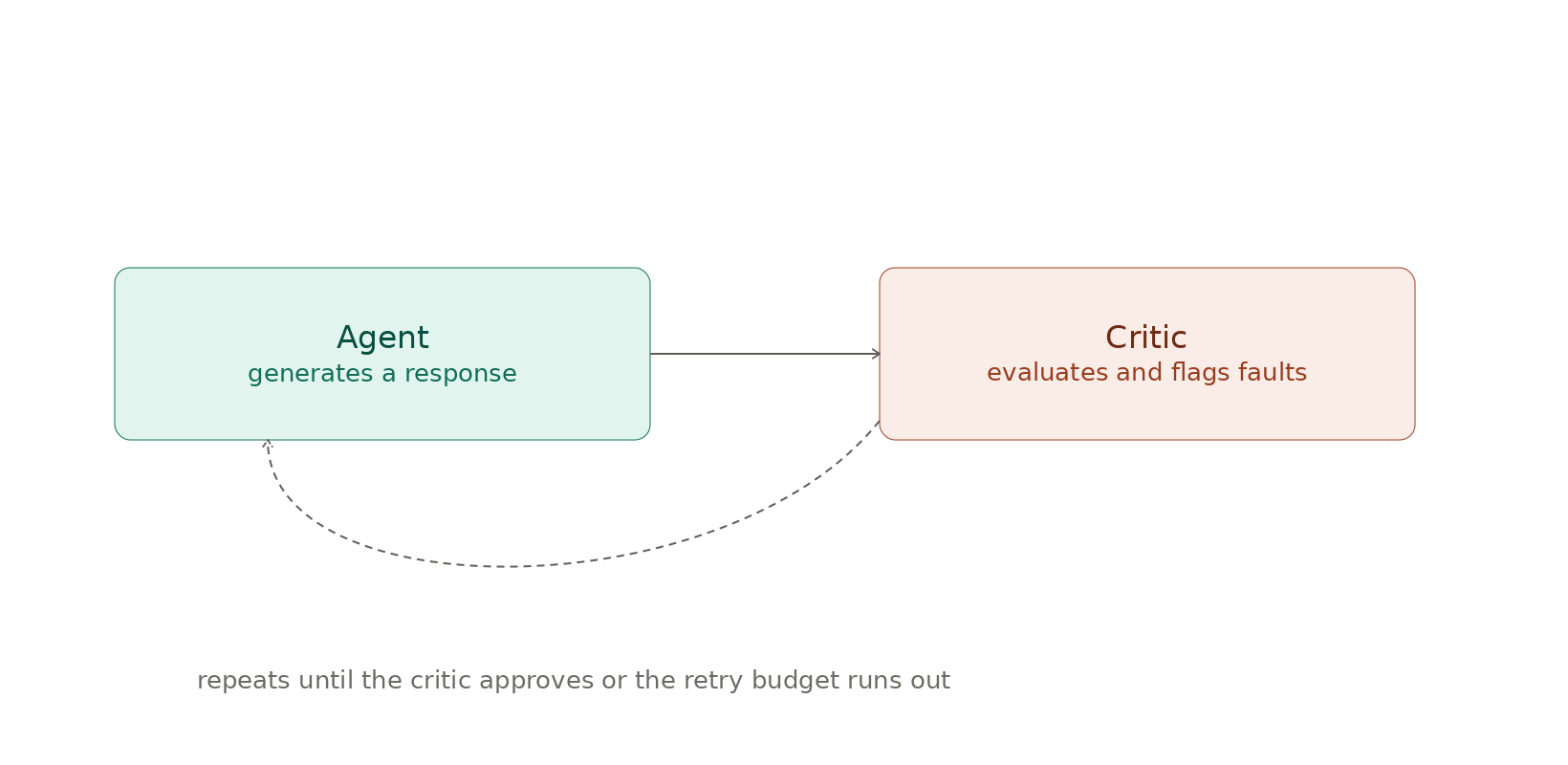
Self-Reflection Loop (Generator-Evaluator). Ideal use case: Workloads where output quality is critical and deterministically verifiable: failing test suites, schema validation errors, or formal linter assertions. A generator agent synthesizes code; an evaluator critiques output against objective signals; the generator refines. Theoretical foundation: Self-Refine Madaan et al., 2023 and Reflexion Shinn et al., 2023. Trade-offs: Without an immutable iteration cutoff, it degenerates into infinite loops; absent an objective, deterministic validation signal, it degrades into sycophancy: the model uncritically approves its own output. Operational rule: Enforce explicit loop budgets and strictly decouple the evaluator from the generator.
► TECHNICAL TRACK: Implementing the Council Pattern
# Example 8.1: Architectural Review Council Pattern.# Three specialized counselors evaluate an architecture concurrently;# an authoritative synthesizer renders the binding decision.# Empirical foundation: Multi-agent debate elevates factual grounding [Du et al., 2023](/en/vol1/back/references/#ref-du2023).
import anthropic
client = anthropic.Anthropic()
COUNSELORS = {    "scalability": """You are a Principal Distributed Systems Architect.    Evaluate the proposal strictly from: throughput, p99 latency, high availability,    and operational reliability at hyperscale. Be concise: maximum 300 words.    Ground arguments in concrete distributed systems mechanisms, not vague opinions.""",    "developer_experience": """You are a Staff Software Architect focused on    Developer Experience (DevEx) and operational simplicity. Evaluate strictly from:    onboarding velocity, local debugging ease, maintenance cost, and technical debt.    Defend boring technology and the YAGNI principle. Maximum 300 words.""",    "economics": """You are an Enterprise Systems Economist.    Evaluate Total Cost of Ownership (TCO), cloud infrastructure burn, delivery lead time,    and capital ROI. Reason through Barry Boehm's software economics and DORA metrics.    Maximum 300 words.""",}
def consult(role_system: str, problem: str) -> dict:    resp = client.messages.create(        model="claude-sonnet-4-6",        max_tokens=1024,        system=role_system,        messages=[{"role": "user",                   "content": f"Evaluate from your architectural domain: {problem}"}],    )    return {        "text": next(b.text for b in resp.content if b.type == "text"),        "tokens": resp.usage.input_tokens + resp.usage.output_tokens,    }
def architecture_council(architectural_dilemma: str) -> dict:    """    Council Pattern: 3 specialized perspectives debate a system design;    the frontier reasoning model synthesizes the definitive verdict.    In production, counselor invocations are dispatched concurrently.    """    views = {name: consult(system, architectural_dilemma)             for name, system in COUNSELORS.items()}
    synthesis = client.messages.create(        model="claude-opus-4-8",   # Frontier model reserved for synthesis        max_tokens=2048,        system="""You are the Chief Technology Officer rendering a BINDING DECISION        synthesized from three specialized advisory councilors. Your output must strictly follow:
        1. DECISION: [unambiguous single-sentence verdict]        2. PRIMARY RATIONALE: [the decisive argument tilting the trade-off]        3. CONTINGENCIES: [3 measurable conditions that would overturn this decision]        4. IMMEDIATE NEXT STEP: [the concrete action to execute this sprint]        5. PRIMARY RISK: [the critical failure mode and its automated mitigation]
        Do not summarize counselor arguments. State the decision directly.""",        messages=[{            "role": "user",            "content": (                f"Architectural Dilemma: {architectural_dilemma}\n\n"                f"SCALABILITY PERSPECTIVE:\n{views['scalability']['text']}\n\n"                f"DEVELOPER EXPERIENCE PERSPECTIVE:\n{views['developer_experience']['text']}\n\n"                f"ECONOMIC PERSPECTIVE:\n{views['economics']['text']}\n\nRender your decision."            ),        }],    )
    total_tokens = (sum(v["tokens"] for v in views.values())                    + synthesis.usage.input_tokens                    + synthesis.usage.output_tokens)
    return {        "decision": next(b.text for b in synthesis.content if b.type == "text"),        "perspectives": {k: v["text"] for k, v in views.items()},        "meta": {            "total_tokens": total_tokens,            "agents_consulted": len(COUNSELORS) + 1,            "pattern": "Council (Multi-Agent Debate + Synthesis)",        },    }

# Canonical usage:# result = architecture_council(#     "We run a 5-year-old monolithic Django platform serving 50K daily active users. "#     "Engineering proposes migrating to event-driven microservices to 'scale better'. "#     "Is this the correct architectural investment today?"# )# print(result["decision"])# Expected output: An actionable architectural verdict, not an ambiguous "it depends".
Pattern Selection: The Architectural Decision Tree
Section titled “Pattern Selection: The Architectural Decision Tree”- Can the task be resolved deterministically within a single well-prompted inference call? → Do not orchestrate. (The simplest option routinely overlooked by enthusiasts.)
- Are all execution steps deterministic and known upfront? → Pipeline.
- Are discrete sub-tasks fully independent and parallelizable? → Fan-Out with an invariant integration contract.
- Is output quality machine-verifiable via automated tests or schemas? → Self-Reflection Loop with a strict iteration budget.
- Is the decision irreversible, high-risk, and characterized by conflicting trade-offs? → Council.
- Does the task demand dynamic decomposition across multiple bounded contexts? → Hierarchical. And establish the deep distributed observability detailed in Volume 4, Chapter 8, because you will need it.
■ EXECUTIVE TRACK
The executive takeaway of this chapter reduces to a single principle: multi-agent orchestration is a capital investment decision, never a technological fashion statement. Every orchestration topology purchases a specific architectural quality attribute (velocity, resilience, perspective coverage) at a quantifiable cost in token burn and operational complexity. Demand from your engineering leadership what you demand from any capital allocation: an explicit benchmark against the simplest single-agent alternative, with total unit cost and quality metrics presented in the identical ledger Kapoor et al., 2024. When a team proposes a five-agent council, the correct executive inquiry is: “What precision did we gain relative to a single well-prompted agent, and what was the marginal cost?”, not “Does it work?” (nearly everything works in a demo).
The Agent Lifecycle as a Finite State Machine: Production Rigor
Section titled “The Agent Lifecycle as a Finite State Machine: Production Rigor”Before designing orchestrators to coordinate swarms, one must understand how an individual autonomous agent transitions across lifecycle states. In production, this lifecycle is a deterministic finite state machine, not an informal whiteboard diagram: every transition must be observable, auditable, and predictably fail-safe. This demarcates an unstable prototype from an enterprise production runtime operating at scale.
An autonomous agent operates across five explicit, mutually exclusive states: IDLE (awaiting task ingestion), PLANNING (decomposing goals and selecting tools), EXECUTING (invoking external tools, effectors, and APIs), EVALUATING (validating intermediate outputs and deciding on retries), and terminal states: COMPLETED or FAILED. Every state transition is triggered by an observable event: task received, plan formulated, tool observation ingested, or budget exhausted.
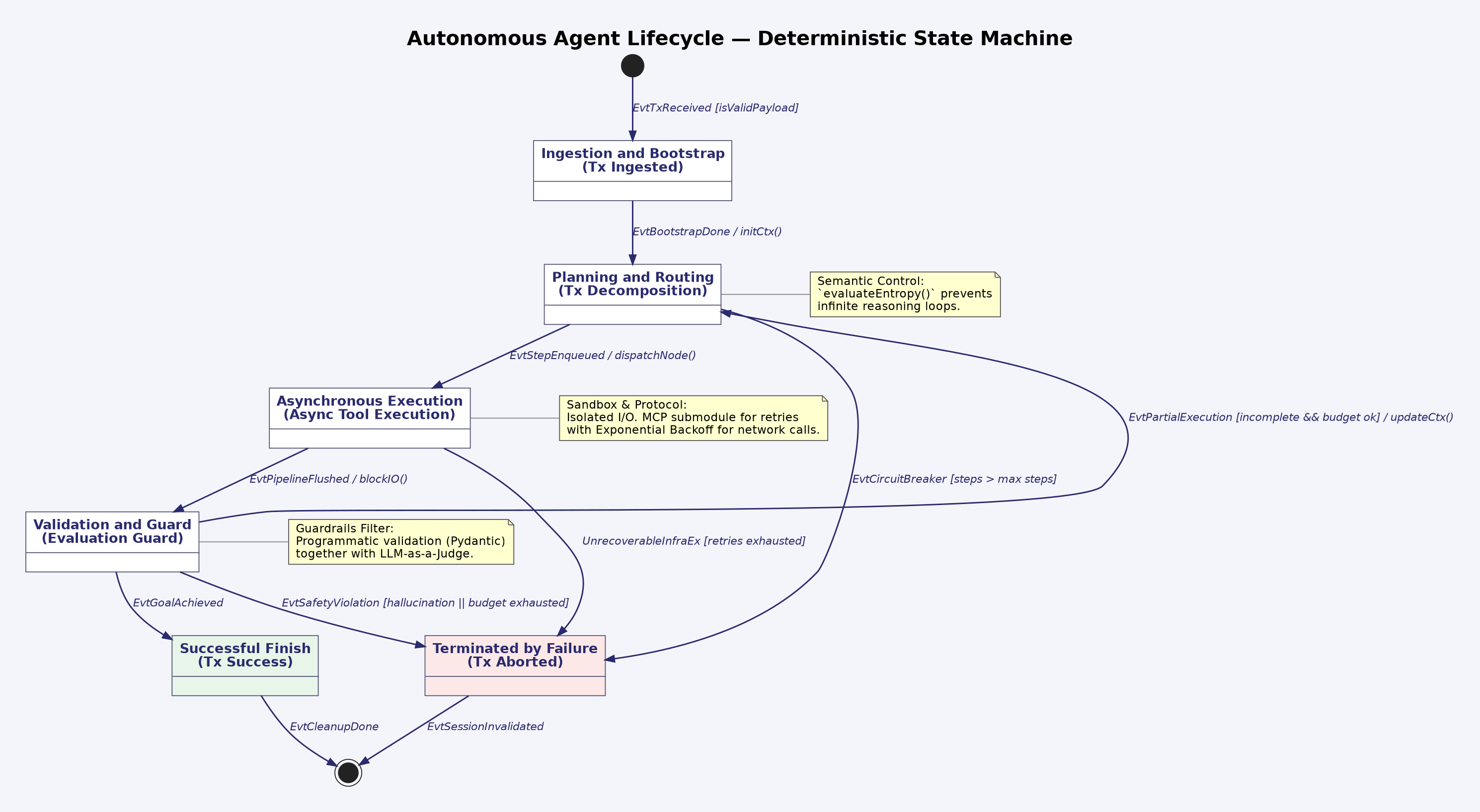
Analyzing this lifecycle exposes four critical architectural invariants:
State Representation Is Domain Policy. The state machine explicitly segregates business-level transitions (“retry required,” “success”) from infrastructure-level transitions (“budget exhausted,” “network timeout”). This separation allows compliance auditors and human operators to parse immutable audit trails without sifting through low-level stack traces. Every state transition event must record: timestamp, agent_id, from_state, to_state, deterministic reason code, and accumulated token consumption.
Backpressure Prevents Systemic Cascades. When an agent transitions into EXECUTING, tool invocations must not execute unchecked. The underlying Model Context Protocol (MCP) server (Chapter 9) mediating tool access must reject invocations that violate token budgets, permission perimeters, or domain invariants (Chapter 6). This rejection triggers a deterministic transition: EXECUTING → EVALUATING with reason "tool_rejected_by_guardrail". The agent receives this as an immutable hard constraint, not negotiable feedback.
Observations Close the Control Loop. When an external tool fails (remote API timeout, schema validation error), the state machine transitions: EXECUTING → EVALUATING. The evaluation logic evaluates: Should the agent retry? (transient network glitch), select an alternative tool? (ambiguous specification), or terminate? (exhausted retries). Absent structured failure diagnostics, this decision degenerates into blind hallucination. Hence, tool return contracts (Chapter 4) must structure errors: {"is_error": true, "reason": "timeout", "recovery_hint": "retry with smaller batch"}.
Budgets Are Immutable Constraints. When an agent reaches $N$ loop iterations, burns $M$ tokens, or exceeds wall-clock timeout $T$, the state machine transitions automatically: EVALUATING → FAILED. Governance guardrails (Volume 4, Chapter 1) are baked directly into the state machine itself, not implemented as optional application logic: once counters cross the threshold, execution transitions are physically blocked.
► TECHNICAL TRACK: TypeScript Finite State Machine with Integrated Budget Governance
// Production agent state machine with built-in auditability and budget governance.// Budget policies are enforced within state transitions, not scattered across application code.
enum AgentState {  IDLE = "IDLE",  PLANNING = "PLANNING",  EXECUTING = "EXECUTING",  EVALUATING = "EVALUATING",  COMPLETED = "COMPLETED",  FAILED = "FAILED",}
interface StateTransition {  timestamp: Date;  fromState: AgentState;  toState: AgentState;  reason: string;  tokensConsumedTotal: number;  agentId: string;}
interface AgentBudget {  maxIterations: number;  maxTokens: number;  maxTimeMs: number;  currentIterations: number;  currentTokens: number;  startTimeMs: number;}
interface LlmResponse {  inputTokens: number;  outputTokens: number;  text: string;}
interface ToolExecutionResult {  isError: boolean;  content: string;  tokensUsed: number;}
class AgentStateMachine {  private state: AgentState = AgentState.IDLE;  private transitions: StateTransition[] = [];  private budget: AgentBudget;
  constructor(    private agentId: string,    maxIterations: number = 10,    maxTokens: number = 100_000,    maxTimeMs: number = 300_000 // 5-minute hard timeout  ) {    this.budget = {      maxIterations,      maxTokens,      maxTimeMs,      currentIterations: 0,      currentTokens: 0,      startTimeMs: Date.now(),    };  }
  // Asserts whether state transition is authorized under active budget constraints  private canTransitionTo(nextState: AgentState): boolean {    const elapsed = Date.now() - this.budget.startTimeMs;    if (elapsed > this.budget.maxTimeMs) return false;    if (this.budget.currentIterations >= this.budget.maxIterations) return false;    if (this.budget.currentTokens >= this.budget.maxTokens) return false;    return true;  }
  async executeTask(    input: string,    completeLlm: (prompt: string) => Promise<LlmResponse>,    invokeTool: (plan: string) => Promise<ToolExecutionResult>  ): Promise<string> {    // Transition: IDLE → PLANNING    this._transition(AgentState.PLANNING, "task.received");
    const plan = await completeLlm(`Formulate execution plan for: ${input}`);    this.budget.currentTokens += plan.inputTokens + plan.outputTokens;
    while (true) {      this.budget.currentIterations++;
      // Guardrail verification: Can execution proceed?      if (!this.canTransitionTo(AgentState.EXECUTING)) {        this._transition(AgentState.EVALUATING, "budget.exhausted");        break;      }
      // Transition: PLANNING → EXECUTING      this._transition(AgentState.EXECUTING, "plan.selected");
      const toolResult = await invokeTool(plan.text);      this.budget.currentTokens += toolResult.tokensUsed;
      // Transition: EXECUTING → EVALUATING      this._transition(AgentState.EVALUATING, "observation.received");
      // Evaluation: Determine whether to retry or terminate      if (toolResult.isError) {        if (this.budget.currentIterations < this.budget.maxIterations) {          // Retry permitted: EVALUATING → PLANNING          this._transition(AgentState.PLANNING, "retry.required");          continue;        } else {          // Exhausted budget: EVALUATING → FAILED          this._transition(AgentState.FAILED, "max.iterations.reached");          break;        }      } else {        // Success: EVALUATING → COMPLETED        this._transition(AgentState.COMPLETED, "task.success");        return toolResult.content;      }    }
    // Terminal failure handling    throw new Error(      `Agent ${this.agentId} halted in state: ${this.state}. ` +      `Iterations: ${this.budget.currentIterations}/${this.budget.maxIterations}, ` +      `Tokens: ${this.budget.currentTokens}/${this.budget.maxTokens}`    );  }
  private _transition(nextState: AgentState, reason: string): void {    const transition: StateTransition = {      timestamp: new Date(),      fromState: this.state,      toState: nextState,      reason,      tokensConsumedTotal: this.budget.currentTokens,      agentId: this.agentId,    };
    // Structured JSON log for real-time compliance streaming    console.log(JSON.stringify(transition));    this.transitions.push(transition);    this.state = nextState;  }
  getAuditTrail(): StateTransition[] {    return [...this.transitions];  }}
The power of this architecture is that spend budgets are not passive docstrings: they are computational invariants evaluated before every transition. An agent that exhausts its allocation cannot “accidentally continue running”; the state machine rejects execution transitions unconditionally.
Enterprise Agent Architecture: The Production Platform
Section titled “Enterprise Agent Architecture: The Production Platform”When multiple autonomous agents must orchestrate enterprise workflows across distributed teams, heterogeneous latencies, and statutory compliance audits, ad-hoc scripting collapses. Systems architecture requires an Enterprise Agent Platform structured into four decoupled layers, each maintaining explicit contracts, single responsibilities, and distributed observability:
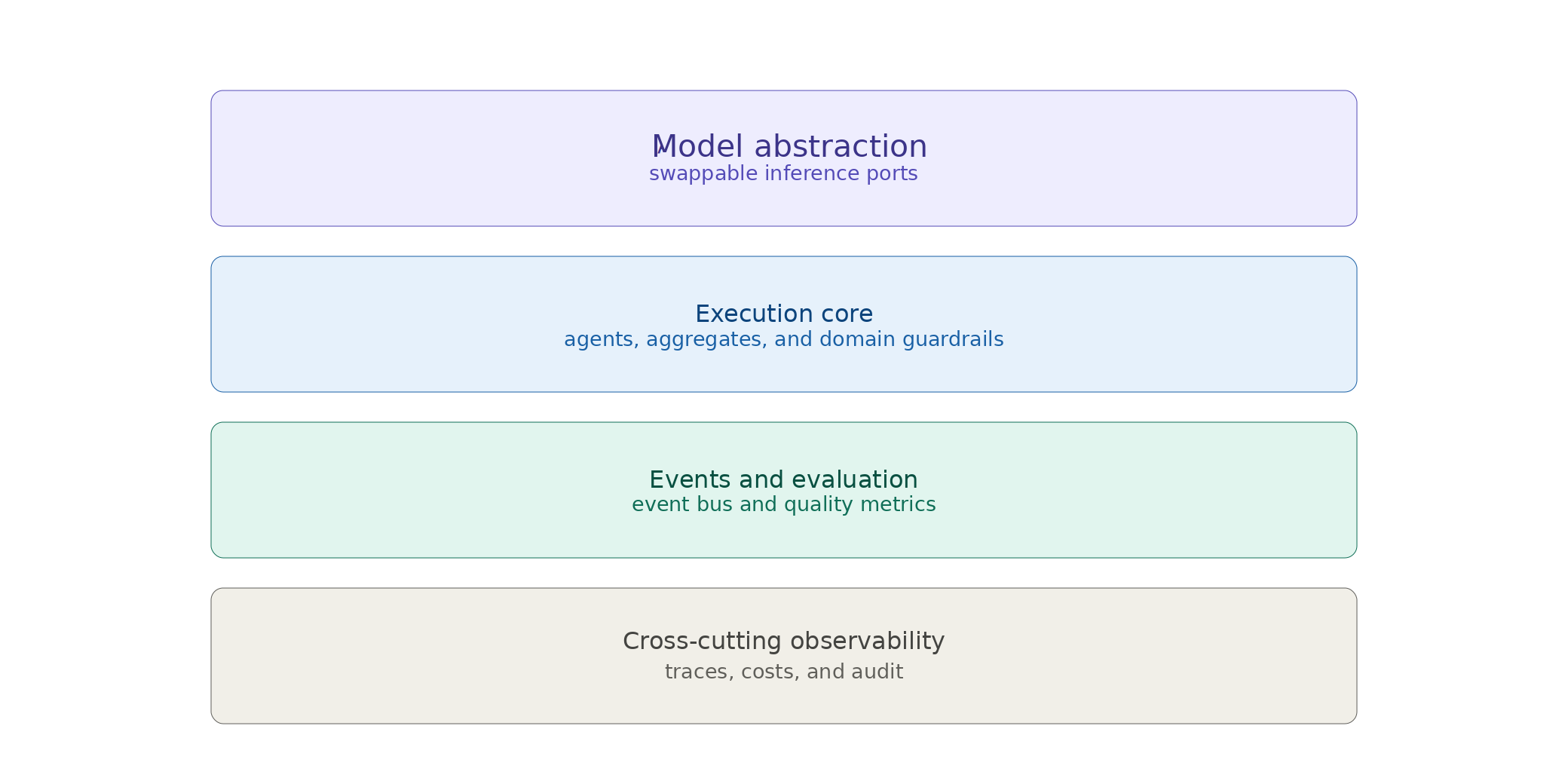
1. Model Abstraction Layer (AI Gateway). Mediates all egress to foundation model providers. Concurrently enforces: (a) resilience, retrying failed calls with exponential jitter; (b) prefix caching, reusing static domain contexts at ~90% cost reduction; (c) budget quotas, throttling or rejecting requests when financial limits are met; and (d) model tiering, dynamically routing inference to the most cost-effective model (Chapter 3). Cardinal architectural invariant: an agent must never know which cloud vendor serves its inference.
2. Execution Core (Orchestrator + MCP). Hosts the finite state machine, the ReAct execution harness (Chapter 4), and multi-agent delegation logic. The Orchestrator decomposes goals and coordinates specialists. The MCP Server acts as the nervous system: exposing typed tools, auditing permissions, and enforcing domain invariants (Chapter 6). This layer encapsulates pure business policy, completely insulated from low-level infrastructure details.
3. Event Backbone and Continuous Evaluation. When an agent finishes a task, it emits a structured domain event to Apache Kafka: execution payload, token metrics, and results. This event streams to two destinations: (a) downstream consumer services advancing business workflows; and (b) the Continuous Evaluation Harness, which evaluates output quality, flags hallucinations, and routes anomalies to a Dead-Letter Queue (DLQ) for human audit. Architecture rule: evaluation is continuous and asynchronous; quality regressions are detected in minutes, not during quarterly audits.
4. Transversal Observability Layer. Every state transition, model inference, and tool execution emits distributed trace spans via OpenTelemetry (Volume 4, Chapter 8). When an enterprise SLA breaches, distributed traces instantly expose whether the root cause was the foundation model, a failing third-party tool, database lock contention, or bad prompt design.
► TECHNICAL TRACK: Layer Decoupling via Hexagonal Ports in Java
// Enterprise orchestrator coordinating platform layers via abstract ports.// Ports (interfaces) represent the sole architectural contract.
package com.syntheticcode.platform.orchestration;
import org.springframework.stereotype.Service;import org.springframework.transaction.annotation.Transactional;import java.time.Instant;import java.util.Map;
@Servicepublic class PlatformAgentOrchestrator {
    private final LlmPort llmGateway;              // Model Abstraction Layer    private final McpServerPort toolExecutor;      // Execution Core    private final EventBusPort eventPublisher;     // Event Backbone    private final EvalHarnessPort evaluator;       // Continuous Evaluation    private final ObservabilityPort tracer;        // Distributed Telemetry
    public PlatformAgentOrchestrator(            LlmPort llmGateway,            McpServerPort toolExecutor,            EventBusPort eventPublisher,            EvalHarnessPort evaluator,            ObservabilityPort tracer) {        this.llmGateway = llmGateway;        this.toolExecutor = toolExecutor;        this.eventPublisher = eventPublisher;        this.evaluator = evaluator;        this.tracer = tracer;    }
    @Transactional    public AgentResult executeTask(TaskRequest task) {        Span rootSpan = tracer.startSpan("agent.task", task.agentId(), task.taskId());
        try {            // STEP 1: Planning (FSM State: PLANNING)            rootSpan.addEvent("state.planning");            Plan plan = generatePlan(task);
            // STEP 2: Execution (FSM State: EXECUTING)            rootSpan.addEvent("state.executing");            AgentResult result = executeWithRetries(plan, rootSpan);
            // STEP 3: Event Emission (Decoupled Delivery)            eventPublisher.publish(new AgentExecutedEvent(                task.taskId(),                task.agentId(),                result,                result.tokenMetrics(),                Instant.now()            ));
            // STEP 4: Asynchronous Quality Evaluation            evaluator.asyncEval(result, task.agentId());
            rootSpan.addEvent("state.completed");            return result;
        } catch (Exception e) {            rootSpan.recordException(e);            rootSpan.addEvent("state.failed");
            // Route failed transactions to Dead-Letter Queue (DLQ)            eventPublisher.publishToDLQ(new AgentFailedEvent(                task.taskId(),                e.getMessage(),                task            ));            throw e;        } finally {            rootSpan.end();        }    }
    private AgentResult executeWithRetries(Plan plan, Span span) {        int attempt = 0;        final int MAX_ATTEMPTS = 5;
        while (attempt < MAX_ATTEMPTS) {            try {                LlmResponse response = llmGateway.complete(                    plan.systemPrompt(),                    plan.userPrompt(),                    plan.tier()                );
                if (response.requiresToolUse()) {                    ToolResult toolResult = toolExecutor.executeTool(                        response.toolName(),                        response.toolInput(),                        plan.domainContext() // Enforce domain invariants                    );
                    span.addEvent("tool.executed",                        Map.of("tool", response.toolName(),                               "success", !toolResult.isError()));
                    plan = plan.withObservation(toolResult);                } else {                    return new AgentResult(response.text(), response.tokens());                }                attempt++;            } catch (RateLimitException e) {                span.addEvent("rate_limit", Map.of("retry_after_ms", e.getRetryAfterMs()));                try {                    Thread.sleep(e.getRetryAfterMs());                } catch (InterruptedException ie) {                    Thread.currentThread().interrupt();                    throw new RuntimeException("Thread interrupted during backoff", ie);                }                attempt++;            }        }
        throw new BudgetExhaustedException("Max retry attempts exhausted for task: " + plan.taskId());    }
    private Plan generatePlan(TaskRequest task) {        return new Plan(task.taskId(), task.prompt(), "BALANCED", task.domainContext());    }}
The decisive virtue of this architecture is complete decoupled evolvability. Migrating from Kafka to Apache Pulsar requires zero changes to the orchestrator: it programs strictly to EventBusPort. Swapping foundation models involves configuring the AI Gateway without recompiling Java binaries. Updating evaluation metrics alters the DLQ harness without touching the execution core. Systemic extensibility emerges strictly from decoupled abstractions.
Clean Orchestrators: The Four Architectural Anti-Patterns
Section titled “Clean Orchestrators: The Four Architectural Anti-Patterns”The orchestrator in a Synthetic Enterprise functions as the Composition Root does in Dependency Injection: it is the solitary locus that establishes who communicates with whom. Synthetic Clean Code (Chapter 4) identifies four catastrophic anti-patterns:
- The God-Orchestrator. An orchestrator that, beyond coordinating specialists, synthesizes domain logic, rewrites generated code, and overrides specialists. This represents the god class anti-pattern: when a council synthesizer starts “improving” code produced by the coder agent, boundaries dissolve, and regression evals can no longer isolate failure attribution. Rule: The orchestrator decides and composes; it never authoritatively generates domain assets.
- Chatty Agents. Communicating agents that blindly pass exhaustive conversation histories to one another “just in case.” Every handoff doubles token consumption and triggers context degradation Liu et al., 2024. Rule: Agents exchange strictly typed schemas (the Master Prompt JSON, Chapter 5), never conversational transcripts.
- The Courtesy Loop. Communicating agents that politely flatter and validate each other until compute budgets exhaust (“excellent observation,” “I completely concur”). This is the classic failure mode of unstructured debate: premature superficial consensus. Rule: Debates must enforce fixed rounds, adversarial prompts, and a designated synthesizer empowered to break ties Du et al., 2023.
- Infinite Hierarchical Nesting. Orchestrators delegating to sub-orchestrators that delegate to sub-sub-orchestrators. Each hierarchy tier injects latency, multiplies token spend, and introduces a cognitive point of failure; empirical literature confirms that a single tier of delegation captures nearly all multi-agent value (Qian et al., 2024; Hong et al., 2024). Rule: Restrict delegation depth to a single tier unless quantitative evals prove otherwise.
Aspect-Oriented Programming (AOP) for Autonomous Agents: Error Propagation as a Cross-Cutting Concern
Section titled “Aspect-Oriented Programming (AOP) for Autonomous Agents: Error Propagation as a Cross-Cutting Concern”The preceding patterns and anti-patterns conceal a dangerous blind spot: none codify what occurs when an individual pipeline stage, fan-out worker, or council advisor fails. Absent disciplined architecture, every agent script implements bespoke try/except blocks, arbitrary retries, and inconsistent logging formats. As swarms expand toward 20 to 96 agents (Volume 4, Chapter 5), this duplication becomes the primary source of system instability.
Aspect-Oriented Programming (AOP), formalized by Kiczales et al. (1997) to decouple cross-cutting concerns (telemetry, security, transactions) from core domain logic, provides the exact design pattern needed: intercepting every agent invocation and tool execution with unified error handling, completely invisible to the agent itself.
The Three Mandatory Cross-Cutting Aspects:
- Ingestion & Normalization Aspect. Wraps every agent invocation, transforming raw runtime exceptions into a typed
AgentErrordata structure populated with metadata: agent ID, tool identifier, attempt counter, and the active orchestration topology. - Propagation & Degradation Aspect. Determines whether an exception bubbles up unmodified (Hard Failure), degrades into a partial result for the synthesizer (Soft Degradation), or triggers exponential backoff retries.
- Traceability Aspect. Injects error states into OpenTelemetry spans matching the identical schema utilized by successful runs, enabling cross-model audits (Volume 3, Chapter 20) to benchmark vendor error rates with statistical rigor.
import asyncioimport functools
def with_agent_error_aspect(degradation_policy):    """Decorator isolating cross-cutting error handling from agent domain logic."""    def decorator(agent_func):        @functools.wraps(agent_func)        async def wrapper(*args, **kwargs):            attempt = 0            while True:                try:                    result = await agent_func(*args, **kwargs)                    record_trace(agent_func.__name__, "success", attempt)                    return result                except Exception as exc:                    agent_error = AgentError.from_exception(                        exc, agent_name=agent_func.__name__, attempt=attempt                    )                    record_trace(agent_func.__name__, "error", attempt, agent_error)                    action = degradation_policy.decide(agent_error, attempt)                    if action == "retry":                        attempt += 1                        await asyncio.sleep(calculate_backoff(attempt))                        continue                    if action == "degrade":                        return DegradedResult(reason=agent_error)                    raise agent_error  # Hard Failure: bubble up to parent orchestrator        return wrapper    return decorator
@with_agent_error_aspect(degradation_policy=STANDARD_POLICY)async def researcher_agent(query: str):    # Pure business logic; zero boilerplate try/except or logging    ...
This decorator is framework-agnostic: the identical aspect intercepts Claude Task tools, OpenAI Agents SDK handoffs, or Google ADK ParallelAgent nodes. Domain logic remains completely untouched when migrating providers—preserving the Vendor-Agnostic Backend at the code level.
Degradation Policies Must Differ by Topology. A linear pipeline must halt execution upon hard failure (its strictness is its core value). A parallel fan-out should gracefully degrade rather than collapsing: losing one search source must not abort synthesis, provided the missing data is documented. A council must expose missing quorum to the synthesizer (“2 of 3 advisors responded”), never masking dropouts. A hierarchical swarm must propagate worker failures as structured AgentError schemas, allowing the orchestrator to reroute intelligently. A self-reflection loop must fail closed: if the evaluator crashes, the default verdict is “unverified/rejected,” never “approved by default”—the identical security fence enforced in Volume 3, Chapter 2.
Why Unified Error Aspects Enable Systemic Velocity. A swarm with fragmented, ad-hoc error handling is not slow because models are slow: it is slow because every operational glitch requires a human engineer to manually trace where the exception was swallowed. Sustained autonomous executions spanning dozens of agents for hours depend entirely on clean error aspects: without uniform capture and propagation, an agent swarm simply cannot survive long enough to complete complex missions.
Worked Exercise 8.1: Select the Optimal Orchestration Pattern
Section titled “Worked Exercise 8.1: Select the Optimal Orchestration Pattern”Problem Statement. Select and justify the optimal orchestration pattern for each scenario: (a) translating 2,000 product descriptions into three languages; (b) selecting a distributed database partitioning strategy that would require months of engineering labor to reverse; (c) synthesizing a complex backend function iteratively until its automated unit test suite passes.
Walkthrough Solution.
- (a) None / Trivial Batch Fan-Out. These represent 6,000 independent, deterministic tasks: a single well-prompted inference call dispatched asynchronously via batch APIs at 50% discount (Volume 4, Chapter 1). Anyone proposing an autonomous multi-agent swarm here is purchasing architectural complexity with zero return: the first branch of the decision tree exists precisely to reject this over-engineering.
- (b) Council. A high-consequence, irreversible decision with legitimate conflicting trade-offs (scalability vs. operational simplicity vs. infrastructure cost), where zero automated unit tests exist. Structured multi-agent debate demonstrably elevates factual rigor Du et al., 2023, and the compute cost of the debate (~$0.20) is entirely negligible compared to the capital cost of a flawed architectural commitment.
- (c) Self-Reflection Loop. An objective, automated verification signal exists (the deterministic test suite passes), satisfying the core prerequisite of the pattern (Shinn et al., 2023; Madaan et al., 2023). Must enforce a strict iteration budget ($N \le 5$), with the test runner—not another LLM—serving as the deterministic evaluator.
Core lesson: The inquiry is never “which pattern is superior?”, but rather “which architectural property must I purchase, and what verification signal is available?”. Deterministic verification → Self-Reflection Loop; competing trade-offs → Council; independent tasks → Batch Fan-Out; linear steps → Pipeline.
Chapter 8 Takeaways
Section titled “Chapter 8 Takeaways”- More agents is not inherently better: absent spend controls, multi-agent comparisons are marketing illusions Kapoor et al., 2024. Deploy the minimal pattern that purchases the required property.
- Five canonical patterns: Pipeline (default), Fan-Out (independent + contract), Council (high-consequence trade-offs), Hierarchical (dynamic decomposition), and Self-Reflection Loop (deterministic verification + budget).
- Production Finite State Machine: The agent lifecycle (Idle → Planning → Executing → Evaluating → Completed/Failed) is an observable, auditable state machine with budget guardrails embedded directly in state transitions.
- Budgets as Code Policies: Invariant state transitions, not optional suggestions. When iteration or token ceilings are reached, the machine transitions to Failed unconditionally.
- Four-Layer Enterprise Platform: (1) Model Abstraction (gateway with caching and quotas), (2) Execution Core (orchestrator + MCP), (3) Event Backbone and Evaluation (Kafka + DLQs + Eval Harness), (4) Transversal Observability (distributed OpenTelemetry tracing). Decoupling is mandatory: changing foundation model providers must never require recompiling orchestrator code.
- Four architectural anti-patterns: God-Orchestrator, Chatty Agents, Courtesy Loops, and Infinite Hierarchical Nesting.
- Agents exchange structured contracts, never raw conversational transcripts.
- Aspect-Oriented Programming (AOP) decouples error capture, propagation, and distributed tracing from core agent domain logic, providing the systemic stability required for large-scale swarms.
- The Council pattern prepares human architectural decisions by surfacing explicit trade-offs for pennies; it does not abdicate human accountability.
- Structured Auditability: Every transition, event, and tool execution logs actor, timestamp, unit cost, and payload. Dead-Letter Queues catch failures; distributed traces diagnose them. This establishes the foundation of compliance, debugging, and post-incident evaluation.