Chapter 12: Hybrid Architectures in Multi-Agent Ecosystems
Hybrid architecture is not indecision between two worlds; it is the architectural wisdom of deploying each precisely where it excels.
The False Dilemma of Architectural Purity
Section titled “The False Dilemma of Architectural Purity”In systems architecture, a dogmatic purist temptation chronically re-emerges: select a single paradigm—all cloud or all on-premise; strictly deterministic or entirely probabilistic AI—and enforce it without nuance. Across multi-agent ecosystems, architectural purity is almost always an anti-pattern: each component enforces distinct constraints across latency, compute expenditure, data sovereignty, and operational reliability. Forcing an entire topology into a single homogeneous paradigm compromises every subsystem it touches. Hybrid architecture is the deliberate optimization of each component according to its intrinsic nature, not a lowest-common-denominator compromise.
Zhang et al. (2023) document in ACM Computing Surveys that AI systems adopting hybrid cloud-edge topologies achieve a 40% to 60% reduction in operational expenditure relative to pure cloud implementations, while matching or improving latency for localized transactions. Far from a reluctant compromise, hybridization represents the mathematically optimal architecture for production-grade agent swarms.
Academic Formulation: Architectural hybridization in multi-agent systems represents an instantiation of the domain-specialization principle: each agentic component is deployed within the computational runtime that best satisfies its localized operational boundary conditions, independent of global systemic homogeneity. This principle, derived from distributed systems engineering, gains critical importance in AI architectures where variance across latency, data privacy, and FLOP intensity is fundamentally higher than in classical software systems.
The Orthogonal Axes of Hybridization
Section titled “The Orthogonal Axes of Hybridization”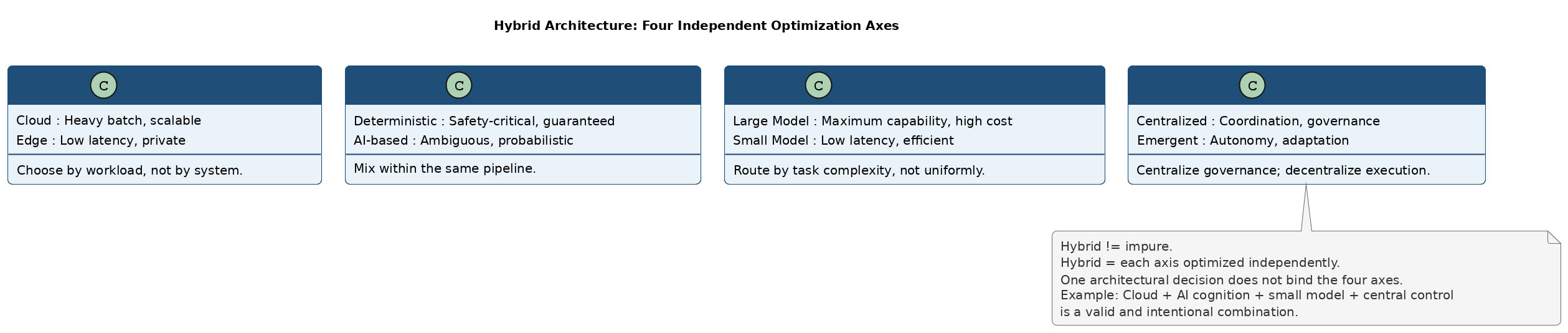
A production multi-agent ecosystem can—and typically should—be hybrid across multiple independent, orthogonal axes:
| Axis | Paradigm A | Paradigm B | Decision Boundary |
|---|---|---|---|
| Compute | Cloud Hyperscaler | On-Premise / Edge | Latency envelope, data sovereignty, compute cost |
| Cognition | Deterministic Code | Probabilistic Foundation Model | Irreversibility, blast radius, auditability |
| Models | Frontier Large Language Models | Quantized Small Language Models (SLMs) | Task cognitive complexity (cf. Ch. 28) |
| Control Topology | Centralized Orchestrator | Emergent Decentralized Swarm | Coordination overhead vs. autonomous agility |
These axes are fully decoupled: an enterprise topology can use cloud GPUs for unconstrained reasoning while anchoring sensitive data processing on local edge NPUs; utilize generative models for ambiguous customer dialogue while gating state mutations behind deterministic rules; and deploy 70B+ frontier models for strategic synthesis alongside 3B quantized models for high-velocity classification—all within the identical system.
The CAP Theorem Applied to Hybrid Swarms
Section titled “The CAP Theorem Applied to Hybrid Swarms”Eric Brewer’s CAP Theorem (2000)—originally formulated for distributed data stores—establishes that a distributed system cannot simultaneously guarantee Consistency (all nodes observe identical state concurrently), Availability (every non-failing node returns a response), and Partition Tolerance (the system functions despite arbitrary network message loss).
Applied to hybrid cloud-edge agent swarms, CAP dictates non-negotiable architectural trade-offs. For edge agents residing on physical endpoints (laptops with dedicated NPUs, factory-floor gateways, mobile nodes), transient network partitions are the baseline operating reality, not anomalies. Consequently, the hybrid swarm must be engineered for Availability and Partition Tolerance (AP), deliberately trading synchronous strong consistency for eventual consistency, backed by idempotent state reconciliation when network connectivity is restored.
This mandates that edge agents maintain operational autonomy during WAN disconnection, persisting an append-only transaction log synced upstream upon reconnection. A “local edge agent” that synchronously blocks on an outbound cloud API call to evaluate a critical decision is not an edge agent: it is merely a cloud client burdened with network jitter.
Applied Case Study: Ryzen AI as an Edge Node in Cloud-Edge Hybridization
Section titled “Applied Case Study: Ryzen AI as an Edge Node in Cloud-Edge Hybridization”In engineering practice, hybridization does NOT mean “a diluted fraction of everything.” It means extreme domain specialization. Consider an applied architecture utilizing AMD Ryzen AI processors that concretizes this principle far better than abstract theory.
Consider a critical validation agent that must return deterministic decisions in < 5 ms. Executing this node on a remote cloud GPU introduces severe operational friction:
- WAN Network Latency: 50–100 ms baseline jitter.
- Geopolitical Data Egress: Local transactions traversing international undersea transit to Virginia or Frankfurt.
- Compute Idle Overhead: Provisioned cloud instances incurring $0.50/hour even while waiting on ingress.
Running that same validation node locally on an AMD Ryzen AI processor (integrated into the operator’s endpoint) delivers:
- Latency: < 5 ms deterministic execution.
- Marginal Cost: ~$0.001/hour amortized hardware lifecycle cost.
- Data Sovereignty: Sensitive telemetry never leaves physical endpoint memory.
Conversely, a deep cognitive reasoning agent tolerating 100–500 ms latency remains deployed on high-memory cloud GPU clusters (with access to frontier 70B+ parameter checkpoints). This is authentic architectural hybridization: agents are not naively duplicated; each is specialized to its technical and economic sweet spot.
The AMD Ryzen AI 300 series (up to 50 TOPS NPU, 15–25W envelope) acts as the bridge making local edge swarms feasible on commodity consumer hardware. Without dedicated NPUs, “edge” compute on laptops is constrained to CPU contention or battery-draining discrete GPUs. With integrated NPUs, endpoints possess a tri-processor topology (CPU + GPU + NPU), enabling local Byzantine consensus and localized RACI verification (cf. Vol. 3, Ch. 15).
The resulting hybrid topology:
┌─ LOCAL EDGE (Ryzen AI Endpoint) [Deterministic, Sovereign, Sub-10ms]│ ├─ Agent A: Critical RBAC Gatekeeper [<5ms decision envelope, 24/7 runtime]│ ├─ Agent B: Local Consensus Auditor [Byzantine consensus executed locally]│ └─ Agent C: Semantic Vector Cache [100% offline operational capability]│├─ DISTRIBUTED CLOUD (GPU Infrastructure)[Probabilistic, High-Compute, Shared]│ ├─ Agent D: Deep Reasoning Engine [70B+ model, 100-500ms latency envelope]│ ├─ Agent E: Continuous Evaluation [Batch model optimization & fine-tuning]│ └─ Agent F: Global State Registry [Global swarm checkpoint synchronization]│└─ FALLBACK TIER (Cold Cloud Storage) [Audit Compliance, Disaster Recovery] └─ Agent G: Regulatory Compliance [Immutable trace logging, weekly audits]The empirical cost-performance matrix makes the architectural trade-off quantitative:
| Agent Node | Execution Domain | Hardware Substrate | Latency | Daily Run Cost | Architectural Justification |
|---|---|---|---|---|---|
| A (RBAC Gate) | Edge | Ryzen AI NPU | < 5 ms | $0.15 | Mandates sub-10ms determinism |
| B (Consensus) | Edge | Ryzen AI NPU | 10 ms | $0.15 | Local consensus must survive WAN partition |
| C (Cache) | Edge | Ryzen AI NPU | 1 ms | $0.15 | Offline local operation required |
| D (Reasoning) | Cloud | Multi-GPU Cluster | 200 ms | $1.50 | Demands frontier model capacity |
| E (Training) | Cloud | GPU Spot Pool | 60 sec | $2.00 | Batch optimization economies of scale |
| F (Sync) | Cloud | Serverless CPU | 5 sec | $0.50 | Lightweight stateless synchronization |
Total Hybrid Architecture Cost: ~$4.45 / day Total Cost if 100% Cloud Deployed: ~$12.00 / day (2.7x cost inflation) Total Cost if 100% Edge Deployed: ~$1.00 / day (Cognitive reasoning crippled; frontier intelligence lost)
Allocating agent placement is an architectural decision, never an accidental default. The decisive metric is: “What is the absolute maximum latency tolerance for this specific agent?” If < 10 ms → Edge NPU. If > 100 ms with high cognitive complexity → Cloud GPU cluster. If latency fluctuates dynamically → Deploy across both using circuit breakers.
Integration Patterns for Hybrid Architectural Seams
Section titled “Integration Patterns for Hybrid Architectural Seams”The true complexity of hybrid architectures resides not within individual agents, but across the architectural seams connecting disparate domains. Every cloud-edge boundary represents an integration surface vulnerable to distributed failure modes. Five design patterns mitigate this risk:
Agentic Circuit Breaker: The edge agent detects cloud API timeouts or rate limits and automatically trips into a localized degraded mode before upstream callers block. Degraded mode may rely on smaller quantized models or deterministic heuristics: it is not the optimal cognitive response, but it is available. Chris Richardson (2018) formalizes this pattern in Microservices Patterns as an essential primitive for distributed fault tolerance.
Event Sourcing for Reconnection Sync: All mutations evaluated at the edge during network partitions are appended to an immutable local append-only commit log. Upon WAN restoration, the cloud replays the log in sequence to reconcile global state. This eliminates data loss during physical partition events.
Agentic CQRS (Command Query Responsibility Segregation): Decoupling state mutations (Commands, routed asynchronously to the cloud) from state reads (Queries, served with sub-millisecond latency from local edge semantic caches). This decoupling insulates local edge operations from cloud API availability.
The Saga Pattern for Distributed Agent Transactions: When an operational workflow demands coordination across cloud and edge (e.g., verifying local biometric identity on-device, followed by committing a financial transaction in the central cloud core), a distributed Saga orchestrates execution via compensating transactions. If a downstream cloud step fails, the Saga coordinates automated compensating rollbacks across both domains.
The Bulkhead Pattern: Partitioning agent execution pools so that the failure of remote cloud dependencies cannot consume thread pools or memory buffers dedicated to mission-critical local edge agents.
Wrapping the Probabilistic Within the Deterministic
Section titled “Wrapping the Probabilistic Within the Deterministic”The most consequential hybridization is not computational (cloud vs. edge), but cognitive: interleaving deterministic logic with probabilistic reasoning. A catastrophic anti-pattern in modern AI engineering is dissolving all operational logic into LLM prompts, surrendering mission-critical decisions to non-deterministic inference.
A mature hybrid architecture enforces the inverse: wrapping probabilistic generation within immutable deterministic boundaries. Agents reason, hypothesize, draft, and explore; but irreversible state mutations must pass through non-negotiable deterministic validators. The agent proposes a financial transfer; an immutable deterministic rule engine validates limits, sanctions lists, and cryptographic multi-factor authorization before committing the database transaction. The cognitive dexterity of artificial intelligence is harnessed strictly within the formal guarantees of classical software engineering.
This duality can be formalized as: Critical_State_Mutation = f_deterministic(agent_candidate_proposal), where f_deterministic is a pure function acting as the invariant guardian of systemic integrity.
The Inherent Risk: Seam Complexity
Section titled “The Inherent Risk: Seam Complexity”Hybridization incurs an undeniable architectural tax: integration seam complexity. Every boundary separating disparate paradigms (cloud/edge, probabilistic/deterministic) introduces an integration surface susceptible to silent network partitions, distributed trace fragmentation, and ambiguous operational accountability. Optimizing a hybrid architecture does not mean proliferating heterogeneous runtimes arbitrarily; it demands minimizing and hardening integration seams: fewer boundaries, strictly typed contracts, and comprehensive distributed telemetry.
Li et al. (2024) demonstrate in NeurIPS that cloud-edge hybrid AI systems incorporating centralized seam observability (distributed tracing, automated synthetic heartbeats, unified correlation IDs) achieve a mean operational availability of 99.95%, compared to 99.50% for unmonitored hybrid deployments. That 0.45% availability delta represents 43 hours of unmitigated annual downtime—a disparity translating to millions in enterprise outage liabilities.
Executive Perspective: Pitching Hybrid Architecture to the CFO
Section titled “Executive Perspective: Pitching Hybrid Architecture to the CFO”■ EXECUTIVE TRACK
Justifying a hybrid multi-agent architecture to the Chief Financial Officer (CFO) requires three concrete financial metrics, two enterprise risks mitigated, and one durable competitive advantage:
Three Financial Metrics: (1) Operating expenditure (OpEx) compression of 40% to 60% compared to monolithic cloud hosting by shifting high-frequency inference to client and edge hardware. (2) Latency reduction from 200 ms to < 10 ms for core workflows, directly driving measurable user conversion and engagement. (3) Availability elevation from 99.50% to 99.95% by eliminating single-cloud vendor SPOFs.
Two Mitigated Enterprise Risks: (1) Cloud Vendor Lock-In: Standardizing agent communication via protocol abstractions (e.g., MCP) allows swapping hyperscalers without refactoring edge runtime nodes. (2) Regulatory Non-Compliance: Sensitive consumer data processed on localized edge hardware never egresses physical devices, radically simplifying GDPR, HIPAA, and jurisdictional sovereignty compliance.
One Strategic Competitive Advantage: Operational system survivability—the business platform remains fully functional offline during global hyperscaler outages, providing a formidable market differentiator in industries where continuous uptime is paramount.
Key Takeaways from Chapter 12
Section titled “Key Takeaways from Chapter 12”- Architectural purity is almost always an anti-pattern in multi-agent engineering; hybridization optimizes each agentic node according to its specific operational boundary conditions.
- The CAP Theorem mandates selecting Availability and Partition Tolerance (AP) across cloud-edge hybrid swarms, enforcing eventual consistency paired with deterministic reconciliation.
- The AMD Ryzen AI case study quantifies real-world ROI: a hybrid deployment costs ~$4.45/day versus ~$12.00/day for all-cloud, achieving sub-5ms local determinism without sacrificing deep cloud reasoning.
- Five core integration patterns govern hybrid seams: Agentic Circuit Breakers, Event Sourcing, CQRS, Sagas, and Bulkheads.
- The ultimate cognitive hybridization wraps probabilistic AI reasoning inside immutable deterministic validators: agents propose; formal code authorizes.