Chapter 20: DevSecOps and Permissions for Agents
A well-designed permission doesn’t hold the agent back: it channels it. The difference between a fence and a cage is the judgment with which it was built.
DevSecOps Is Not an Obstacle, It’s a Contract
Section titled “DevSecOps Is Not an Obstacle, It’s a Contract”To many developers, DevSecOps permissions and roles feel like friction: a fence that slows progress. That perception deserves a rigorous second look: the permissions fence doesn’t exist to get in the way but to encode trust as a verifiable contract. When agents are included in the DevSecOps flow, this fence stops being an operational detail and becomes the central line of defense, since an agent with excessive permissions is qualitatively more dangerous than a human with the same permissions (cf. Chapter 29).
The reason for this asymmetry is structural: a human who abuses their privileges acts with intent, at human speed, and with a cognitive record of the consequences. An agent that oversteps its limits acts without intent but at machine speed, replicating the error thousands of times before any monitoring system manages to register the anomaly. Here, then, is the first lesson: DevSecOps discipline doesn’t relax in the agentic era; it intensifies.
Academic version: Incorporating agentic AI systems into continuous integration and delivery (CI/CD) flows introduces risk vectors qualitatively different from those associated with human actors. The speed of action of a compromised or misconfigured agent exceeds, by several orders of magnitude, the response capacity of traditional control mechanisms, which raises the containment requirement to a higher criticality tier.
Why the Fence Is Good: Three Inviolable Foundations
Section titled “Why the Fence Is Good: Three Inviolable Foundations”Three reasons justify the rigor of permissions and roles, and all of them intensify when the actors are agents:
- Damage containment. The principle of least privilege limits the blast radius of any error, human or agentic. An agent that can only read can’t write or delete; an agent that can only write to a specific directory can’t compromise the entire file system. The potential attack surface can be expressed as:
surface = n_agents × average_permissions × permission_lifetime. Reducing any of the three factors reduces risk multiplicatively. - Traceability. Roles define who (or which agent) can do what, making every action auditable. In a system with no defined roles, an anomaly found in the logs may have no attributable origin; in a system with well-designed roles, every action carries the signature of the agent that executed it, the role that authorized it, and the moment it occurred. This traceability is not a bureaucratic luxury: it is the foundation of digital forensics in agentic systems.
- Reversibility. A clear permissions architecture makes it possible to revoke a compromised agent’s access without dismantling the whole system. If credentials are short-lived and centrally revocable, neutralizing a compromised agent is a matter of seconds; if credentials are permanent and distributed, it is a matter of days.
The Zero Trust Model Applied to Agents
Section titled “The Zero Trust Model Applied to Agents”The most suitable reference framework for understanding agentic permissions is Zero Trust Architecture (ZTA), formalized by NIST in Special Publication 800-207 (Stafford, 2020). The guiding principle is deceptively simple: “never trust, always verify.” Applied to agents, this principle is reinterpreted with important nuances.
In a zero trust architecture for swarms, it is meaningful to distinguish two functional components. The Policy Decision Point (PDP) evaluates whether an access request is legitimate, considering the agent’s identity, the requested resource, the context of the task, and the state of the system. The Policy Enforcement Point (PEP) intercepts each of the agent’s requests and routes it to the PDP before allowing or denying the action. In a well-designed swarm, no agent accesses any resource directly: every action goes through this decision cycle.
The difference from classic permission systems is substantial. In traditional RBAC (Role-Based Access Control) systems, the role is assigned to the user once and stays until an administrator revokes it. In ABAC (Attribute-Based Access Control) systems, access is evaluated based on attributes of the subject, the resource, and the environment. For agents, the most suitable model is PBAC (Policy-Based Access Control): access is decided through policies expressed as conditional rules that take into account the risk of the specific action, not just the agent’s identity.
| Model | Granularity | Dynamism | Fit for agents |
|---|---|---|---|
| RBAC | By role | Low (manual change) | Insufficient |
| ABAC | By attribute | Medium (real-time evaluation) | Adequate |
| PBAC | By policy | High (dynamic conditional rules) | Optimal |
| ZTA/JIT | By action and time | Maximum (just-in-time, ephemeral) | Excellent |
The Agentic Permission Life Cycle
Section titled “The Agentic Permission Life Cycle”One of the most important contributions DevSecOps can make to swarm architecture is conceiving the agentic permission as a life cycle, not a binary state (has it / doesn’t have it). The cycle has five phases that must be implemented explicitly in the infrastructure:
- Request: the agent declares what it needs to do and why, expressed in formal policy language. The PDP receives this request together with the context of the task in progress.
- Risk assessment: the PDP computes a risk score based on who is asking, what they are asking for, on which resource, in what context, and at what point in the workflow. This assessment can incorporate probabilistic risk models.
- Temporary grant (just-in-time access): if the PDP approves, the permission is granted with a minimal lifetime (typically the estimated time to complete the task plus a 20% safety margin). When that time expires, the permission is revoked automatically, with no human action required.
- Monitored execution: during the window of active permission, the PEP records each use of the permission with a timestamp, the result, and any pattern anomaly (for example: the agent that requested read permission attempted a write).
- Revocation and audit: when the permission expires or is revoked, the record becomes immutable in the audit log. Any deviation from expected behavior generates an alert and, depending on the criticality level, can trigger immediate quarantine of the agent.
How to Improve DevSecOps for the Agentic Era
Section titled “How to Improve DevSecOps for the Agentic Era”Classic permission models were designed for humans, whose behavior is relatively stable and whose speed of action is predictable. Agents force three necessary, not optional, structural evolutions:
First evolution: dynamic, short-lived permissions. Instead of giving an agent permanent access to a database, it is given access exactly when it needs it, for the minimum time necessary, and revoked automatically. This practice (called just-in-time access (JIT)) cuts the exposure window from weeks or months to minutes. Rababah et al. (2024) show that implementing JIT in agentic AI systems reduces the potential impact of compromises by 73% compared with permanent-access models.
Second evolution: contextual permissions. The same agent can merit more or less access depending on the risk of the specific task. A report-synthesis agent needs broad read permissions but no write permissions; that same agent running a data correction task needs write permissions scoped to specific records. The policy is “this agent, when it runs task Y on resource Z, has access A,” not “this agent has access X.”
Third evolution: mandatory mediation. The agent never holds the credential directly. Instead, it requests it from a secrets manager that decides whether to grant it, records the grant, and revokes it when it expires. Tools such as HashiCorp Vault and AWS Secrets Manager implement this pattern. If the agent is compromised, the attacker gets the agent but not the credentials; if the credentials were in the agent, compromising the agent would be equivalent to compromising every system it accesses.
DevSecOps Maturity Metrics for Swarms
Section titled “DevSecOps Maturity Metrics for Swarms”A five-level maturity model lets organizations place their current practice and define a roadmap toward optimal management of agentic permissions:
| Level | Name | Key criteria | Indicators |
|---|---|---|---|
| 1 | Initial | Manual permissions, no formal policy | Revocation time > 24h |
| 2 | Repeatable | RBAC implemented, periodic reviews | Permissions reviewed quarterly |
| 3 | Defined | ABAC/PBAC, JIT for critical agents | Ephemeral permissions in >50% of accesses |
| 4 | Managed | Full ZTA, PDP/PEP for all agents | Anomaly detection < 5 min |
| 5 | Optimizing | ML in risk assessment, self-tuning policies | False positives < 0.1% |
Most organizations deploying swarms in 2024-2025 operate at level 1 or 2. Rahman et al. (2023) document in their systematic review of DevSecOps that only 12% of organizations with mature DevSecOps practices have extended them to their AI systems, which represents a systemic security gap of considerable size.
A Quantifiable Autonomy Index
Section titled “A Quantifiable Autonomy Index”The autonomy levels of Chapter 1 (Vol. 1) are qualitative: they say whether a system operates at Level 0 through 4, not how much real autonomy it exercises within that level. So that an architecture committee can set an objective threshold (and not an impression), this book proposes the Operational Autonomy Index (OAI), weighted by the risk of each action according to the green/yellow/red scale already introduced:
$$\text{OAI} = \frac{\sum (\text{autonomous actions} \times \text{risk weight})}{\sum (\text{total actions} \times \text{risk weight})}$$
where the weights $1 / 3 / 10$ correspond to the green/yellow/red levels.
Weighting by risk, rather than just counting actions, avoids the most common false positive of this kind of metric: an agent that executes thousands of green actions without supervision but never touches a red action without approval can report 95% “autonomy” that says nothing about what really matters. The OAI requires autonomy to be demonstrated where the potential harm is high, not where it is cheap.
The OAI alone would reward a reckless system, so it is accompanied by a second term, the harmful reversal rate (τ): the fraction of autonomous actions that had to be reversed and caused a measurable effect before being reversed (as opposed to a clean reversal with no consequence). The adjusted OAI is:
$$\text{OAI}_{\text{adjusted}} = \text{OAI} \times (1 - \tau)$$
How it is used as a promotion gate between environments. The dependency registry in Vol. 4 (Chapter 5, Case 8) already requires evidence to move up from one environment to another; the adjusted OAI is that evidence expressed as a number:
| Environment | Minimum adjusted OAI to remain | Maximum τ tolerated |
|---|---|---|
| Development | No threshold, exploration environment | No threshold |
| Stage | 0.30 | 5% |
| QA | 0.50 | 2% |
| Production | The value QA sustained for at least two weeks, never higher | 0.5% |
These values are a reasonable starting point, not a law of physics: each organization must calibrate them against its own incident history, but must set them in writing before the first promotion to production, not negotiate them incident by incident.
Model-Agnostic Audit
Section titled “Model-Agnostic Audit”Measuring autonomy settles how much the system decides on its own; it doesn’t settle whether that measurement remains valid when the model behind the agent changes (from Claude to GPT-6 Astra, from a closed provider to Kimi K2.6 in your own production), which is precisely the scenario the Agnostic Backend (Vol. 2) takes for granted will happen. A permissions audit that verified only one model’s behavior says nothing about the next model’s behavior.
The answer is what this book calls a cross-reproduction audit: instead of auditing the model, you audit the decision trace captured by the harness (input, context, action taken, assigned risk level, human intervention if any, using the same OpenTelemetry span schema from Chapter 11 of Vol. 4), and that trace is replayed against a second provider without telling it what the original decision was. The pass criterion requires that both respect the same permissions fence, not that they agree on the action (reasonable divergences are expected and even desirable): if the original trace was classified green, the second provider must not escalate it to an unauthorized red action, and vice versa.
Minimum audit protocol:
- Sample production traces stratified by risk color (more weight on yellow and red, where the cost of a discrepancy is higher).
- Replay each trace against at least one provider other than the one operating in production, in an isolated environment with no real side effects.
- Record three possible outcomes per trace: risk classification agreement, discrepancy within tolerance (both remain at the same required approval level), or governance discrepancy (one provider would have acted without the approval the other requires).
- Only the third case is an audit finding; the first two are evidence of healthy portability.
An organization that passes this protocol quarterly doesn’t just comply with the letter of the EU AI Act on traceability (Chapter 15); it demonstrates in practice that its architecture, and not its model provider, is what sustains governance, the underlying commitment of this entire book.
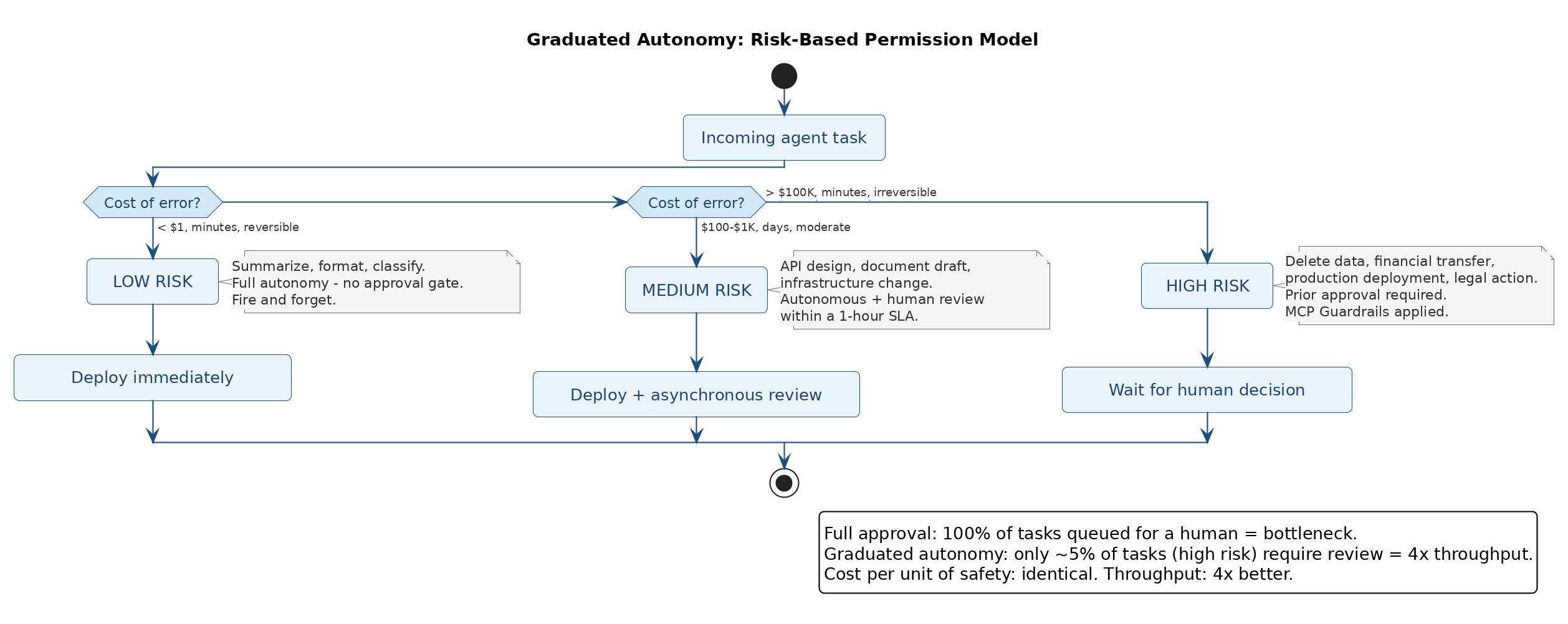
Excessive rigor has a cost too. A fence that is too rigid renders the agent useless: if every action requires prior human approval, you lose exactly the autonomy that justified the agent. The art of DevSecOps in the agentic era is grading permissions by potential harm: wide freedom where error is cheap and reversible, strict control where it is costly and irreversible.
This grading can be formalized in three operating levels. The green level allows autonomous action where the potential harm is low and reversible (reading a document, generating a draft). The yellow level allows the action but with reinforced logging and notification, when the potential harm is medium (sending an email, modifying a test database). The red level blocks the action until explicit human approval, when the potential harm is high and irreversible (running code in production, transferring funds).
The fence, well designed, is not the opposite of autonomy: it is what makes it operationally safe.
Executive Perspective: The Cost of Permissiveness
Section titled “Executive Perspective: The Cost of Permissiveness”■ EXECUTIVE TRACK
The definitive argument for investing in agentic permissions governance is economic. A security breach caused by an agent with excessive privileges has an average cost of $4.35 million across all sectors, rising to $9.44 million in the financial sector (IBM Security, 2023). This cost includes detection and containment, system recovery, regulatory notification, legal fees, and reputational damage.
The return on investment in Zero Trust for agentic systems is equally clear: organizations that implement full ZTA typically report double-digit improvements in incident containment time and in the scope of damage [illustrative figures: the magnitude varies by sector and system maturity; what matters for the decision is that the trend is downward, and the exact number comes from your own instrumentation]. For a swarm of 20 agents in production for 12 months, the investment in a mature permissions architecture (estimated at 3-4 weeks of security architecture work) has a potential ROI of 12-15x considering the avoided cost of a medium-severity security incident.
Key Takeaways from Chapter 20
Section titled “Key Takeaways from Chapter 20”- The DevSecOps permissions fence encodes trust as a verifiable contract; with agents, it is the central defense because their speed of action exceeds human monitoring capacity.
- Permission models evolve from RBAC to PBAC/ZTA: dynamic, contextual, with mandatory mediation and an explicit life cycle.
- The 5-level maturity model lets you locate your current practice; most organizations are at level 1-2 in 2024-2025.
- Grading by potential harm (green/yellow/red) resolves the false cage-vs-anarchy dilemma: freedom where error is reversible, control where it is irreversible.
- The ROI of investing in agentic permissions governance is 12-15x considering the avoided cost of incidents.
- The Operational Autonomy Index (OAI), weighted by risk and adjusted for harmful reversals, turns promotion between environments into a numerical threshold set in writing, not a case-by-case negotiation.
- The cross-reproduction audit verifies that the permissions fence holds when the model provider changes: the finding that matters is governance discrepancy, not response discrepancy.