Chapter 21: Every Line of Code as a Responsibility of the AI Agent and Multi-Agent Systems
The agent writes the line; the human answers for it. That asymmetry is the heart of everything.
A Line of Code Is Never Neutral
Section titled “A Line of Code Is Never Neutral”One principle underlying all responsible engineering practice deserves to be engraved: every line of code is a responsibility. It is a commitment (to whoever will maintain it, to whoever will depend on it, to the system that will house it for years), not a neutral fragment. When AI agents start writing lines in bulk, this principle doesn’t dilute: it becomes urgent. Because an agent can generate a thousand lines in a minute, but responsibility for those thousand lines isn’t generated; it is assumed, and only a human can assume it.
The difference between code written by a human and code generated by an agent doesn’t lie in syntactic correctness or immediate functionality (both can be perfect on those dimensions). It lies in the traceability of the reasoning: when a human writes a line, there is in their mind a model of why that solution and not another, which invariants it maintains, which assumptions it makes. When an agent generates that same line, the reasoning is opaque by nature; the artifact exists, but the process that produced it can’t be inspected directly.
Academic version: The mass adoption of code generation systems based on large-scale language models introduces a structural dissociation between the speed of software artifact production and the human capacity to understand and take responsibility for those artifacts. This dissociation constitutes what could be called agentic epistemological debt: a form of technical debt qualitatively different from the classic kind, in which the code is functionally correct but cognitively opaque to the team that maintains it.
The Fundamental Asymmetry: Speed vs. Accountability
Section titled “The Fundamental Asymmetry: Speed vs. Accountability”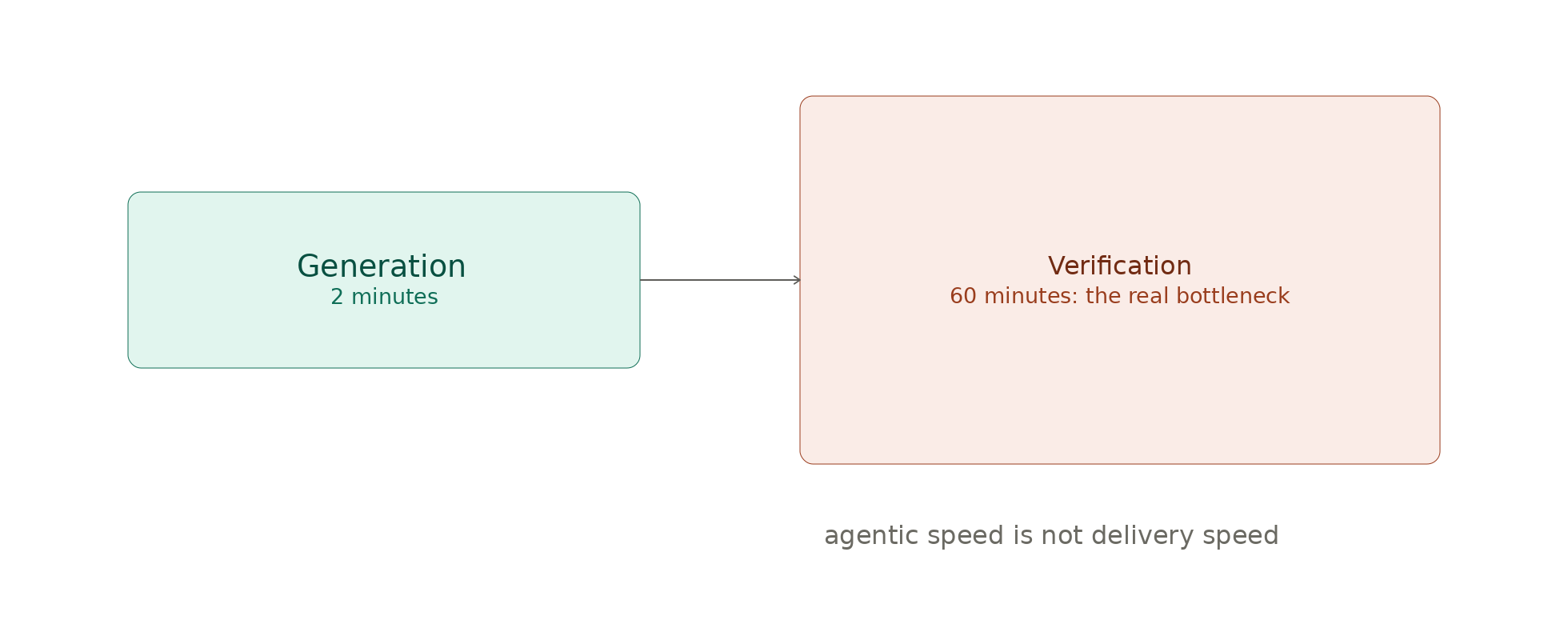
Here is the central tension in agent-assisted programming: generation speed has decoupled from accountability speed. The agent produces code at a pace no human can review with the same depth with which they would have written it.
The math is unforgiving. An agent generates 1,000 lines in 2 minutes. A senior engineer reviews at sufficient depth (understanding logic, edge cases, security implications) at a rate of 50 lines an hour. The review time is therefore 20 hours for those 1,000 lines. The agent contributes 2 minutes of the total process; the human, 1,200 minutes. Mathematically: optimizing the agent from 2 minutes to 30 seconds saves 0.1% of the total time. Optimizing human review from 20 hours to 10 hours saves 50%. The bottleneck is human judgment, not generation.
This inversion of intuition has deep strategic consequences. Teams that invest heavily in generation tooling without investing proportionally in review infrastructure (automated tests, specialized static analysis, structured peer review) are optimizing the 0.1% while neglecting the 99.9%.
Pearce et al. (2022) published in the IEEE Symposium on Security and Privacy a rigorous analysis of code generated by GitHub Copilot: 40% of the code snippets generated in security contexts contained vulnerabilities that passed superficial detection. They were not obvious syntactic errors; they were logical vulnerabilities that required a deep understanding of the usage context to be detected. The implication is direct: superficial review (reading the code without understanding it) is not review; it is security theater.
A silent risk thus arises: accepting lines that work without understanding why, building up a system whose logic nobody fully owns. This is different from classic technical debt: classic debt is “poorly done but works.” Agentic debt is “well done by machine, but the human doesn’t understand it.” It is epistemological debt, not quality debt. And it is more dangerous, because the code works until it suddenly doesn’t, with no obvious cause.
The Epistemological Crisis of Synthetic Code
Section titled “The Epistemological Crisis of Synthetic Code”The most important distinction to emerge in the agentic era is the one separating classic technical debt from agentic epistemological debt.
Classic technical debt, formalized by Ward Cunningham (1992) with his financial metaphor, describes code that works but is implemented suboptimally: quick fixes taken consciously with the intention of refactoring later. This code is understandable (the team knows why it’s wrong) and the debt is, at least in principle, quantifiable and payable.
Agentic epistemological debt is different in nature. Code generated by an agent can be perfectly correct in functional terms, pass every test, meet every acceptance criterion… and yet nobody on the team understands why it works. It’s not “poorly done but works”: it’s “well done by machine, but the human doesn’t understand it.” It is debt on the plane of knowledge, not technical quality.
What is less obvious is that this debt is more dangerous than the classic kind, precisely because the code works (until it stops), and when it fails, there is no mental model on the team that allows diagnosing the cause. The system collapses suddenly, in production, against an input nobody anticipated because nobody had reasoned about the limits of the algorithm.
Academic version: Agentic epistemological debt represents an ontologically distinct category within the taxonomy of technical debt. Unlike implementation debt (suboptimal code with understandable logic) and design debt (suboptimal architecture with traceable decisions), epistemological debt is characterized by the opacity of the reasoning process that produced the artifact, generating an asymmetry between the observable quality of the code and the team’s capacity to maintain it responsibly.
A Taxonomy of Agentic Responsibility
Section titled “A Taxonomy of Agentic Responsibility”Responsibility for agentic code is not monolithic: it is distributed across three dimensions that must be identified and assigned explicitly in the development process:
Generation responsibility. Which agent generated this code, with what instructions, on what date, using which model and version? This dimension is technically tractable: generation metadata can be annotated in the commit. A proposed annotation scheme: @agent-generated: claude-sonnet-5 · task: implement OAuth2 flow · date: 2025-03-14 · risk-level: high.
Integration responsibility. Which identified human reviewed this code, understood it, and decided to integrate it into the system? This is the responsibility no agent can assume. Accepting a pull request containing agentic code without real understanding of how it works is not integration responsibility: it is a simulacrum of it. The EU AI Act (Arts. 13-14, Regulation 2024/1689) establishes that responsibility for high-risk AI systems falls on the human deployer, not the model; by extension, responsibility for integrating agentic code into critical systems falls on the engineer who accepted it.
Maintenance responsibility. Who will answer when this code fails (in six months, in two years, under conditions nobody anticipated), and who will have the knowledge needed to diagnose and remediate it? Teams that accept agentic code without documenting the implicit reasoning are transferring this responsibility to a future self who will have less context, more pressure, and a more complex system.
Disciplines for Making Agentic Code Accountable
Section titled “Disciplines for Making Agentic Code Accountable”Faced with this reality, three disciplines are not just advisable but operationally necessary:
Risk-proportional review. Not every agentic line deserves the same scrutiny. Code that touches authentication logic, handling of personal data, financial transactions, or infrastructure control requires deep review. Code that generates a text formatter or computes a sum deserves basic functional verification. This differentiation is the only way to make review sustainable in large-scale code generation systems.
Understanding before acceptance. The golden rule, non-negotiable: don’t integrate agentic code you don’t understand. “It works” isn’t sufficient criterion. If nobody on the team can explain why this algorithm converges, why this database index is suitable, why this error handling is correct, then nobody will be able to fix it when it fails in production.
Traceability of origin. Knowing which agent generated what, when, with what instructions, and which human integrated it. Kochhar et al. (2024) propose at ICSE an accountability framework for AI-assisted development that includes six mandatory metadata fields in every commit containing agentic code: model used, original prompt, acceptance criteria applied, identified human reviewer, assessed risk level, and traceability to the corresponding business requirement.
The Programmer as Guarantor, Not Typist
Section titled “The Programmer as Guarantor, Not Typist”Consequently, the programmer’s role transforms deeply, but it isn’t devalued: it rises. They stop being the one who types every line and become the guarantor of every line (the one who decides which deserve trust, which demand review, and which must be rejected). This is, paradoxically, a greater responsibility than writing. Writing a line takes knowledge; answering for a thousand lines someone else wrote takes judgment, and judgment is precisely what distinguishes an engineer from a text generator.
This transformation of the role has direct implications for performance evaluation. Teams that measure productivity in lines of code generated are evaluating the agent’s speed, not the engineer’s. Teams that measure productivity in well-founded integration decisions (code accepted with documented understanding, code rejected with technical justification) are evaluating the engineer’s real competence in the agentic era.
The QA Perspective: Verification as the New First Line
Section titled “The QA Perspective: Verification as the New First Line”► TECHNICAL TRACK
From the Senior QA’s perspective, the proliferation of agentic code completely reconfigures the quality strategy. Agentic verification requires two additional layers beyond the classic approach.
The first is comprehension verification: confirming that the team understands why the code works, not just that it works. This can be done through technical reviews where the author explains the reasoning of the agentic code (an exercise which, if impossible, indicates the code should not have been integrated).
The second is boundary verification: explicitly identifying the assumptions of the agentic code and testing its behavior at the limits of those assumptions. Agents optimize for average use cases; QA must cover the extreme cases the agent didn’t anticipate.
Liu et al. (2023) analyze at NeurIPS the correctness rate of LLM-generated code: while 85% of the generated programs pass basic functional tests, only 62% pass more exhaustive test suites that include edge cases and failure conditions. The 23% gap represents exactly the risk surface that superficial review leaves exposed.
Key Takeaways from Chapter 21
Section titled “Key Takeaways from Chapter 21”- Every line of code is a commitment; with agents, the principle becomes urgent because generation speed has decoupled from accountability speed.
- Agentic epistemological debt is more dangerous than classic technical debt: the code works until it suddenly fails, with no mental model available for diagnosis.
- The responsibility taxonomy has three dimensions: generation (which agent?), integration (which human accepted?), and maintenance (who will answer in the future?).
- The three non-negotiable disciplines: risk-proportional review, understanding before acceptance, traceability of origin.
- The programmer rises from typist to guarantor; answering for a thousand lines takes more judgment than writing one.