Chapter 25: Japan: Synthetic Multi-Agent Systems on the Factory Floor
One robot is just a machine. Fifty orchestrated robots are emergent intelligence.
The Leap from Automation to Autonomy
Section titled “The Leap from Automation to Autonomy”Here is a phenomenon that explains why Japan dominates precision manufacturing: Honda, Toyota, and Siemens no longer deploy programmed robots. They deploy swarms of agents. A vision agent inspects 100 components per second. A decision agent votes on pass or fail. A robot agent carries out the coordinated action.
The architecture is not centralized. It runs on distributed consensus. The 100 vision agents emit candidates (defect locations), and the coordinator agent applies a Byzantine Fault Tolerant protocol (PBFT) to pick the verdict. It tolerates up to 33% faulty agents without losing correctness.
The Economics of Agentic Scale
Section titled “The Economics of Agentic Scale”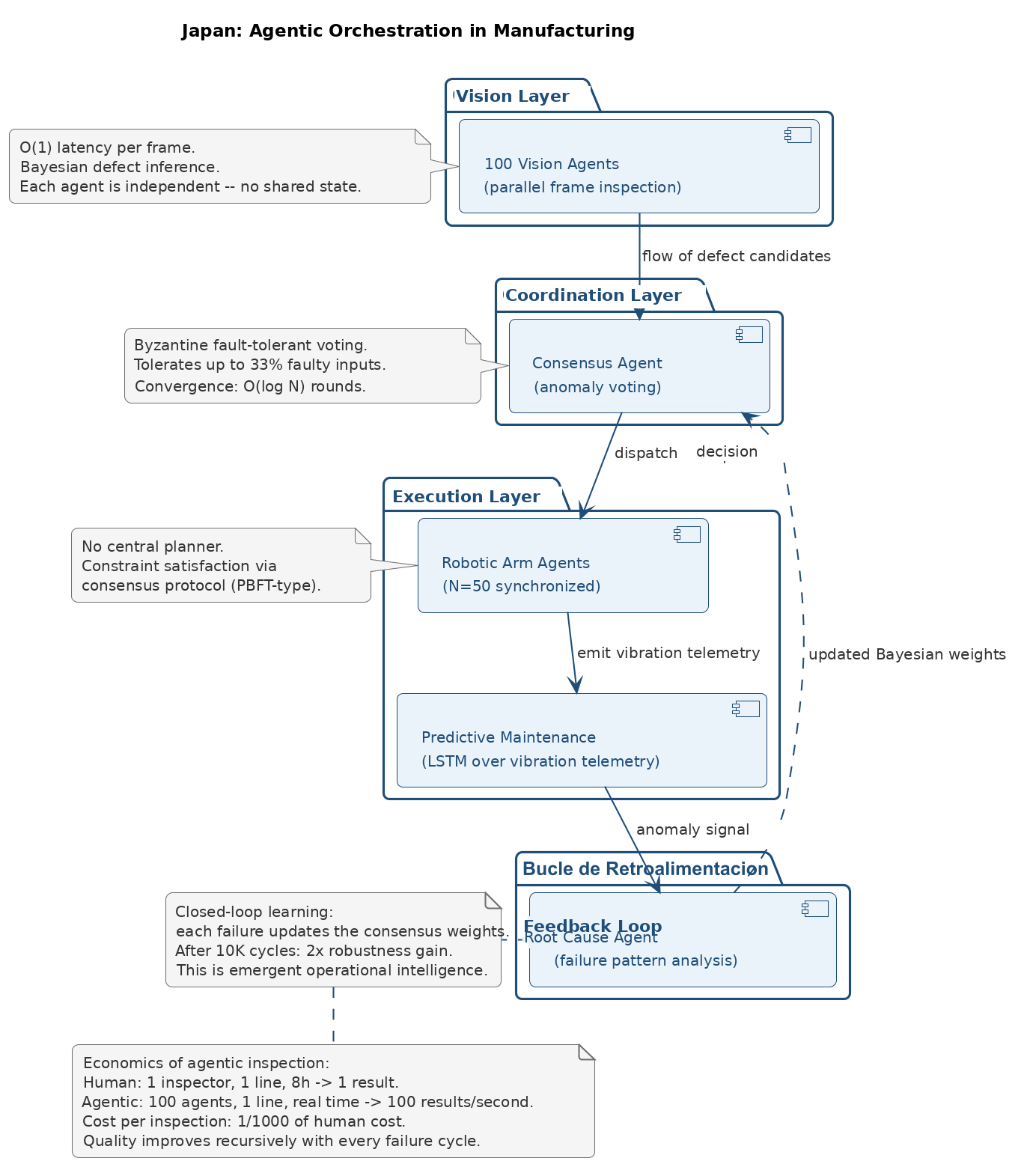
Look at the numbers. A human inspector checks about 500 components per shift (8 hours). A swarm of 100 agents checks 100 components per second. That is a 1,000x difference, at 1/1,000 of the cost per inspection.
What matters most is that quality did not degrade. It emerged. This is fundamentally different from conventional automation. A robot that fails needs reprogramming. A swarm that fails corrects itself: a root cause analysis agent examines each failure and adjusts the weights in the consensus protocol. After 10,000 cycles, the system is twice as robust.
Ryzen AI Embedded: The Factory’s Distributed Brain
Section titled “Ryzen AI Embedded: The Factory’s Distributed Brain”One thing that transforms agentic manufacturing is where the coordinator agent lives. In Japan, Honda and Siemens are experimenting with Ryzen AI embedded in edge control boxes (15–25 W, fanless, MTBF over 100,000 hours).
Here is why Ryzen AI beats a GPU for robotic orchestration:
Deterministic latency: The 16 TOPS of the Ryzen AI NPU hold latency steady under 5 ms even under load. A cloud GPU suffers network jitter (±50 ms). In robotics, latency variance means servo wobble, and servo wobble means defects. Ryzen AI keeps the servo loop predictable.
On-device learning: Japanese manufacturers keep their production data in local environments under trade secret protection. With Ryzen AI in the control box, you can train a predictive maintenance LSTM agent directly on real-time vibration data. The model improves without ever touching the cloud, so confidentiality is preserved.
Automatic fallback: If the network goes down (a common event in factories with electromagnetic interference), Ryzen AI keeps running the 8 vision agents locally. The assembly line does not stop. The cloud is redundancy, not a dependency.
The architectural point is that every collaborative robot (cobot) can carry its own Ryzen AI APU on its control board. That differs from traditional robotics, where the “brain” lives in one of three places:
- A central computer (monolithic, single point of failure)
- The cloud (unacceptable latency)
- An embedded microcontroller (no AI)
With Ryzen AI, the robot itself is an agent with local reasoning. Coordination among 50 robots runs on Byzantine Fault Tolerance (see Vol. 2, Chapter 25, Japan), with the NPU running the consensus protocol in about 1 ms.
The cost is reasonable: a Ryzen AI APU built into an industrial controller runs about $300–400 per robot. An edge GPU (Jetson Orin) costs $1,000 or more, and cloud inference costs $10–50 per robot per day. Break-even: 10–30 days, depending on utilization.
On-device training changes the picture. Every night, the robot downloads vibration, temperature, and gripper-cycle data, and an internal LSTM agent retrains on it (PyTorch and TensorFlow Lite run natively on Ryzen AI). By morning, the robot is better than it was yesterday. That is operational emergence.
The decisive point is that Ryzen AI replaces what used to require a centralized architecture (a brain in a computer, with robots as appendages) with a distributed one in which every robot is an agent with its own cognition. A factory that scales is one where every component can think locally.
The Executive View: Agentic Manufacturing as a Durable Competitive Advantage
Section titled “The Executive View: Agentic Manufacturing as a Durable Competitive Advantage”■ EXECUTIVE TRACK
From an organizational leadership standpoint, the Japanese model of agentic manufacturing offers a replicable framework whose ROI can be quantified more precisely than that of most enterprise AI investments.
The case for conventional automation is cost reduction through labor substitution. The case for agentic manufacturing is qualitatively different: it is the emergence of quality through distributed intelligence. A human inspector checking 500 components per shift introduces fatigue-related error variance that grows toward the end of the shift. A swarm of 100 vision agents checks 100 components per second with zero variance in attention. The quality gap compounds over time: across a production run of a million components, the cumulative difference in defect rate between human and agentic inspection can decide whether a supplier keeps its contract with an automotive OEM.
Three organizational implications deserve direct attention from executives. First, the capital expenditure profile of agentic manufacturing is front-loaded but pays back faster than conventional automation: the $300–400 per-robot cost of the embedded Ryzen AI controller reaches break-even in 10–30 days of operation, compared with 18–36 months for traditional robotic cell installations. Second, the organizational change required to move from centralized robotics to distributed intelligence is substantial: teams used to programming centralized controllers have to build new mental models for emergent coordination. Third, the data that agentic manufacturing systems generate (vibration signatures, thermal profiles, and gripper force profiles at the component level) forms a proprietary dataset that, over time, trains models competitors without that data cannot replicate. The data moat is the durable advantage, not the hardware.
Key Takeaways from Chapter 25
Section titled “Key Takeaways from Chapter 25”- 100 vision agents, PBFT consensus, and 50 robots add up to emergent intelligence.
- Economics: 1,000x the inspections at 1/1,000 of the cost, with better quality.
- Fault tolerance: up to 33% faulty agents, and the system keeps running.
- Ryzen AI embedded in each cobot creates distributed cognition: deterministic latency under 5 ms, on-device learning, and automatic fallback when the network fails.
- Break-even: 10–30 days, versus a Jetson Orin ($1,000+) or cloud inference per robot ($10–50 per day).
- The data moat (proprietary training on thousands of production cycles) is the durable competitive advantage, not the hardware.