Chapter 1: The Silent Token-Burn
The Debt That Doesn’t Show Up on the Balance Sheet
Section titled “The Debt That Doesn’t Show Up on the Balance Sheet”In the traditional accounting of software projects, costs are visible: person-hours, licenses, infrastructure. In the agentic era, a category of cost emerges that appears in no initial budget: Token-Burn, the accumulated token consumption generated by poorly designed iterations, needlessly inflated contexts, and agents that “think out loud” with ungoverned verbosity.
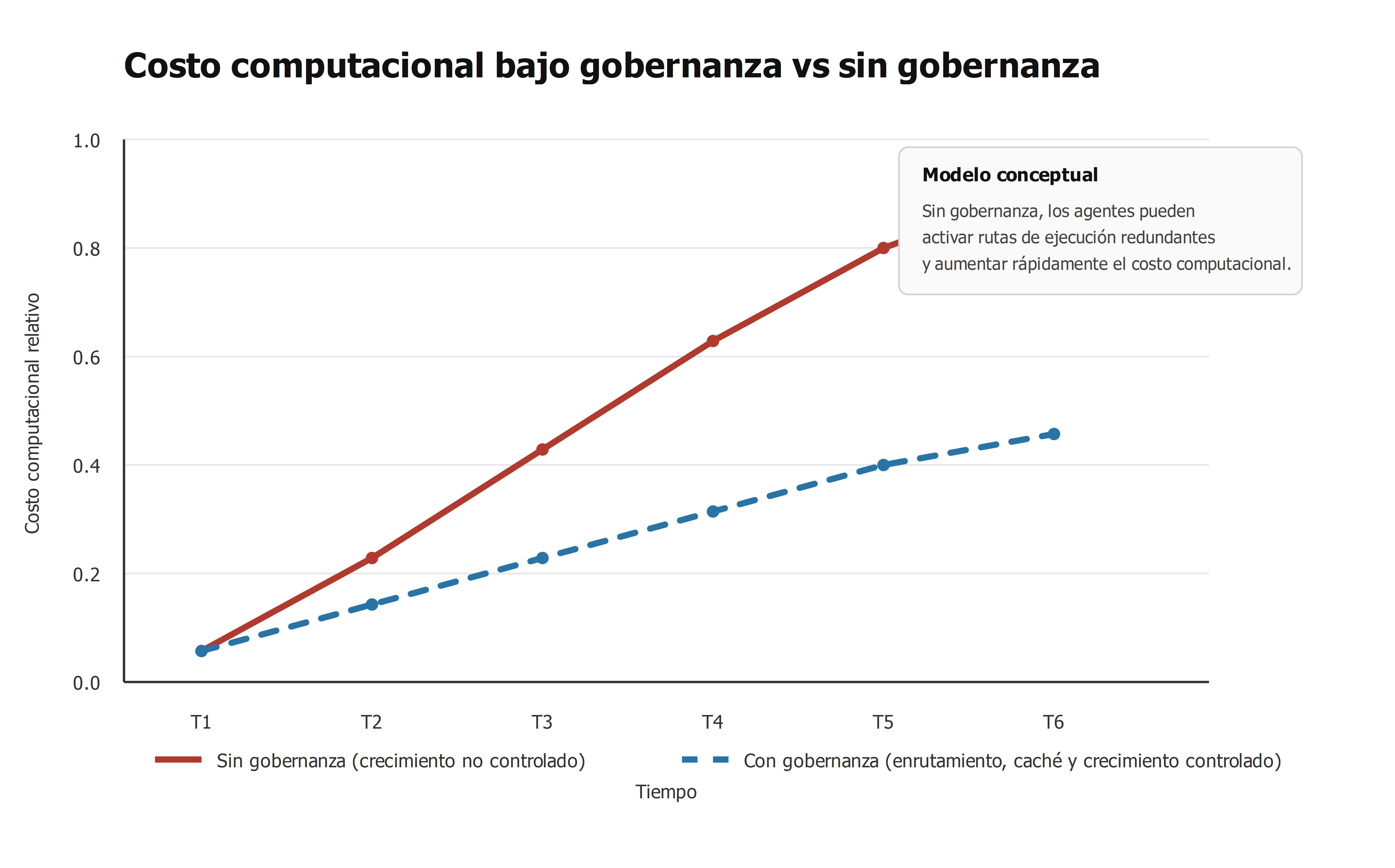
It is silent because each individual call looks trivial: a few cents, maybe a dollar. The problem emerges at scale. A team of ten engineers using agents without governance can rack up tens of thousands of dollars a month in tokens without anyone in leadership knowing, not because anyone is hiding it, but because no system adds it up. The exact accounting analogy is Boehm’s technical debt: the cost of fixing a defect grows nonlinearly with the time it takes to detect it (Boehm, 1981). Token-Burn is economic debt with the same structure: the later governance is installed, the more expensive the period without it.
The CIU Metric: Cost per Useful Iteration
Section titled “The CIU Metric: Cost per Useful Iteration”We introduce the CIU (Cost per Useful Iteration) as the fundamental economic metric of the agentic era:
$$CIU = \frac{\text{Total token cost of the pipeline}}{\text{Number of features validated and in production}}$$
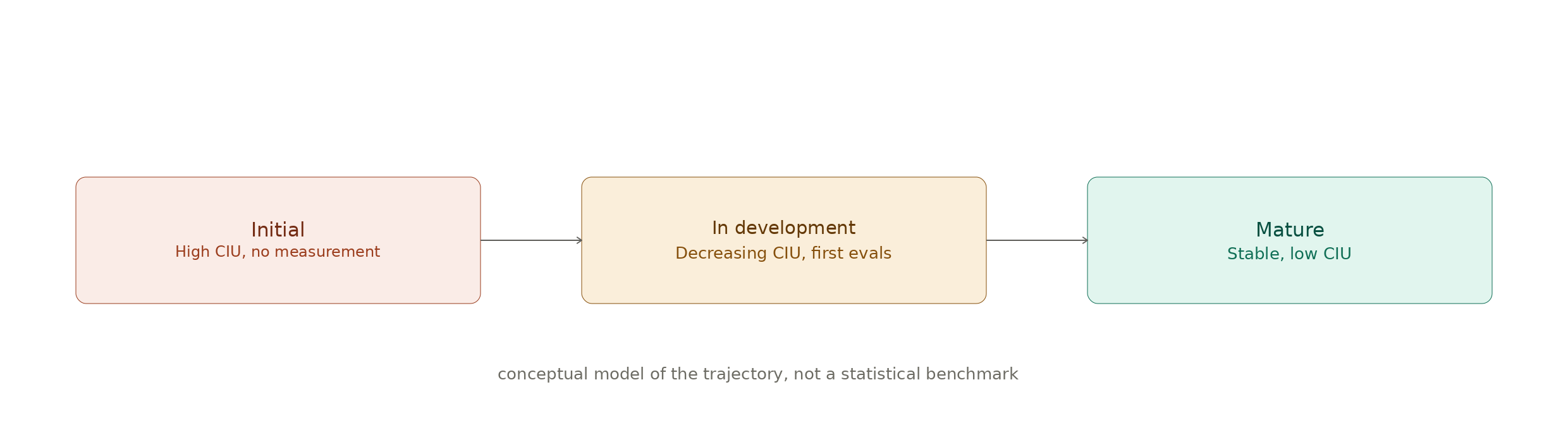
Put another way, the CIU translates token spend into business terms: what does it actually cost to take a feature from idea to production using agents? The denominator is the key word: validated. Iterations that don’t reach production are not productivity; they are cost. A CIU that rises while the volume of generated code grows is the unmistakable signature of the illusion of speed described in the preface.
The metric ties into a central result of agent evaluation research: comparisons of agentic systems that don’t control for cost are neither science nor engineering: they are marketing (Kapoor et al., 2024). The CIU is cost control applied to your own organization: every architecture in Chapter 8 must justify its CIU against the simple alternative.
The Five Main Causes of Excessive Token-Burn
Section titled “The Five Main Causes of Excessive Token-Burn”- Inflated context. Injecting full documentation when only a fragment is needed. This is the most common cause and the most expensive, and it also degrades quality: models use information buried in long contexts worse (Liu et al., 2024). Solution: tuned RAG and context discipline.
- Wrong model. Using the premium model for tasks the economy model solves just as well. At the prices in force at the close of this edition, the difference between tiers is 5× per token; multiplied by thousands of daily calls, it funds an engineer. Solution: routing by complexity (Chapter 3).
- Loops with no stopping criterion. Agents that iterate past the point of diminishing returns. Solution: explicit iteration budgets (Chapter 4) and this chapter’s metric.
- No prompt cache. Resending the same prefix (system prompt, domain context, tools) at full price on every call. Modern APIs cache stable prefixes: cache reads cost around 10% of the normal input price, with a small one-time write surcharge. For agents with long prefixes and many iterations, the savings are on the order of 80–90% of input cost. The condition: the prefix must be byte-identical between calls; a timestamp interpolated at the start of the prompt silently destroys all the savings.
- Ungoverned verbosity. Not limiting output tokens or specifying the level of detail. Output typically costs five times more than input; paying for verbosity is paying a premium for noise.
To these five a lever is added that is an opportunity, not a cause: what isn’t urgent, in batch. The batch processing APIs of the main providers offer around a 50% discount for asynchronous workloads: nightly evaluations, bulk classification, documentation generation. A mature pipeline separates interactive traffic from deferrable traffic and sends the latter at half price.
► TECHNICAL TRACK: Token-Burn Control System
# Example 1.1: Real-time CIU tracker.# Detects and alerts when the CIU exceeds defined thresholds.# Integrate into the AI Gateway (Chapter 3) for automatic coverage.
import statisticsfrom dataclasses import dataclass, fieldfrom datetime import datetime, timedeltafrom typing import List
@dataclassclass IterationRecord:    feature_id: str    tokens_consumed: int    cost_usd: float    reached_production: bool    timestamp: datetime = field(default_factory=datetime.now)
class CIUTracker:    """    Tracks the CIU in real time and raises alerts when thresholds are exceeded.    """
    def __init__(self, alert_ciu_usd: float = 5.0):        self.iterations: List[IterationRecord] = []        self.alert_ciu_usd = alert_ciu_usd
    def record(self, feature_id: str, tokens: int,               cost_usd: float, validated: bool):        self.iterations.append(IterationRecord(            feature_id=feature_id,            tokens_consumed=tokens,            cost_usd=cost_usd,            reached_production=validated,        ))        current_ciu = self.compute_feature_ciu(feature_id)        if current_ciu > self.alert_ciu_usd:            self._emit_alert(feature_id, current_ciu)
    def compute_feature_ciu(self, feature_id: str) -> float:        """CIU for a specific feature."""        records = [r for r in self.iterations if r.feature_id == feature_id]        if not records:            return 0.0        total_cost = sum(r.cost_usd for r in records)        validated = sum(1 for r in records if r.reached_production)        if validated == 0:            return float("inf")  # in progress: no denominator yet        return total_cost / validated
    def compute_global_ciu(self, window_days: int = 30) -> float:        """Team-wide aggregate CIU over the last N days."""        cutoff = datetime.now() - timedelta(days=window_days)        recent = [r for r in self.iterations if r.timestamp >= cutoff]        if not recent:            return 0.0        total_cost = sum(r.cost_usd for r in recent)        validated = sum(1 for r in recent if r.reached_production)        return total_cost / max(validated, 1)
    def monthly_report(self) -> dict:        cutoff = datetime.now() - timedelta(days=30)        records = [r for r in self.iterations if r.timestamp >= cutoff]        feature_cius = [            self.compute_feature_ciu(r.feature_id)            for r in records            if self.compute_feature_ciu(r.feature_id) != float("inf")        ]        return {            "period": "last 30 days",            "total_iterations": len(records),            "total_cost_usd": round(sum(r.cost_usd for r in records), 2),            "features_in_production": sum(1 for r in records                                          if r.reached_production),            "global_ciu": round(self.compute_global_ciu(), 4),            "average_ciu_per_feature": round(                statistics.mean(feature_cius), 4) if feature_cius else 0.0,            "alert_active": self.compute_global_ciu() > self.alert_ciu_usd,        }
    def _emit_alert(self, feature_id: str, ciu: float):        # In production: Slack, PagerDuty, dashboard.        print(f"TOKEN-BURN ALERT: feature '{feature_id}' has "              f"CIU=${ciu:.2f} (threshold: ${self.alert_ciu_usd:.2f}). "              f"Review the pipeline.")
■ EXECUTIVE TRACK: The CFO’s Questions
The whole chapter boils down to four questions a chief financial officer will ask sooner or later, and that you should be able to answer beforehand:
- How much did we spend on inference last month, by team and by product? Without a central gateway (Chapter 3), this question has no answer.
- What is our CIU and how is it evolving? It is the only metric that connects AI spend to delivered value.
- What fraction of the spend is avoidable? Audit the five causes; in organizations with no prior governance, finding 40–60% avoidable spend is typical, dominated by inflated context and the wrong model.
- Is spend growing faster or slower than value? Growing spend with a falling CIU is a healthy investment; growing spend with a rising CIU is the operational definition of Token-Burn.
Worked Exercise 1.1: Audit This Pipeline
Section titled “Worked Exercise 1.1: Audit This Pipeline”Problem. A team reports this product description generation pipeline: the premium model for all calls; the entire catalog (90,000 tokens) injected into every prompt “for context”; no max_tokens configured; a retry loop until the description “sounds good” according to the model itself; everything on interactive traffic even though the batch runs overnight. Identify the causes of Token-Burn and rank the fixes by savings.
Annotated solution. All five causes are present: the exercise is a bestiary. In descending order of savings: (1) inflated context: the entire catalog per call is the bulk of the bill; with RAG, each product needs its own record and little else, with estimated savings above 90% of input and better quality as a bonus (Liu et al., 2024). (2) Wrong model: product descriptions are an economy-tier task, with an immediate 5× saving on whatever remains. (3) Batch at half price: it runs overnight, which is the definition of deferrable traffic. (4) A loop with no objective criterion: “sounds good” as judged by the generator is the self-congratulation antipattern (Chapter 8); replace it with verifiable criteria (length, required attributes present, no claims not contained in the record) with a budget of two retries. (5) Unlimited output: max_tokens matched to the format. The exercise’s pedagogical trap: fix (4) is the least lucrative in tokens but the most important for quality; the order by savings is not always the order by value, and knowing how to tell them apart is the craft.
The Cost Below the Token Line: The Infrastructure That Runs the Agent
Section titled “The Cost Below the Token Line: The Infrastructure That Runs the Agent”The CIU measures the token’s cost; it is not the total cost. Every agent call runs on infrastructure that also bills: the gateway that routes it, the cache that makes it cheaper, the network egress that moves its data, and the storage where the documents it retrieves live. In small systems this line is noise next to the model bill; in systems that touch regulated or high-volume data, it stops being so, and then the decision of where each piece runs becomes a cost lever of the same order as the five causes above.
Hybrid architecture is that lever. The idea, which the author developed in published material (see “Author’s Public Work”), is to separate two workloads with opposite economics: inference, elastic and cheap to pay for by use in the cloud, and data, which when sensitive or voluminous is expensive to move and to expose. The pattern keeps the data close to its origin (in a private cloud or on-premise) and brings to it only the computation that needs it, instead of dragging the data to the inference on every iteration.
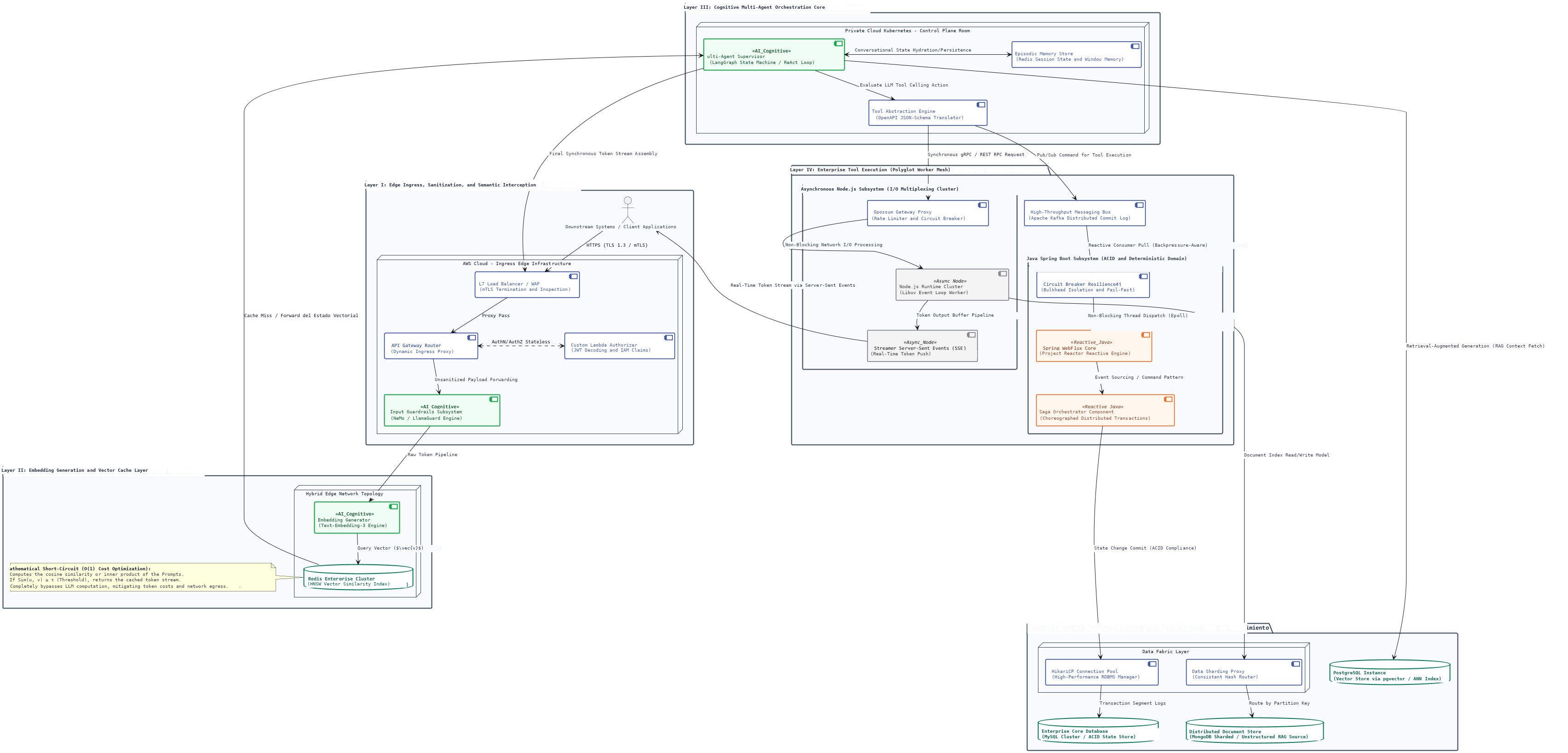
The diagram makes concrete three cost decisions an agent in production inherits from its infrastructure. First, the read cache (Redis, at the front) is not just latency: every cache hit is a database query that isn’t paid for and an egress that isn’t moved: the infrastructure-layer analogue of the model’s own prompt cache. Second, the encrypted tunnel between clouds (VPN Gateway, Bastion, Firewall) and the security perimeter (WAF, DDoS protection) are the non-negotiable price of keeping sensitive data where it belongs; budgeting for them up front avoids the surprise of the egress bill, which is to data transit what Token-Burn is to the token: invisible call by call, brutal at month’s end. Third, keeping the data on-premise or in a private cloud turns a variable, growing cost (egress and managed storage in the public cloud) into a fixed, amortizable one, exactly the calculation Chapter 7 will return to when comparing the batch synchronizer with the event stream.
Honesty demands the flip side, however: hybrid is neither free nor universally better. It adds a network boundary to operate, a security plane to audit, and a complexity that is justified only when the volume or the sensitivity of the data demands it. For an agent querying public documentation, taking everything to the cloud is cheaper and simpler. The rule is the same one that governs the rest of the book: the architecture is chosen with the numbers on the table, not with the enthusiasm of the diagram. The CIU measures the token; this line hides a second bill, and ignoring it is the infrastructure version of the debt that doesn’t show up on the balance sheet.
Key Takeaways from Chapter 1
Section titled “Key Takeaways from Chapter 1”- Token-Burn is silent by construction: no call looks expensive; the aggregate, without a system to measure it, doesn’t exist for anyone.
- CIU = total token cost / features validated in production. The denominator is the key word.
- Five causes: inflated context, wrong model, loops with no stopping, no cache, and ungoverned verbosity. And one lever: the deferrable, in batch at half price.
- The cache demands a byte-identical prefix: a timestamp at the start silently destroys the savings.
- Architecture comparisons without cost control are marketing (Kapoor et al., 2024); the CIU is that control applied to your own house.
- Below the token line there is a second bill: gateway, cache, egress, and storage. Hybrid architecture (elastic inference in the cloud, data close to its origin) is a cost lever when volume or sensitivity justifies it, and unnecessary overhead when it doesn’t.