Chapter 12: The Fight Between AI Agents and Multi-Agent Systems: Why Being the Best Model Isn't Enough to Win
Like the T-1000, being the most advanced model doesn’t guarantee victory if your environment defeats you.
The T-1000 Metaphor and Its Technical Precision
Section titled “The T-1000 Metaphor and Its Technical Precision”The author draws on a memorable image that deserves to be taken at its technical value: the T-1000’s artificial intelligence, though technologically superior in individual capabilities, is defeated not by a smarter system but by one with a better systemic architecture. The lesson goes beyond fiction: in the world of AI agents, the best model does not win automatically.
An outstanding reasoning model (say, in the 99.9th percentile of all available benchmarks), when poorly orchestrated, poorly fed with context, lacking adequate tools, and without risk containment, loses to a model of modest capabilities embedded in a well-designed architecture. This claim isn’t intuitive, but it is empirically robust and technically grounded. The benchmark measures the model in isolation under laboratory conditions; production measures the whole system under real conditions of load, noise, adversarial pressure, and integration.
The Systemic Quality Function: The Math Behind the Argument
Section titled “The Systemic Quality Function: The Math Behind the Argument”This chapter’s central thesis can be formalized mathematically, which gives it a solidity the metaphor alone doesn’t provide. The effective quality of an agentic system is its limiting minimum, not the sum of its components’ qualities:
Q_system = min(Q_model, Q_architecture, Q_context, Q_tools, Q_containment)Where each Q represents the normalized quality, on a [0, 1] scale, of the corresponding component. If any one of these five factors is 0 (the context is null, the tools are unavailable, risk containment is nonexistent), the system’s quality is 0 regardless of how high Q_model is.
This min() function has counterintuitive but important implications. With Q_model = 0.99 (a state-of-the-art model) and Q_architecture = 0.3 (a deficient architecture), the system produces Q_system = 0.3. If the model is replaced with one at Q_model = 0.85 but the architecture is improved to Q_architecture = 0.85, the result is Q_system = 0.85 (a 183% improvement in systemic quality with an inferior model). This result explains why investing in architecture has a far better return than chasing the latest model when the architecture is below 0.8.
The empirical validation of this function comes from AgentBench data (Liu et al., 2024): the same model (GPT-4) produces results that vary between 40% and 82% success rate depending solely on the orchestration environment and the tools available (a 105% variation with the model held constant).
The Five Dimensions That Decide the Systemic Fight
Section titled “The Five Dimensions That Decide the Systemic Fight”What determines, then, which agent or swarm prevails under real conditions? Not the model’s raw power, but a constellation of systemic factors, each of which can be the bottleneck:
1. Context. The best model without the right context reasons perfectly about the wrong question. A model that receives incorrect, incomplete, or poorly organized information produces answers that are internally coherent and externally wrong (the worst kind of error, because it passes plausibility filters). The quality of the context depends on the design of the retrieval system (RAG), the management of the context window, and the selection of which information is relevant to which agent.
2. Orchestration. A mid-range model well coordinated with specialized ones outperforms a solitary genius with no structure. Hong et al. (2024), in MetaGPT (ICLR 2024), showed that explicitly assigning professional roles to agents (business analyst, architect, developer, QA) in a multi-agent system raises the completion rate of working software by 184% compared with a system without explicit roles, using the same base model.
3. Tools. Access to the right tools through MCP or equivalent protocols multiplies the system’s effective capability more than any model version jump. An agent with access to web search, code execution, and a structured database produces results that no pure language model can replicate, regardless of its size.
4. Speed and cost. An agent that responds within the SLA at a viable cost per transaction beats, in the market, one that is more accurate but 10 times more expensive or 10 times slower. This factor is particularly relevant in competition between models: Claude Haiku 3.5 is roughly 6 times cheaper than Claude Sonnet 3.5 per token; on tasks where its quality is sufficient, the cost difference lets you scale 6 times further on the same budget.
5. Robustness to failure. An agent that degrades gracefully under adverse conditions (high tool latency, contaminated context, ambiguous instructions) survives the one that collapses or produces silently incorrect output. The graceful degradation pattern applied to agents requires explicitly designing the fallback behavior for each anticipated failure mode.
Benchmark Evidence: Why Model Rankings Mislead
Section titled “Benchmark Evidence: Why Model Rankings Mislead”The language model evaluation industry has produced high-quality benchmarks (MMLU, HumanEval, MATH, GSM8K) that precisely measure the capabilities of the model in isolation. The problem is how the benchmark results are interpreted, not their quality.
Zheng et al. (2023), in the work that produced Chatbot Arena (NeurIPS 2023), showed that the ranking of models by human preference in real conversation diverges significantly from the ranking on static benchmarks: models that score highest on MMLU are not necessarily preferred by real users on practical tasks. The gap is explained by factors static benchmarks don’t capture: naturalness of the response, handling of ambiguous instructions, and behavior on out-of-distribution questions.
In the agentic domain, the divergence is even greater. Jimenez et al. (2024), in SWE-bench (ICLR 2024), evaluated models’ ability to resolve real GitHub issues. The results were revealing: the model with the best score on HumanEval (a code generation benchmark) was not the one that resolved the most issues on SWE-bench. Success in real agentic tasks depends on the ability to plan multiple steps, recover from intermediate errors, and stay consistent with the system’s state, capabilities that static code generation benchmarks don’t measure.
Model Routing Strategies: The Intelligence of Selection
Section titled “Model Routing Strategies: The Intelligence of Selection”► TECHNICAL TRACK
One of the most important practical consequences of the systemic quality function is dynamic model routing: the strategy of using different models for different types of tasks within the same system, choosing at runtime the optimal model according to the nature of the subtask, its risk level, and its expected volume.
A practical routing taxonomy distinguishes three categories of tasks:
| Category | Classification criterion | Recommended model | Reason |
|---|---|---|---|
| High complexity, low volume | Multistep reasoning, critical decisions | Highest-capability model (Claude Opus, GPT-4o) | Quality > cost on rare tasks |
| Medium complexity, medium volume | Content generation, standard analysis | Balanced model (Claude Sonnet, GPT-4o-mini) | Optimal quality/cost balance |
| Low complexity, high volume | Classification, extraction, triage | Small, fast model (Claude Haiku, GPT-4o-mini) | Cost < quality on massive tasks |
The router itself can be a small model trained or fine-tuned to classify task complexity in milliseconds, adding negligible latency. The cost savings from this strategy can exceed 60% in systems with high variability in task complexity, while keeping quality at the 90th percentile or above for the tasks that require it.
The System Beats the Model: Implications for the Architect
Section titled “The System Beats the Model: Implications for the Architect”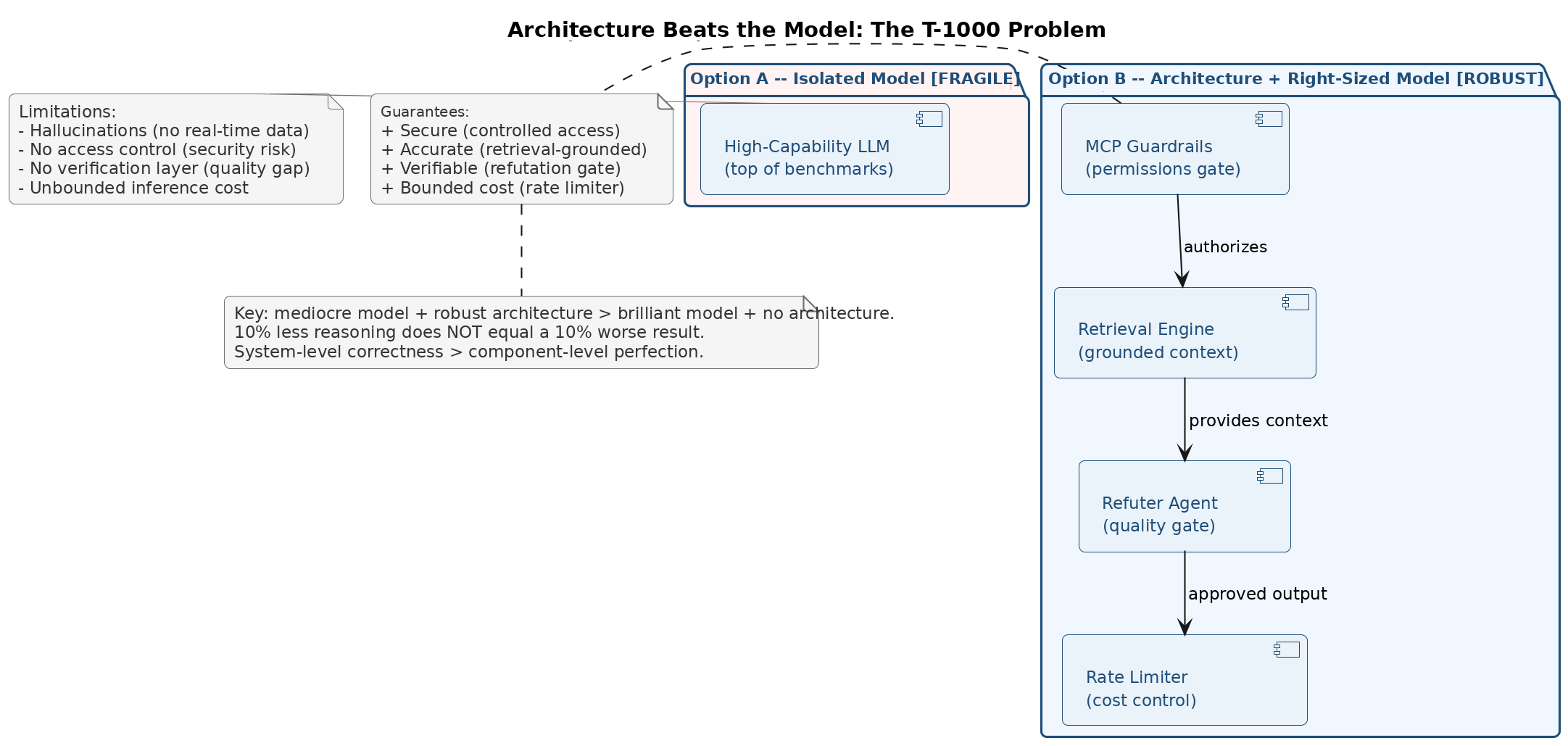
Here is the central thesis in summary: in agentic competition, architecture is the real battlefield, not the model. Companies that invest obsessively in having the “best model” are fighting the wrong war, for three structural reasons.
First, model convergence: Claude, GPT, Gemini, and their competitors converge each year on the standard benchmarks at a rate of about 5 percentage points per year on the most discriminating metrics. The advantage of today’s best model is tomorrow’s median model parity.
Second, the cost of model dependence: a system designed around a specific model has to be redesigned every time that model changes (and models change every 6-12 months). A model-agnostic architecture incorporates any improvement without a redesign.
Third, the floor effect: in systems with Q_architecture < 0.6, no model, however good, can take Q_system above 0.6. The most profitable investment is always to raise the minimum component of the function.
Build vs. Buy in the Era of the Commodity Model
Section titled “Build vs. Buy in the Era of the Commodity Model”■ EXECUTIVE TRACK
The convergence of models toward a commodity has direct strategic implications for build-vs-buy decisions. When the base model is a commodity accessible via API, the competitive advantage lies not in the model but in the architecture that orchestrates it, the proprietary data that feeds it, and the verification processes that ensure its quality.
This reshapes the make-or-buy calculation: it makes sense to buy the base model (for most organizations there is no competitive advantage in building general-purpose models from scratch) and to build the orchestration architecture, the context retrieval system, and the proprietary quality evaluators (that is where the durable advantage lives).
The exception is domain-specialized models: in healthcare, law, finance, and other sectors with proprietary data and privacy requirements, fine-tuning base models on your own data can in fact produce durable competitive advantage. But even there, the orchestration architecture amplifies or limits that advantage.
Key Takeaways from Chapter 12
Section titled “Key Takeaways from Chapter 12”- Systemic quality is the minimum of the qualities of the model, the architecture, the context, the tools, and the containment; any component at 0 makes the system useless regardless of the model.
- AgentBench (Liu et al., 2024): the same model (GPT-4) varies by 105% in success rate depending only on the orchestration environment.
- MetaGPT (Hong et al., 2024): explicitly assigning professional roles raises the completion rate by 184% with the same base model.
- SWE-bench (Jimenez et al., 2024): the best model on HumanEval is not the one that resolves the most real GitHub issues; static benchmarks mislead.
- Dynamic model routing can cut costs by more than 60% while holding quality at the 90th percentile or above, by assigning the right model to the right complexity.
- Models converge about 5 percentage points per year on discriminating benchmarks; the advantage of today’s best model is tomorrow’s median parity.
- Build vs. buy: buy the base model (a commodity), build the orchestration architecture, context, and evaluators (a durable competitive advantage).