Chapter 2: The AI Engineer: The Most Valuable Profile of the Next Decade
A New Discipline Emerges
Section titled “A New Discipline Emerges”In 2023, Shawn Wang, known throughout the tech community as “swyx,” published an essay that circulated across thousands of engineering organizations: The Rise of the AI Engineer Wang, 2023. The thesis was crisp and definitive: an entirely new category of technical professional was emerging—neither a traditional Machine Learning Engineer (who trains models) nor a Data Scientist (who analyzes statistical datasets), but rather an engineer who builds production applications on top of pre-trained foundation models. The underlying economic dynamic was straightforward: pre-training a frontier foundation model demands hundreds of millions of dollars in compute capital, restricting model training to a handful of elite hyperscale research laboratories Bommasani et al., 2021; building production software on top of those models requires an API key, accessible to any engineering team on Earth. Wherever such extreme economic asymmetry exists, a new engineering profession inevitably crystallizes.
That practitioner—the AI Engineer—is the foundational architect of the agentic era.
The Role Differentiation Matrix
Section titled “The Role Differentiation Matrix”To grasp what makes the AI Engineer unique, one must demarcate the role from adjacent disciplines:
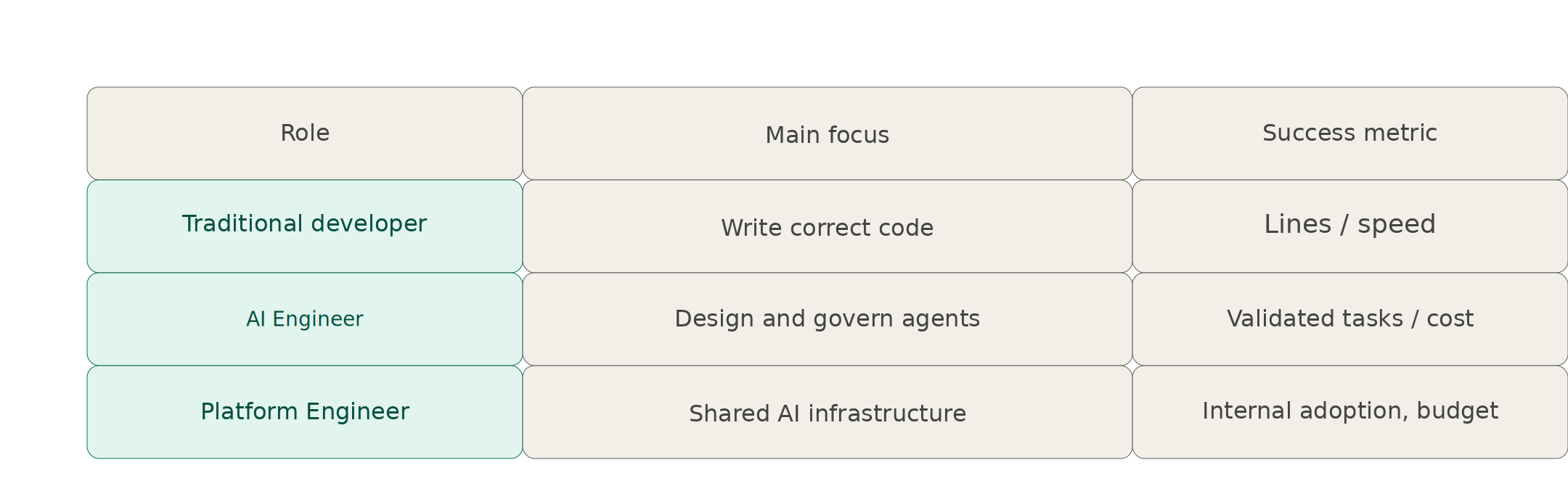
This demarcation is not bureaucratic hairsplitting; it reflects the fundamental vector of engineering workflows. The Machine Learning Engineer works toward the model: data pipelines, loss curves, distributed pre-training, and weight quantization. The AI Engineer works from the model outward: structured prompting, context architecture, execution harnesses, tool design, evaluation suites, and product integration. While both intersect with classical software engineering, their core artifacts, operational metrics, and failure modes are completely disjoint.
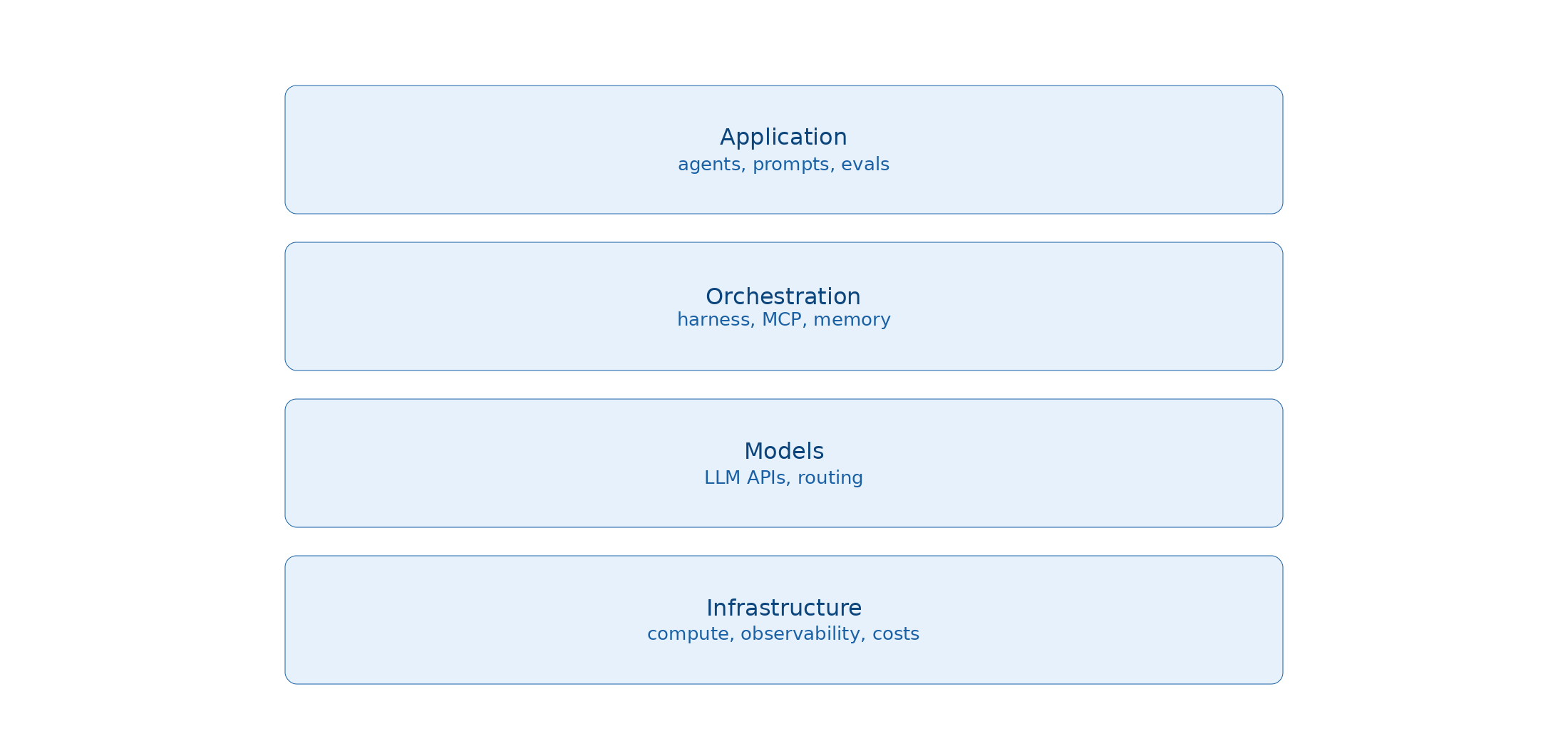
► TECHNICAL TRACK: The AI Engineer’s Stack
The AI Engineer operates an integrated stack combining classical systems engineering with agentic primitives:
The Seven Core Competencies of the AI Engineer
Section titled “The Seven Core Competencies of the AI Engineer”1. Prompt Engineering as a Formal Software Discipline. This is not “talking politely to chatbots”: it is the systematic engineering of deterministic, machine-verifiable instruction sets. Its techniques are supported by peer-reviewed literature: chain-of-thought prompting demonstrably enhances multi-step deductive reasoning Wei, Wang, et al., 2022; in-context few-shot learning has been documented as a discontinuous emergent capability since GPT-3 Brown et al., 2020; and declarative programmatic frameworks like DSPy demonstrate that prompts must be treated as compilable, optimizable code rather than brittle hand-tuned strings Khattab et al., 2024. The engineering takeaway is absolute: a production prompt is version-controlled, covered by automated assertions, and subjected to code review like any mission-critical artifact.
2. Retrieval-Augmented Generation (RAG) Architecture. The foundational pattern for grounding foundation models in private enterprise knowledge without fine-tuning, formalize by Lewis et al. (2020): retrieving semantically relevant knowledge chunks from external stores and injecting them into the inference window prior to generation. The AI Engineer must master semantic chunking strategies, dense embedding vectors, hybrid keyword/vector indexing, and neural re-ranking—and, crucially, understand their mathematical boundaries: irrelevant retrieved context actively poisons model generation. RAG also serves as the primary engineering defense against hallucination—the well-documented failure mode (exhaustively cataloged by Ji et al., 2023) where models synthesize fluent yet factually baseless outputs.
3. Tool Design and Function Calling. Codifying the tools an autonomous agent can invoke, engineering their schema documentation, and managing typed error propagation across multi-step execution chains. The cardinal engineering rule: a tool’s name and semantic description IS its prompt. The foundation model decides whether and when to invoke an API by parsing that schema description, precisely as a human engineer decides which library function to invoke by reading its docstring (Schick et al., 2023; Anthropic, 2024).
4. Context Architecture and State Memory. Context windows expanded from 4,000 tokens to over one million tokens within four years, yet raw token capacity does not equal active attention: transformer models exhibit degraded retrieval accuracy for information positioned in the middle of long contexts—an empirical vulnerability measured by Liu et al. (2024) and known as the lost in the middle phenomenon. The AI Engineer architects stateful memory hierarchies that persist, retrieve, and summarize relevant state across asynchronous sessions, rather than indiscriminately dumping entire raw databases into the inference window—which represents the primary driver of catastrophic Token-Burn (Volume 4, Chapter 1).
5. Systems Evaluation (Evals). Constructing automated evaluation harnesses to measure whether an agent improves or regresses across prompt iterations, model upgrades, and code changes. This functions as the direct equivalent of Test-Driven Development (TDD) for non-deterministic architectures, analyzed in depth in Volume 4, Chapter 3. The core pattern—deploying an LLM as an automated judge evaluating the outputs of another model—achieves human agreement rates exceeding 80%, parity with inter-annotator human agreement Zheng et al., 2023, provided known positional and verbosity biases are strictly calibrated.
6. Unit Economics and Cost Optimization. Selecting the optimal model tier for each task, exploiting prompt caching, executing non-urgent tasks via asynchronous batch endpoints, and architecting pipelines that minimize token consumption while maintaining rigorous output quality. This is an engineering discipline, not a procurement negotiation: the decisions that drive enterprise cloud invoices (complexity-based dynamic routing, cacheable prefix structure) reside in application code (Volume 4, Chapter 1).
7. Multi-Agent Orchestration. The advanced apex of the stack: engineering distributed architectures where multiple specialized agents collaborate, challenge each other, and enforce mutual governance boundaries (Chapters 5 and 8). This requires mastery of all six preceding competencies; a multi-agent swarm deployed without evals, context boundaries, or spend limits is not systems architecture—it is an uncontrolled distributed fire.
# Example 2.1: The signature of a well-designed tool# The description IS the prompt that the model reads to decide when to invoke it
tools = [    {        "name": "search_technical_documentation",        "description": """Searches the enterprise technical knowledge base.        USE when: the user asks about internal architecture, proprietary APIs,        past architectural decisions, or team standards.        DO NOT USE for: third-party library code, general programming concepts.""",        "input_schema": {            "type": "object",            "properties": {                "query": {                    "type": "string",                    "description": "The specific technical query to search. Be specific."                },                "domain": {                    "type": "string",                    "enum": ["architecture", "apis", "security", "database", "frontend"],                    "description": "Technical domain to filter results"                }            },            "required": ["query"]        }    }]
Note the prescriptive “USE when / DO NOT USE for” guardrail: structured descriptions that explicitly state when to invoke a tool, rather than merely summarizing what it computes, measurably improve correct invocation rates across frontier models, which naturally default toward conservative tool usage Anthropic, 2024.
■ EXECUTIVE TRACK: The Economic Value of the AI Engineer
As of 2026, the AI Engineer represents one of the steepest talent shortages in the global software industry. The structural drivers:
- Traditional coding bootcamps manufacture junior developers at scale, but cannot produce AI Engineers: the discipline mandates prior production systems experience.
- Traditional ML Engineers possess half the stack (models and math) but lack the other half (production software systems engineering and API design).
- Senior backend developers possess half the stack (distributed systems) but lack familiarity with probabilistic LLM primitives and context architecture.
This scarcity creates a pronounced, verifiable salary premium: compensation intelligence platforms (such as levels.fyi) consistently position AI Engineering compensation in the upper percentiles of technical labor, substantially outstripping generic software engineering roles across identical seniority bands. While absolute dollar compensation figures decay rapidly, the relative premium represents durable strategic intelligence, persisting unbroken across 2023–2026.
For engineering organizations across Latin America and emerging tech hubs operating under currency differentials, this dynamic creates a powerful arbitrage window: a compact team of skilled AI Engineers in Lima, Buenos Aires, or Medellín can match the shipping velocity of teams five times their size that have failed to transition, at a fraction of the capital expenditure. This window is temporary, as with all economic arbitrage, closing the moment global competitors complete their internal transformations.
The decisive executive question is not “what AI tools should we purchase?”, but “are we deliberately training AI Engineers internally, or outsourcing our core architectural destiny?”
Demonstrate, Do Not Accumulate: The Practitioner Manifesto
Section titled “Demonstrate, Do Not Accumulate: The Practitioner Manifesto”Mastering multi-agent systems does not require hoarding certificates.
It demands demonstrating that you can engineer production systems.
Architecting distributed systems.
Deploying live applications.
Harnessing modern primitives (Docker, Kubernetes, Terraform) applied to concrete business problems on the day they are learned, rather than collecting credentials on a static résumé.
And, above all, as an engineer: solving non-trivial production challenges.
That is the standard an executive technical committee (or prospective client) verifies in a one-hour technical audit; a PDF certificate cannot substitute for it. The preceding section cataloged the seven core competencies; this section details how an external auditor verifies them in practice, and how engineering teams can capture the current arbitrage window before it closes.
The Three-Artifact Standard. An AI Engineer who can present: (1) a public repository hosting an original multi-agent system, complete with execution harnesses and reproducible eval suites (not a derivative tutorial clone); (2) that identical architecture deployed and publicly accessible in production; and (3) a documented post-mortem of a live production failure they diagnosed, root-caused, and resolved—has proven far more engineering competence than any candidate presenting five cloud certifications. All three artifacts are verifiable within a single technical interview.
Separating Production Primitives from Ecosystem Noise. Not every library warrants engineering investment; the hallmark separating an AI Engineer from a hype-driven enthusiast is discerning when a framework resolves a structural distributed bottleneck versus when it merely adds superficial abstraction bloat. Three operational criteria: Is it maintained by an organization with durable economic incentives (a major cloud provider or open-source foundation, rather than an unmaintained weekend repository)? Does a stable alternative already exist, and does the new entrant resolve an unsolved structural problem? Does the toolchain survive network partitions and endpoint outages without corrupting state? Applied to the Model Context Protocol (MCP) servers detailed in Chapter 9, this framework separates production-grade tools from transient noise:
| Tooling | Core Problem Resolved | Production Maturity Rationale |
|---|---|---|
| GitHub MCP Server | Pull request reviews, automated issue triage, natural language CI/CD triggering | The most widely deployed MCP server in the ecosystem; co-maintained by GitHub |
| Terraform MCP Server (Official HashiCorp) | Queries Terraform Registry modules/providers; HCP Terraform workspace management | Secure-by-default architecture (unauthenticated read-only Registry access) serves as a reference pattern |
| Kubernetes / Lens MCP Server | EKS/AKS cluster management, pod diagnostics without touching raw local kubeconfigs | Native integration with dominant enterprise cloud control planes |
| Docker MCP Toolkit / Gateway | Packages 300+ vetted MCP servers as isolated containers with credential boundaries | A turnkey, production-ready implementation of the multi-provider gateway pattern detailed in Chapter 3 |
| Context7 | Real-time library documentation and code snippets fetched dynamically at query time | Directly eliminates the most pervasive category of hallucination: APIs that evolved post-training cutoff |
| Playwright MCP | Headless browser automation for end-to-end integration testing and controlled scraping | De facto industry standard for agents validating live browser DOMs rather than merely generating code |
| Archify | Synthesizes architectural diagrams as an agent skill, verifying schema validity and linking nodes directly to repository code lines | Solves the core pathology of AI diagrams: if an architectural component does not exist in code, it is omitted |
| Napkin AI | Translates natural language into editable conceptual diagrams for executive communication | Complements Archify from the opposite perspective: designed for conceptual alignment with non-technical stakeholders |
The Model Context Protocol specification attained formal stability in mid-2026, elevating Streamable HTTP transport to parity with stdio (enabling secure, shared enterprise remote servers rather than isolated local processes). This marks protocol-level maturity; individual server adoption should remain governed by the evaluation matrix above.
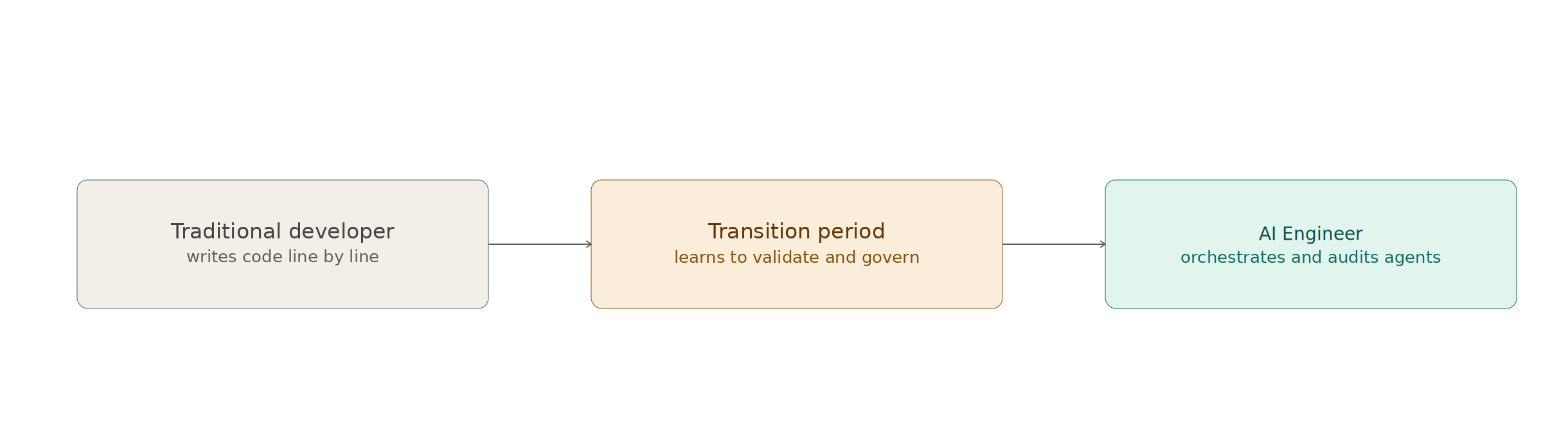
The most capital-efficient conversion path does not run through an academic master’s degree in machine learning. It runs through an intensive eight-to-twelve-week internal enablement program centered on the seven core competencies, grounded in an active internal project, backed by dedicated token budgets, and evaluated against explicit success criteria established on Day One.
Illustrative Production Scenario: Accelerated Upskilling. Consider a team of four senior backend Python developers with zero prior LLM experience. (The following represents a composite case study modeled after recurring enterprise adoption programs; figures illustrate orders of magnitude rather than audited financials.) Following an eight-week intensive enablement program in the seven core competencies, the team spends six weeks engineering an internal contract review system that previously consumed dozens of legal hours weekly. The system processes batches of enterprise agreements with deterministic human-in-the-loop review gates, driving document analysis costs from hundreds of dollars down to pennies. The capital investment of the upskilling program is fully recouped within the first quarter of production operation.
Two engineering warnings prevent this scenario from devolving into marketing fiction. First: the “94% accuracy” frequently advertised in such case studies is meaningless without declaring the underlying evaluation benchmark, the asymmetric cost of false negatives versus false positives, and the operational protocol for reviewing the remaining 6% (addressed in Volume 4, Chapter 3). Second: the system is architected as an automated workflow with mandatory human checkpoints, not an unconstrained autonomous agent; that disciplined choice of autonomy level (Chapter 1) is the sole reason it succeeds in production.
Worked Exercise 2.1: Architect an Eight-Week Team Upskilling Program
Section titled “Worked Exercise 2.1: Architect an Eight-Week Team Upskilling Program”Problem Statement. Design an intensive eight-week enablement curriculum for three senior developers within your organization, using the seven core competencies as the syllabus. Define: syllabus sequence, the vehicle project, and machine-verifiable weekly deliverables.
Walkthrough Solution. Curriculum sequencing must follow architectural dependencies rather than textbook order: Weeks 1–2, Prompt Engineering as Code and Tool/Function Calling Design (foundational building blocks); Weeks 3–4, RAG Architectures and Context/Memory Management (grounding models in internal domain knowledge); Weeks 5–6, Automated Evals (establishing verification harnesses before optimizing performance); Weeks 7–8, Cost Governance and Minimal Orchestration (a disciplined two-agent pipeline). The vehicle project must satisfy three non-negotiable criteria: uses internal proprietary data, carries low blast radius for failure, and serves an internal stakeholder with real operational pain (such as the developer onboarding assistant detailed in Volume 4, Chapter 5). Weekly deliverables must be verifiable technical artifacts rather than passive attendance: Week 5, for instance, concludes with an automated suite of twenty continuous evals running in CI/CD, or the milestone fails. The two cardinal mistakes that derail enablement programs: jumping prematurely into multi-agent orchestration (Competency 7 without the preceding six produces distributed chaos) and training without dedicated, isolated token budgets (an engineer who does not track daily spend never internalizes cost governance—their manager discovers it on the month-end cloud invoice).
Chapter 2 Takeaways
Section titled “Chapter 2 Takeaways”- The AI Engineer builds from the foundation model outward (prompts, context, tools, evals, products); the Machine Learning Engineer builds toward the model Wang, 2023.
- Seven core competencies supported by literature: Prompts (Wei, Wang, et al., 2022; Khattab et al., 2024), RAG Lewis et al., 2020, Tool Design Schick et al., 2023, Context Architecture Liu et al., 2024, Systems Evaluation Zheng et al., 2023, Unit Economics, and Multi-Agent Orchestration.
- A tool’s semantic description is its prompt; prescriptive “USE when / DO NOT USE for” guardrails dramatically improve invocation accuracy.
- The relative salary premium commanded by the role represents durable strategic intelligence; absolute compensation numbers decay.
- Internal team enablement (8–12 weeks, production vehicle project, dedicated token budgets, Day One metrics) consistently outperforms generic academic programs.
- Professional competence is proven through three verifiable artifacts within a single technical interview (an original production repository with evals, a live cloud deployment, and a documented production incident post-mortem), never static certificates. Filtering tooling (including MCP servers) requires long-term maintainer incentives, an unsolved structural problem, and graceful error recovery.
Discussion Questions
Section titled “Discussion Questions”- How many of the seven core competencies does your current engineering team cover in-house today? Which competency represents your most dangerous bottleneck?
- If your engineering leadership had to choose between recruiting one external senior AI Engineer or upskilling two internal senior developers, what criteria would dictate that choice?
- Which internal operational workflow in your organization represents the optimal low-risk, high-visibility vehicle project for an upskilling initiative?