Chapter 5: The Synthetic Enterprise
Applying Work Specialization to Code
Section titled “Applying Work Specialization to Code”Frederick Winslow Taylor revolutionized manufacturing in the early twentieth century with a devastatingly simple principle: systematic division of labor amplifies productivity more than any other organizational variable. A worker executing a single task with mastery consistently outproduces ten generalists executing ten tasks with mediocrity.
The identical economic dynamic governs autonomous multi-agent systems, and here Taylor’s intuition possesses modern empirical validation. A monolithic, general-purpose agent—attempting to plan, write, audit, and deploy software within a single unconstrained prompt—accumulates compounding hallucinations, burns excessive tokens, and produces inferior artifacts compared to a distributed system where each agent is constrained to a typed, bounded domain role. Frameworks structuring agents as a software engineering enterprise proved this independently: ChatDev operationalizes software delivery as an assembly line of discrete phases (design, implementation, testing) staffed by specialized communicating agents Qian et al., 2024; MetaGPT codifies standard operating procedures (SOPs derived from consulting practices) into communication protocols between Product Manager, Architect, and Engineer agents, drastically truncating cascading errors Hong et al., 2024; and AutoGen generalized conversational turn-taking among autonomous agents into a core programming primitive Wu et al., 2023.
This is the foundational thesis of the Synthetic Enterprise: structuring autonomous agents into specialized organizational roles, connected by explicit communication contracts, directly mirrors the topology of a high-performing software engineering organization.
Conway’s Law supplies the formal theoretical scaffolding: “organizations which design systems are constrained to produce designs which are copies of the communication structures of these organizations” Conway, 1968. In agentic software, the law is executed literally: if your autonomous agents lack explicit communication protocols (who communicates with whom, via what data schema, backed by what authority), the emergent system will be as brittle and chaotic as a company devoid of an org chart. The historic shift is that, for the first time, the software architect designs both structures simultaneously: the organizational topology and the distributed software architecture are the exact same engineering artifact.
Design Justification: Class Diagrams for Structural System Modeling
The Synthetic Enterprise is, above all, an invariant structure: which domain roles exist, how the authority hierarchy is organized, and what contracts each role must fulfill. A class diagram (capturing inheritance hierarchies, composition, and interface implementations) illustrates precisely that: reporting lines, domain boundaries, and liability perimeters.
A sequence diagram models runtime execution over time; a component diagram models network deployment topology. Here, systems design requires the static topology of the organization—the structural blueprint that governs runtime behavior.
Class diagrams reappear in Chapter 6 (Domain-Driven Design and Aggregates) and Volume 4, Chapter 6 (Clean Architecture and Hexagonal Ports), where classes model structural invariants that remain stable over time.
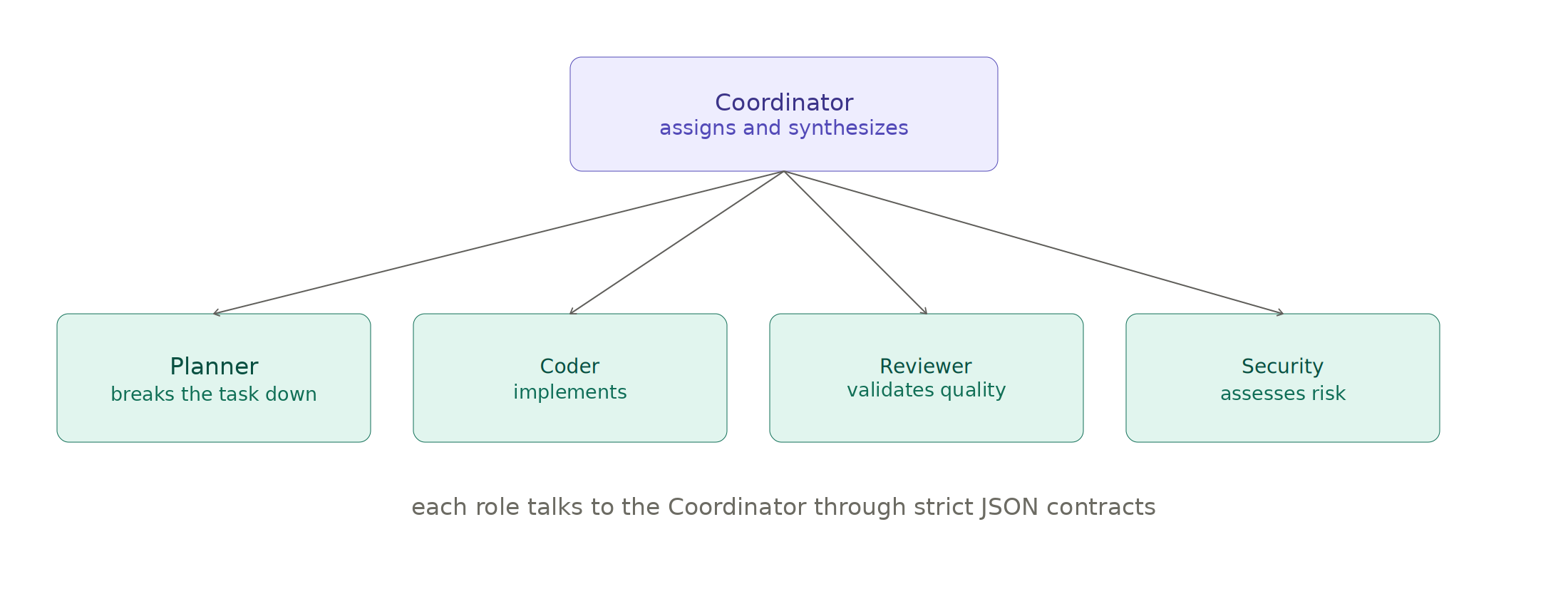
► TECHNICAL TRACK: Implementing the Synthetic Enterprise
# Example 5.1: Baseline Synthetic Enterprise Orchestrator.# Specialized domain roles utilizing tiered foundation models:# the planner leverages a frontier reasoning model; analysts use cost-efficient tiers.
import anthropic
client = anthropic.Anthropic()
AGENT_ROLES = {    "planner": {        "model": "claude-opus-4-8",       # Deep architectural reasoning        "system": """You are the Chief Technology Officer (CTO) of an engineering organization.        You receive a high-level business objective and decompose it into concrete technical tasks.        Output format: JSON object with a 'tasks' list, each containing: description,        assigned_agent, acceptance_criteria, and estimated_complexity ('low' | 'medium' | 'high').""",    },    "coder": {        "model": "claude-sonnet-4-6",     # Balanced code synthesis tier        "system": """You are a Senior Staff Software Engineer. You write clean, testable code        strictly adhering to SOLID principles. Output code only without conversational filler.        If task requirements are ambiguous, ask a single-line clarifying question before writing code.""",    },    "reviewer": {        "model": "claude-sonnet-4-6",        "system": """You are a Principal Engineer specialized in automated code review.        Evaluate code across four dimensions:        1. Correctness (Does it satisfy acceptance criteria?), 2. Security (OWASP Top 10),        3. Maintainability (SOLID, Domain-Driven Design), 4. Performance (algorithmic complexity).        Report ALL findings, including low-severity warnings, with a declared confidence score:        downstream filters determine what requires remediation.        Output format: JSON with 0-10 scores per dimension and an explicit changes_required list.""",    },    "security": {        "model": "claude-haiku-4-5",      # Pattern matching on bounded context, highly economical        "system": """You are an Application Security Auditor. Analyze code for common vulnerabilities:        SQL injection, XSS, SSRF, insecure deserialization, hardcoded secrets, and path traversal.        Output format: JSON with vulnerabilities, severity ('critical' | 'high' | 'medium' | 'low'),        and actionable remediation guidance.""",    },}
def run_agent(role: str, task: str, context: str = "") -> dict:    """Executes a specialized domain agent with its configured model tier and system prompt."""    config = AGENT_ROLES[role]    content = f"{context}\n\nTask: {task}" if context else task
    response = client.messages.create(        model=config["model"],        max_tokens=4096,        system=config["system"],        messages=[{"role": "user", "content": content}],    )    text = next(b.text for b in response.content if b.type == "text")    return {        "role": role,        "output": text,        "tokens_used": response.usage.input_tokens + response.usage.output_tokens,        "model": config["model"],    }
def synthetic_company_pipeline(objective: str) -> dict:    """    Synthetic Enterprise Delivery Pipeline:    Planner -> Coder -> (Reviewer + Security Auditor) -> Consolidated Metrics.    """    total_tokens = 0
    plan = run_agent("planner", objective)    total_tokens += plan["tokens_used"]
    code = run_agent("coder", plan["output"],                     context=f"Technical Plan:\n{plan['output']}")    total_tokens += code["tokens_used"]
    # Code Review and Security Audit are independent: in production, dispatch    # concurrently via asyncio.gather or ThreadPoolExecutor. Sequential here for clarity.    review = run_agent("reviewer", code["output"], context="Code payload under review:")    total_tokens += review["tokens_used"]
    security_audit = run_agent("security", code["output"],                               context="Code payload under security audit:")    total_tokens += security_audit["tokens_used"]
    return {        "plan": plan["output"],        "code": code["output"],        "review": review["output"],        "security": security_audit["output"],        "metrics": {            "total_tokens": total_tokens,            # Production unit cost must be computed per-model and per-token direction            # (input vs. output); see the AIGateway implementation in Chapter 3.        },    }
Notice the deliberate capital allocation embedded in the role registry: the architectural planner is allocated the premium model tier because strategic planning defects cascade down the entire pipeline; the security auditor uses the economy tier because pattern recognition across bounded code diffs requires minimal inference depth. Assigning model tiers by domain role, rather than blindly defaulting to the most expensive frontier model, is the single most effective cost optimization in multi-agent engineering, typically slashing inference invoices by 50%.
The Reviewer’s Directive: A Masterclass in Systems Evaluation
Section titled “The Reviewer’s Directive: A Masterclass in Systems Evaluation”The system prompt for the reviewer role embeds a subtle yet critical directive: “Report ALL findings […] downstream filters determine what requires remediation.” Frontier foundation models interpret severity thresholds so literally that prompting “report only severe vulnerabilities” drastically depresses recall: the model detects an authentic defect yet suppresses reporting because it hesitates over whether it crosses the threshold. The robust pattern strictly decouples detection (exhaustive discovery accompanied by declared confidence scores) from filtering (a deterministic downstream stage, human or automated). This mirrors classical sensor engineering: never conflate physical sensing with threshold filtering.
The Master System Prompt: DRY Applied to Instruction Sets
Section titled “The Master System Prompt: DRY Applied to Instruction Sets”Inspecting the four system prompts in Example 5.1 reveals structural redundancy: each defines a role, scope, operational rules, and an output schema. That repeating structure is an architectural template demanding extraction—the Don’t Repeat Yourself (DRY) principle of Synthetic Clean Code (Chapter 4). We term this canonical template the Master Prompt: a version-controlled contract from which all enterprise agent roles are derived:
# Example 5.2: Master System Prompt — unified structure, parameterized roles.# The template is version-controlled in the repository (prompts/master_v3.md);# each agent role is an explicit dictionary of parameters, not unmanaged markdown.
MASTER_PROMPT = """You are {role}, an autonomous specialist within an engineering swarm.
SCOPE — your exclusive domain responsibility:{scope}
RULES — strictly prioritized; in case of conflict, earlier rules supersede:{rules}
OUT OF SCOPE — if a task falls here, declare it explicitly and terminate execution:{out_of_scope}
OUTPUT FORMAT — emit strictly this schema without conversational filler:{output_format}"""
ROLE_REVIEWER = {    "role": "a Principal Software Engineer specialized in automated code review",    "scope": "evaluate code diffs for correctness, security (OWASP Top 10), "             "maintainability (SOLID, Domain-Driven Design), and algorithmic complexity",    "rules": "1. Report ALL discovered defects with an explicit confidence score (0.0 to 1.0).\n"             "2. Cite the exact file path and line number for every finding.\n"             "3. Do not propose refactoring changes outside the target diff boundaries.",    "out_of_scope": "deciding whether to approve pull requests (reserved for human reviewers); "                    "directly editing or mutating code files",    "output_format": 'JSON: {"findings": [{"line": int, "dimension": str, '                     '"severity": str, "confidence": float, "details": str}]}',}
def build_system_prompt(role_config: dict) -> str:    return MASTER_PROMPT.format(**role_config)
This anatomy (role, bounded scope, prioritized rules, explicit out-of-scope boundaries, structured schema) is deliberately engineered: each block neutralizes a canonical agentic failure mode. The scope prevents responsibility creep (the agentic god class); prioritized rules resolve contradictory constraints that models otherwise resolve stochastically; explicit out-of-scope declarations force graceful escalation instead of hallucinated improvisation; and the output format enforces machine-verifiable contracts across distributed pipelines (Volume 4, Chapter 3). The operational advantages are classical DRY dividends: improving the master template upgrades every agent role simultaneously, regression evals audit the shared contract, and Git diffs on prompts/ expose exactly how organizational behavior was modified.
Editorial Note: Case Study Scope. The following case study is a composite reference scenario engineered to illustrate role-by-role refactoring, rather than an audited enterprise post-mortem. The State of the Art section of this volume notes that multi-year longitudinal studies on production multi-agent systems do not yet exist in academic literature.
Case Study: Refactoring a Monolithic Agent into a Synthetic Enterprise
Section titled “Case Study: Refactoring a Monolithic Agent into a Synthetic Enterprise”(Composite illustrative scenario: models a recurring enterprise refactoring engagement; metrics illustrate representative orders of magnitude.)
Baseline State. An engineering team built “Dev-Bot”: a single autonomous agent powered by a 4,000-word monolithic system prompt attempting to plan features, write backend code, self-review, and draft technical documentation. In isolated demos, it appeared impressive; after three months of production traffic, telemetry exposed systemic decay: first-pass human code acceptance hovered near 40%, unit cost per delivered feature fluctuated erratically by 10× (the CIU metric detailed in Volume 4, Chapter 1), and adjusting prompt instructions to fix one defect broke three others—the classical pathology of an architectural god class Martin, 2009, manifested in natural language.
The Refactoring in Four Disciplined Stages (verified via regression evals before and after each commit, following Fowler, 2018):
- Characterization Harness. Before altering prompt text, the team assembled a suite of forty automated evals reflecting real production tasks from the prior quarter (Volume 4, Chapter 3). These serve as characterization tests: without them, refactoring a prompt is reckless guessing.
- Extracting the Reviewer Agent. The review responsibility was decoupled into an independent agent derived from the Master Prompt above. The primary discovery: the monolith had been consistently “approving its own code”—the self-confirmation bias that generator-evaluator patterns (Chapter 8) are engineered to eliminate. Defect detection rates surged immediately.
- Extracting the Architectural Planner and JSON Contracts. High-level planning transitioned from ambiguous freeform prose into typed task lists with machine-verifiable acceptance criteria (the output format of the Master Prompt). The coder agent now consumed narrowly scoped tasks; prompt token density collapsed, eradicating the lost in the middle phenomenon Liu et al., 2024.
- Role-Based Model Tiering. The planner was allocated the frontier model tier; the coder received the balanced tier; security audits ran on the economy tier (Example 5.1). Cost per Useful Iteration stabilized, dropping by ~40% compared to the original monolith.
Production Outcome. The identical model vendor, identical underlying foundation models, and zero esoteric frameworks: solely Single Responsibility, DRY, typed contracts, and regression testing applied to synthetic workflows. The case study proves the central thesis of this chapter: the reliability of a multi-agent system is, above all, a property of its organizational design, never the foundation model of the day.
Worked Exercise 5.1: Architect an Automated Ticket Triage Pipeline
Section titled “Worked Exercise 5.1: Architect an Automated Ticket Triage Pipeline”Problem Statement. A SaaS enterprise processes 500 support tickets daily. Architect a minimal Synthetic Enterprise pipeline that classifies incoming tickets (billing, technical, sales), extracts structured account metadata, and drafts an initial response for human approval. Assign model tiers per role and justify your architectural decisions.
Walkthrough Solution. Three specialized roles are sufficient; introducing an unconstrained “general coordinator” violates the decision trees in Chapter 8 (the execution steps are deterministic: this is a pipeline, not an exploratory swarm):
| Role | Operational Responsibility | Model Tier | Architectural Justification |
|---|---|---|---|
| Classifier | Category + Urgency + Language | Economy (claude-haiku-4-5) |
Closed classification of short text: economy tiers achieve parity with frontier models here; across 500 requests/day, the cost savings subsidize the downstream pipeline |
| Extractor | JSON extraction (Customer ID, Product, Error) | Economy with JSON schema enforcement | Schema-constrained extraction: deterministically verifiable via Tier 1 unit tests |
| Responder | High-empathy draft response adhering to brand guidelines | Balanced (claude-sonnet-5) |
The sole role where prose nuance matters; receives EXCLUSIVELY the extracted JSON, never the raw ticket: slashes prompt tokens and neutralizes indirect prompt injections (Volume 4, Chapter 4) |
The engineering nuances separating a production architecture from a prototype: (1) the responder consumes structured JSON from the extractor, enforcing minimal context windows and clean bounded contexts; (2) human agents must approve the drafted response before transmission, guaranteeing the system “fails cheaply” (Volume 4, Chapter 5); (3) all three agent roles derive from the versioned Master Prompt; and (4) non-urgent tickets are processed overnight via asynchronous batch APIs at 50% discount (Volume 4, Chapter 1).
Chapter 5 Takeaways
Section titled “Chapter 5 Takeaways”- Task specialization consistently defeats general-purpose monoliths, substantiated by empirical literature: ChatDev, MetaGPT, and AutoGen (Qian et al., 2024; Hong et al., 2024; Wu et al., 2023).
- Conway’s Law (1968) is now deliberately engineered: organizational team topology and distributed agent architecture are the identical artifact.
- Tiered model allocation per role is the foundational cost optimization; it routinely reduces inference spend by half.
- Decouple detection from filtering in review agents: physical sensors must never enforce thresholds.
- The Master System Prompt (role, scope, prioritized rules, out of scope, output schema) represents DRY applied to natural language: one versioned template, multiple parameterized roles.
■ EXECUTIVE TRACK
The Synthetic Enterprise does not eliminate human engineering organizations: it mirrors and magnifies them. Human teams transition from executing repetitive syntax generation to governing autonomous cells of specialized agents that execute within declared guardrails. The governance questions this shift raises (who is liable when an agent fails?, how do we evaluate an engineer who orchestrates?) are addressed in Volume 3. The decisive takeaway for executive leadership today: specialized agent roles are not aesthetic preferences; they represent the design pattern with the strongest published empirical evidence for slashing cascading errors Hong et al., 2024 and maximizing factual correctness Du et al., 2023, backed by quantifiable, governable unit economics.