Chapter 31: Grok, Cody, and Amazon Q
You don’t choose an ecosystem; you map it, evaluate it, and adopt it according to the dominant constraint.
The Missing Map
Section titled “The Missing Map”Chapters 30 and 31 of this volume covered the two poles of the spectrum: tools that live inside VS Code and tools that built their own editor. This chapter covers the rest of the ecosystem, the assistants that operate at the level of the model, the company, or the platform, and that often fall out of the conversation because they are neither VS Code extensions nor standalone IDEs.
Grok: xAI’s Model in the Development Environment
Section titled “Grok: xAI’s Model in the Development Environment”Grok is xAI’s family of models (xAI is Elon Musk’s AI company). Unlike Claude or GPT-4, Grok did not launch with an associated IDE product; its main distribution was the X (Twitter) assistant and the public API. Even so, its relevance to programmers is concrete:
Grok as a Reasoning Model for Code
Section titled “Grok as a Reasoning Model for Code”The Grok-2 and Grok-3 models show reasoning capabilities comparable to the frontier models from Anthropic and OpenAI on coding benchmarks (HumanEval, SWE-bench). Grok’s distinguishing advantage is its training data refresh rate: xAI claims more frequent updates than its competitors, which matters in ecosystems that move fast (frameworks, APIs, language versions).
Integration into the Development Environment
Section titled “Integration into the Development Environment”Grok is consumed through an OpenAI-compatible API, which means Cline (Vol. 2, Chapter 29) can use Grok as its engine with no code changes. For teams looking for alternatives to Anthropic or OpenAI, Grok is a first-class provider at the reasoning layer.
Grok and Real-Time Search
Section titled “Grok and Real-Time Search”One capability that sets Grok apart is real-time web search built into the model. For questions about updated libraries, breaking changes, or undocumented errors, a model with real-time web search has a structural advantage over models with a fixed cutoff.
Cody: Sourcegraph’s Assistant
Section titled “Cody: Sourcegraph’s Assistant”Cody is Sourcegraph’s coding assistant. What fundamentally separates it from Copilot, Cline, or Continue is its enterprise code search layer: Sourcegraph indexes repositories at scale (thousands of repos in an organization), and Cody can reason over that entire index.
The Problem Cody Solves
Section titled “The Problem Cody Solves”In a company with 500 repositories, a programmer looking for “how the retry pattern is implemented on our platform” can’t press Ctrl+F across 500 repos. Sourcegraph was the answer to that problem before AI; Cody turns it into a conversational interface. The question above gets answered by “search the repos for the retry pattern and show me the most recent implementations,” and Cody does it.
Cody and Interchangeable Models
Section titled “Cody and Interchangeable Models”Like Cline, Cody is not tied to one model provider. In the enterprise configuration, it can use Claude (Anthropic), GPT-4 (OpenAI), or private models deployed on the customer’s infrastructure. That matters in regulated sectors where code data cannot leave the corporate perimeter.
Amazon Q Developer: The AWS Ecosystem Assistant
Section titled “Amazon Q Developer: The AWS Ecosystem Assistant”Amazon Q Developer (formerly Amazon CodeWhisperer) is AWS’s entry in code assistants. Its positioning is different: it doesn’t try to be the best general-purpose assistant, but the one most tightly integrated with the AWS ecosystem.
What Q Developer Does Well
Section titled “What Q Developer Does Well”- Completion tuned for AWS SDKs: it knows the S3, Lambda, DynamoDB, and IAM APIs more deeply than general models do.
- Security scanning: it analyzes code for vulnerabilities (OWASP Top 10, dependency CVEs) as part of the completion flow, not as a separate tool.
- Code transformation: Q Developer can migrate legacy Java code or upgrade dependency versions across entire projects, an agentic task that goes beyond completion.
- A genuinely free tier: the individual version of Q Developer is free with generous limits, which makes it accessible for small projects on AWS.
For teams on AWS, Q Developer is the natural entry point. For cloud-agnostic teams, its advantages shrink.
Codeium: High-Speed Autocomplete
Section titled “Codeium: High-Speed Autocomplete”Beyond Windsurf (its IDE, Vol. 2, Chapter 30), Codeium offers extensions for VS Code, JetBrains, and other editors. Its historical value proposition was completion speed: latencies under 100 ms on normal connections, thanks to models optimized for fast inference rather than deep reasoning.
With the Supermaven integration, Codeium widened its context window to one million tokens, letting the model see the whole repository before suggesting the next line. That combination of speed and broad context defines its niche: high-frequency inline completion where latency matters more than depth of reasoning.
Codegen: AI for Mass Code Transformation
Section titled “Codegen: AI for Mass Code Transformation”Codegen (codegen.com) tackles a different problem: large-scale code transformation. It is not a completion assistant or a conversational agent; it is a platform for running coordinated changes across large codebases.
Codegen Use Cases
Section titled “Codegen Use Cases”- Framework migrations (React 17 → React 19, Angular v14 → v17)
- API updates across hundreds of files at once
- Standardizing code patterns across an entire organization
- Refactorings that require understanding dependencies between modules
Codegen combines static analysis of the AST with LLMs to propose changes that respect the semantics of the code, not just its text. For migrations that would touch hundreds of files by hand, it is a productivity multiplier that no conversational assistant can match.
Tabnine and Supermaven: Specialized Autocomplete
Section titled “Tabnine and Supermaven: Specialized Autocomplete”Tabnine was one of the first AI-based code assistants (before GPT-4, before Copilot). Today its pitch is private deployment: the model can be installed entirely on the customer’s infrastructure, with no external traffic. For companies with strict security policies, private Tabnine is the only option that meets every requirement.
Supermaven (now part of Windsurf) stood out for a model architecture optimized for huge contexts at low latency, Jacob Jackson’s “Babble” model. Its contribution to the ecosystem was showing that full-repository context is feasible in real time.
Aider: The Agent in the Terminal
Section titled “Aider: The Agent in the Terminal”Aider (aider.chat) is Cline’s counterpart for the terminal: an open-source coding agent that works without an editor. It takes an instruction, reads the relevant files, proposes the changes as a readable diff, and applies them with the programmer’s confirmation.
Its advantage is its git integration: every Aider change produces a commit with a descriptive message, which makes the change history fully auditable. For CI/CD pipelines where the coding agent runs without a graphical interface, Aider is the natural tool.
The Complete Ecosystem Map
Section titled “The Complete Ecosystem Map”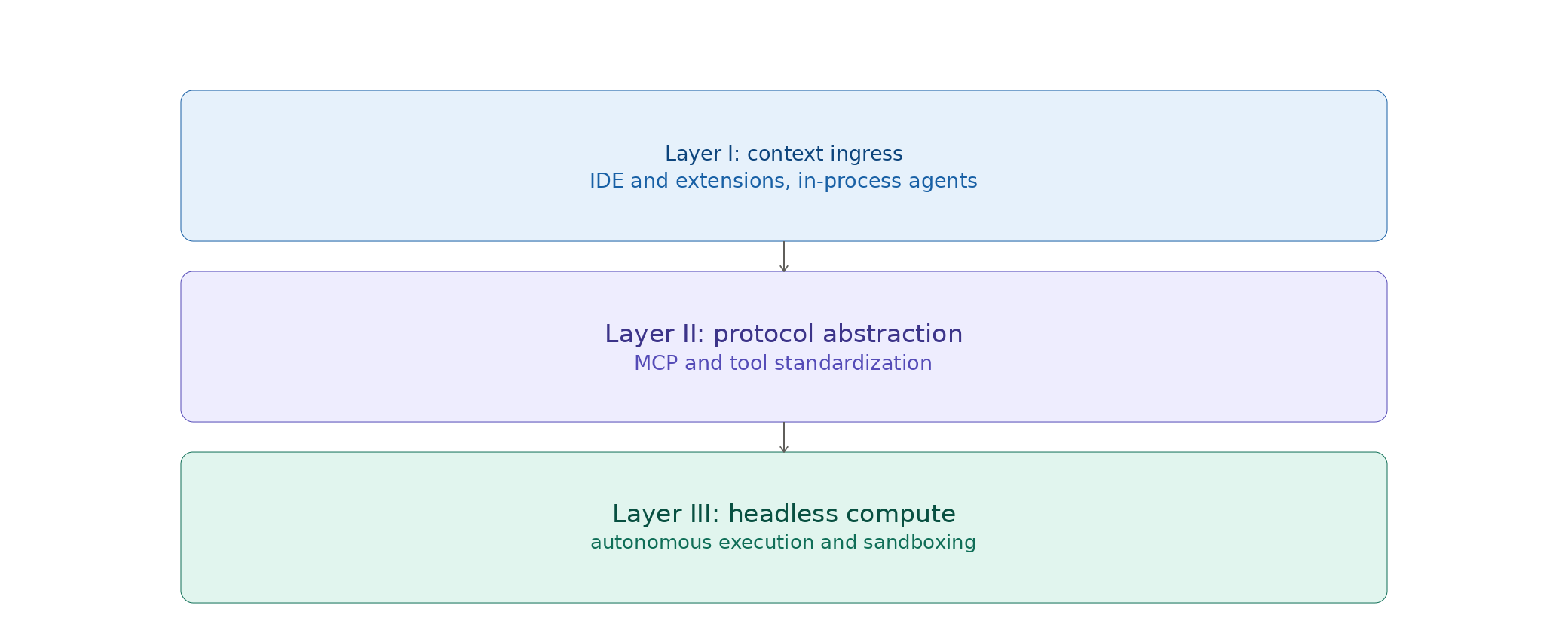
Diagram 31.1: The infrastructure map of AI-Assisted Software Engineering (AI-ASE). An enterprise taxonomy that decouples the development ecosystem into Context/UI Ingress (Layer I), Protocol Abstraction (Layer II), and Headless Sandbox Execution (Layer III).
The Selection Criterion That Matters
Section titled “The Selection Criterion That Matters”With so many tools, the question is “best for which constraint?”, not “which one is the best?”
| Dominant constraint | Right tool |
|---|---|
| Privacy / code inside the perimeter | Private Tabnine, Continue + Ollama |
| Deep AWS integration | Amazon Q Developer |
| Huge codebase (500+ repos) | Cody + Sourcegraph |
| Maximum autonomy in the IDE | Cline, Cursor Composer |
| Mass code migration | Codegen |
| Models with recent data | Grok |
| No graphical interface (CI/CD) | Aider |
| Full-repo context, fast | Windsurf + Supermaven |
Table 31.1: Selection by dominant constraint.
The Executive View: The Ecosystem as an Enterprise Architecture Decision
Section titled “The Executive View: The Ecosystem as an Enterprise Architecture Decision”■ EXECUTIVE TRACK
Choosing AI tools for programmers is not, in the end, a tooling decision. It is an enterprise architecture decision: which layer of the software production stack to outsource, to which vendor, with what privacy guarantees, and with what strategic dependency.
The decision map by dominant constraint (Table 31.1) is the most useful artifact for turning this decision into a structured process. For each team, the question is: which constraint, if unmet, makes the tool unusable? For a European bank: privacy. For a startup on AWS: native integration. For a company with 500 legacy repositories: search at scale. Identifying that dominant constraint shrinks the decision space from 15+ tools to 1–3 viable candidates.
The risk of ecosystem fragmentation. One documented organizational pathology in engineering teams is uncoordinated adoption of multiple tools: developer A uses Cline, developer B uses Copilot, developer C uses Aider, and nobody shares context about how AI is used on the team. The result is not multiplied benefits; it is multiplied heterogeneity without the advantages of collective learning. The recommendation for scrum masters and tech leads is to make an AI tooling policy part of the team’s “Definition of Ready,” documenting which tool is used for which type of task and how agentic output is supervised.
Coding agents as CI/CD pipeline components. The most relevant strategic frontier in the ecosystem in 2025 is not which tool produces the best code completion; it is which tool integrates best into the CI/CD pipeline as an autonomous agent. Aider (with its terminal-oriented design and native git integration) is the most mature candidate to run as a coding agent in automated pipelines: detecting and fixing lint errors, updating dependencies, and generating tests for new code. This integration turns the coding agent from an individual tool into an infrastructure component, with the corresponding implications for availability, observability, and error handling.
The real cost of Devin and long-running agents. Long-running agents like Devin (SWE-agent, Cognition Labs) promise to automate whole engineering tasks, not just assist the programmer but replace them on well-defined tasks. The available empirical evidence (including the critical analysis published on Princeton’s research blog after Devin’s initial demo) suggests that long-running agents succeed on 13–40% of real tasks, depending on complexity. The executive takeaway: they are acceleration tools for well-specified tasks with a short feedback loop, not substitutes for experienced programmers on ambiguous tasks or tasks that require domain judgment.
The State of the Research: Benchmarks That Matter
Section titled “The State of the Research: Benchmarks That Matter”The SWE-bench benchmark (Jimenez et al., 2024, ICLR), already mentioned in Chapter 30, evaluates the resolution of real GitHub issues and is the metric with the greatest ecological validity available. Complementing it, the HumanEval benchmark (Chen et al., 2021, OpenAI) evaluates the ability to generate correct code for standard algorithmic problems, which is useful for comparing the model layer but not the complete agent layer.
For teams that want to evaluate tools in their own context, the most informative protocol is the one developed by Kalliamvakou (2022) on GitHub’s research blog: randomly assign developers to groups with and without access to the tool, measure completion time on tasks representative of the team’s real backlog, and calculate the observed speed multiplier. No external benchmark beats that experiment, run with your own team and your own code, for predictive value.
Key Takeaways from Chapter 31
Section titled “Key Takeaways from Chapter 31”- Grok brings frontier models with frequently refreshed data and real-time web search.
- Cody (Sourcegraph) solves code search at enterprise scale with a conversational interface.
- Amazon Q Developer is the natural entry point for teams on AWS, with built-in security scanning.
- Codeium as an extension plus Supermaven defines the niche of high-speed completion with broad context.
- Codegen handles mass transformations that no conversational assistant can match.
- The choice among tools is not about quality; it is about the dominant constraint: privacy, scale, integration, autonomy.
- Executive view: setting an AI tooling policy as part of the team’s working agreements reduces fragmentation, and Aider as a CI/CD component turns the agent from an individual tool into infrastructure.
- SWE-bench and the controlled evaluation protocol are the most rigorous measures for justifying adoption.