Chapter 1: The Agentic Awakening
The Transition from Traditional Developer to Agent Orchestrator
Section titled “The Transition from Traditional Developer to Agent Orchestrator”For four decades, software developer productivity was measured in lines of code per hour, tickets closed per sprint, and pull requests merged per week. It was an industrial assembly-line metric applied to cognitive labor, and it barely held together: code synthesis velocity had an immutable physical ceiling—the speed of human typing.
That ceiling vanished.
The evolutionary progression can be reconstructed with precision from the literature. In 2017, the Transformer architecture established the technical substrate for everything that followed Vaswani et al., 2017. In 2020, large language models demonstrated they could perform novel tasks from a handful of in-context demonstrations without parameter retraining Brown et al., 2020. In 2021, a specialized code model resolved programming challenges specified in natural language at pass rates that astonished its creators, who paired their findings with an unsparing analysis of emergent safety risks Chen et al., 2021. In 2022, Reinforcement Learning from Human Feedback (RLHF) converted statistical autocomplete models into instruction-following assistants Ouyang et al., 2022, alongside empirical documentation that advanced capabilities—multi-step arithmetic and chain-of-thought reasoning—emerge discontinuously with scale Wei, Tay, et al., 2022.
In 2023 arrived the decisive synthesis: foundation models learned to act. They learned to interleave reasoning traces with external tool invocations (Yao, Zhao, et al., 2023; Schick et al., 2023) and populate sandbox environments with believable emergent social dynamics Park et al., 2023. Between 2023 and 2024, multi-agent frameworks demonstrated that coordinated swarms consistently outperform isolated models on complex software engineering benchmarks (Qian et al., 2024; Hong et al., 2024; Wu et al., 2023). And by 2025–2026, the first multi-agent systems operating under intermittent human supervision reached enterprise production environments, prompting foundation model providers to codify formal architectural blueprints for production deployment Anthropic, 2024.
The software developer whose sole competitive advantage is generating valid syntax now faces the predicament of the telegraph operator confronting automated circuit switching: the craft has not vanished, but it is no longer the economic bottleneck that commands premium compensation. The history of engineering is largely the history of technical disciplines that ascended the ladder of abstraction—or were rendered obsolete outside of it.
► TECHNICAL TRACK
What an Agent Formally Is
Section titled “What an Agent Formally Is”Autonomous agent theory predates large language models by decades. Distributed Artificial Intelligence (DAI) establishes that system intelligence is proportional to the quality of interactions among distributed components, rather than the isolated capability of any individual node (Ferber, 1999). Wooldridge’s classic definition (2009) characterizes an agent as a computational entity situated within an environment, capable of autonomous action to fulfill its design objectives. Formally, an agent:
- Perceives its environment through sensors. In LLM agents: the conversation history, user prompts, and structured tool execution payloads.
- Reasons over that environment utilizing an internal world model. In LLM agents: the parametric weights of the model augmented by dynamically injected context.
- Acts upon the environment through effectors. In LLM agents: function calls, API invocations, database mutations, and filesystem operations.
- Learns from execution outcomes to refine subsequent behaviors. In contemporary LLM agents, this adaptation occurs in-context within the session (via prompt updates and external memory stores), rather than through weight updates.
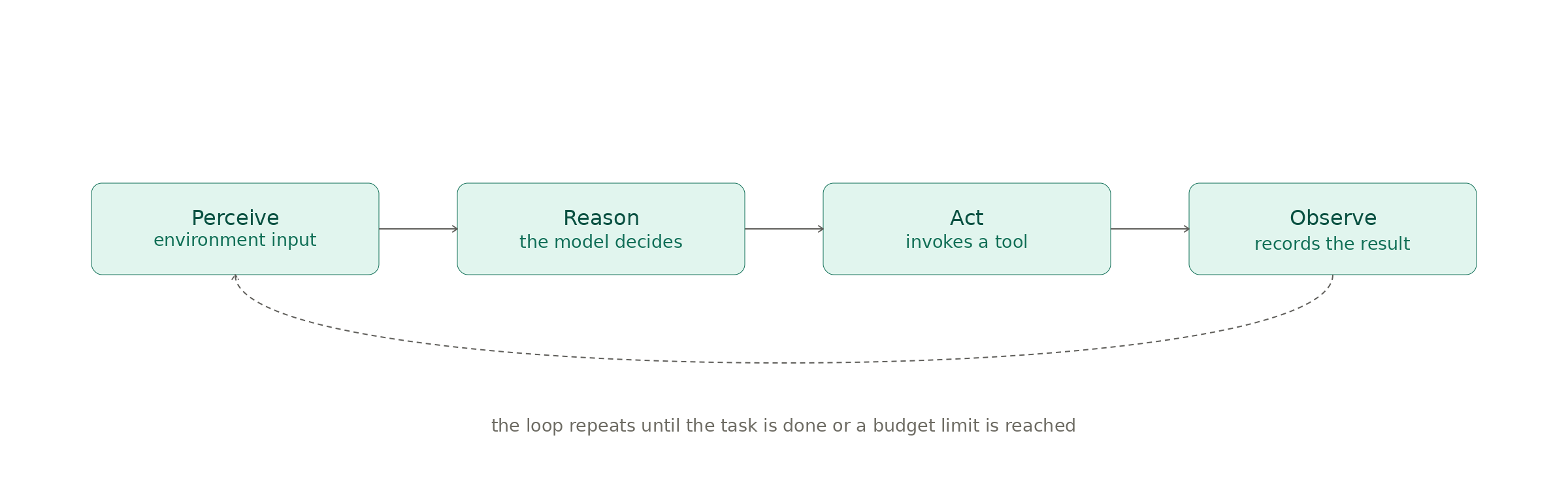
This definition yields an immediate operational conclusion: a chatbot is not an agent. A chatbot perceives and reasons, but it cannot act upon external systems nor close the feedback loop by observing the empirical consequences of its side effects. The demarcation between the two is not the underlying model—which may be identical—but the enclosing architecture. Anthropic (2024) formulates an operational distinction enforced throughout this series: workflows are systems where developer-authored code orchestrates execution steps while the LLM performs deterministic tasks within a hardcoded harness; agents are systems where the model dynamically charts its own execution trajectory—selecting which tool to invoke, evaluating intermediate results, and determining when to terminate. The same reference delivers the most valuable yet frequently ignored engineering rule in modern AI: begin with the simplest workflow pattern that resolves the challenge, and escalate to autonomous agency only when task variance demands it.
Reactive and Proactive: The Two Halves of Agency
Section titled “Reactive and Proactive: The Two Halves of Agency”Classical agency decomposes into two competing properties in perpetual tension Wooldridge, 2009. An agent is reactive when it perceives environmental state changes and responds in time: an emerging bug, a failing test suite, or a corrective steering prompt from a human operator. It is proactive when it does not merely respond to external stimuli, but takes goal-directed initiative: decomposing a high-level objective, synthesizing a plan, and executing actions persistently without requiring human prompts at every step. This distinction is neither novel nor specific to LLMs: it mirrors the demarcation between simple reflex agents and goal-based agents in classical AI Russell & Norvig, 2020.
This tension is fundamental to systems design. A purely reactive agent, driven strictly by stimulus-response without an internal goal, never initiates work autonomously: it is fast and predictable, yet incapable of solving multi-step tasks. A purely proactive agent, executing a plan blindly without re-observing the environment, operates upon stale state, pursuing an objective that has ceased to be valid. Robust agentic engineering resides at the equilibrium point: the ReAct pattern (Chapter 4) operationalizes this balance by interleaving environmental observation (the reactive half) and goal-directed reasoning (the proactive half), cycle by cycle. An agent that only reacts is a glorified webhook trigger; an agent that only plans is a brittle script detached from reality. A reliable agent alternates both halves under a strict compute budget. Do not conflate this agentic reactivity with reactive systems architecture (backpressure, stream processing, Mono/Flux), which governs the underlying message bus upon which agents communicate: these are distinct concepts sharing a name, with the latter explored in Volume 4, Chapter 7.
The frontier of production engineering is actively pushing into the proactive half. What Silicon Valley engineering teams began branding in 2024–2025 as ambient agents is not an unprecedented category of agency. They are background daemon processes triggered by system events rather than direct user prompts, escalating to human operators only when detecting anomalies that mandate intervention Chase, 2025: the proactive agent carried to its logical conclusion, running atop event-driven backbones (Volume 4, Chapter 7). The premise is compelling (“reserve human cognitive bandwidth for high-consequence decisions”), yet demands ruthless scrutiny: every degree of autonomy ceded to the system is a degree of human control surrendered, accompanied by an expanding blast radius Mitchell et al., 2025. Chapter 2 of Volume 3 analyzes this frontier not as marketing hype, but as an engineering trade-off with rigorous design invariants, marking where agents transition from reactive assistants to proactive copilots.
The Autonomy Spectrum
Section titled “The Autonomy Spectrum”Agency is properly modeled as a graduated continuum rather than a binary toggle:
| Level | System Architecture | Flow Orchestration Authority | Production Example |
|---|---|---|---|
| 0 | Single LLM Call | The Developer | Classifying an incoming email |
| 1 | Deterministic Workflow | The Developer | Extraction → Validation → Summarization pipeline |
| 2 | Model-Based Router | The Model selects among fixed paths | Triage of support tickets to specialized handlers |
| 3 | Tool-Equipped Agent | The Model, constrained by a loop budget | Debugging a failing integration test |
| 4 | Multi-Agent Swarm | Orchestrator + Specialized Agents | Greenfield implementation of an end-to-end feature |
Descending each tier in the spectrum expands operational capability while simultaneously magnifying behavioral variance, cost per task, and the blast radius of failure modes. The economic thesis of this work (formalized in Volume 4 via the Cost per Useful Iteration metric) is that the optimal architecture is the minimal autonomy level that satisfies business requirements, never the maximal tier that current models support.
■ EXECUTIVE TRACK
For an engineering director or VP of technology, the agentic paradigm shift translates directly into the income statement: the marginal cost of writing a unit of software has collapsed, yet has migrated entirely into the verification, testing, and governance of synthetic output. The quantitative empirical consensus is unequivocal: AI assistance demonstrably accelerates code production throughput (Peng et al., 2023; Ziegler et al., 2024), but real-world engineering benchmarks expose the boundary: when state-of-the-art models were evaluated against production GitHub issues, they resolved only a modest fraction unassisted Jimenez et al., 2024. The chasm separating “synthesizes plausible code” from “delivers verified, end-to-end production solutions” is precisely where enterprises capture or incinerate capital.
The most catastrophic strategic blunder of the 2025–2026 cycle is optimizing exclusively along the first dimension (reducing engineering headcount because “AI generates the code”) while ignoring the second (who verifies that the synthetic code is correct, secure, maintainable, and aligned with domain invariants). The organizations dominating the agentic era are not those eliminating engineering talent: they are those upskilling senior engineers to orchestrate and govern autonomous agent swarms.
Three questions for your upcoming executive board review:
- Do we track our monthly enterprise spend on foundation model tokens, and do we know which teams drive that consumption? (If the answer is no, Volume 4, Chapter 1 is required reading.)
- What percentage of AI-generated code reaches production without human rework or post-deployment hotfixes? (If unmeasured, reported velocity gains are purely optical illusions.)
- Do we have an active upskilling curriculum to transition senior developers into agent orchestrators, or do we assume it will happen organically? (Volume 1, Chapter 2 provides the blueprint.)
Worked Exercise 1.1: Map Each System Across the Autonomy Spectrum
Section titled “Worked Exercise 1.1: Map Each System Across the Autonomy Spectrum”Problem Statement. Classify each of the following four systems across the Autonomy Spectrum (Levels 0 through 4) and provide architectural justification: (a) a microservice that condenses incoming support tickets into a single-line summary; (b) an assistant that, upon receiving a defect report, inspects the codebase, reproduces the failure locally, and opens a draft pull request; (c) a pipeline that extracts structured data from PDF invoices, runs business validation rules, and ingests records into an ERP; (d) a distributed system where a coordinator assigns a legacy migration across specialized analysis, transpilation, and testing agents.
Walkthrough Solution. (a) Level 0: A single inference call per ticket with no branching logic; higher autonomy levels would incur latency and cost without economic return. (b) Level 3: The model dynamically determines which files to inspect, when to invoke test runners, and when to terminate; requires a bounded iteration budget, read-only tooling, and a sandboxed patch proposal mechanism with zero direct write permissions to main branches. (c) Level 1: Execution steps are static, known, and deterministic; internal decks frequently mislabel this as an “agent,” but it is an invariant workflow—a distinction that matters for budgeting, regression testing, and security boundaries. (d) Level 4: Multi-domain dynamic decomposition; justified only if system (b) already operates with high reliability, as Level 4 inherits all failure modes of Level 3 while introducing coordination latency and emergent communication bugs. Core takeaway: select autonomy levels based on task structure, never organizational vanity.
Chapter 1 Takeaways
Section titled “Chapter 1 Takeaways”- The 2017–2026 evolution is verifiable across literature: Transformer → few-shot prompting → code generation → instruction tuning → tool invocation → multi-agent swarms (Vaswani et al., 2017; Brown et al., 2020; Chen et al., 2021; Ouyang et al., 2022; Yao, Zhao, et al., 2023).
- An agent perceives, reasons, acts, and learns Wooldridge, 2009; a chatbot cannot act: the boundary is architecture, not model capability.
- Agency balances reactivity (responding to environmental state changes in time) and proactivity (taking persistent initiative toward goals); the ReAct pattern balances both by interleaving observation and reasoning (Wooldridge, 2009; Russell & Norvig, 2020).
- Workflows (developer code dictates flow) vs. Agents (the model determines flow): deploy the simplest pattern that satisfies the task Anthropic, 2024.
- The correct autonomy tier is the minimal level that resolves the problem; each step down increases behavioral variance, token spend, and blast radius.
- Engineering costs migrated from code synthesis to verification: leading organizations train senior engineers to govern autonomous agent swarms.