Chapter 24: The Netherlands: When Infrastructure Is the Real Weapon
It is not the one who innovates who holds the power. It is the one who controls the ground where the innovation runs.
The Topology of Power: ASML as a Technology Chokepoint
Section titled “The Topology of Power: ASML as a Technology Chokepoint”The Netherlands has done something no other Western country managed: it has a monopoly on the machines that make leading-edge semiconductors. ASML, with its Extreme Ultraviolet (EUV) lithography technology, controls 92% of advanced chip manufacturing. This is not a minor industrial detail. It is a world-class geopolitical control point. When China needs access to 5 nm technology, it has to go through Amsterdam. When the US wants assurance that its chips are secure, it negotiates with Amsterdam.
What looks secondary at first is that ASML is only a third of the Netherlands’ real power. Given enough time, semiconductors are ultimately replaceable. The interconnection infrastructure is not.
The Gordian Knot: Amsterdam Internet Exchange as a Neural Artery
Section titled “The Gordian Knot: Amsterdam Internet Exchange as a Neural Artery”The Amsterdam Internet Exchange (AMS-IX) is the largest data traffic exchange point in Europe, and 40% of European data traffic flows through it. That means any agent swarm distributed across Europe that needs low latency (under 50 milliseconds) has to pass through Amsterdam. This is not an architectural choice. It is a topological constraint imposed by the physics of the network.
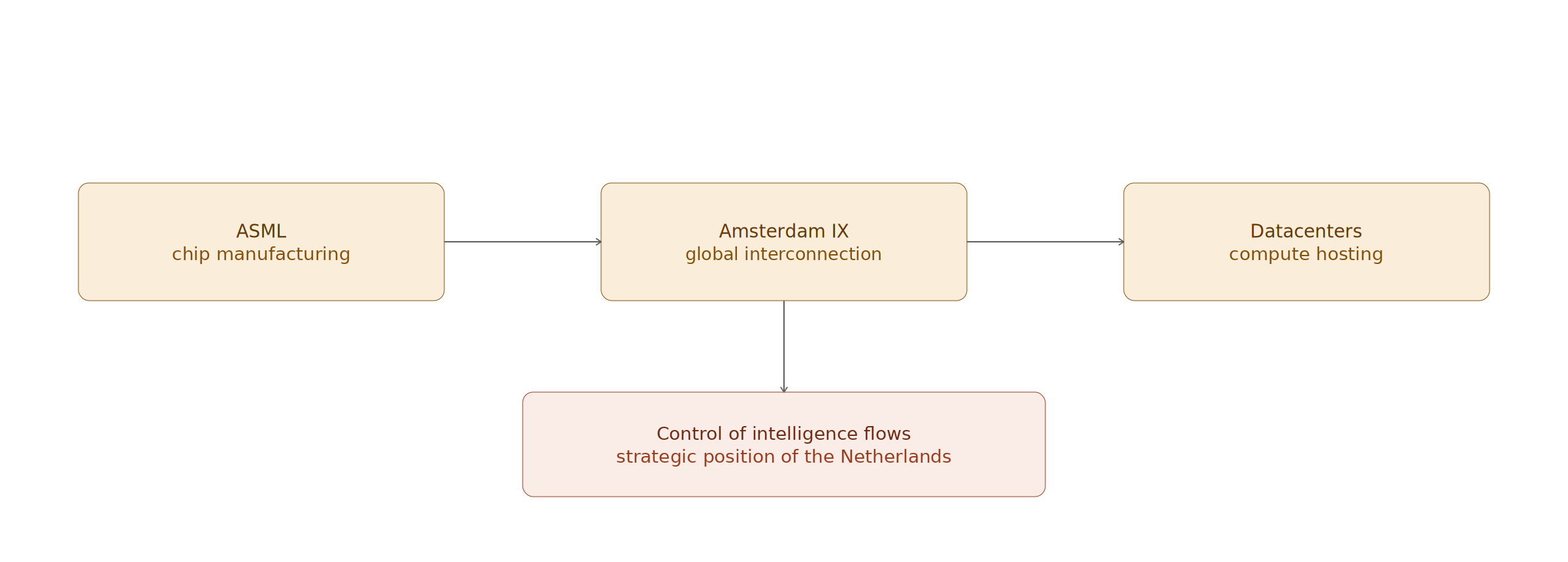
The consequence is subtle but devastating. The Netherlands does not compete with China on GPU volume or with the US on models. It competes on computational sovereignty. A European startup that wants to stay clear of US regulation goes to Amsterdam (GDPR-compliant, no regulatory friction). A swarm of agents that needs latency under 50 ms to coordinate millions of inference operations goes through AMS-IX. Controlling the topological chokepoint means controlling geopolitics.
The Defensive Architecture: Why This Scales in the Netherlands’ Favor
Section titled “The Defensive Architecture: Why This Scales in the Netherlands’ Favor”The math makes the intuition concrete. If peering capacity at AMS-IX is C (measured in Tbps), then the autonomy of each node outside Amsterdam is O(log C), because every decision that requires distributed consensus suffers a delay that grows logarithmically with congestion. The Netherlands controls roughly 20% of European peering capacity, which gives it veto power over latency-critical routes.
Agent swarms that run inference also demand latency under 50 ms. Above that, distributed consensus degrades exponentially (Byzantine Fault Tolerance requires δ < D/3, where D is the network diameter). So any swarm that is critical to Europe has to sit physically within 500 km of Amsterdam. That is the Amsterdam–Paris–Berlin triangle, which happens to hold most of Europe’s data centers.
Technical note on chip fabrication: ASML (Netherlands) builds the lithography machines that create semiconductors. TSMC (Taiwan) uses those machines to manufacture chips at scale (5 nm). The AMD Ryzen AI, made at TSMC, shows the pipeline: Dutch machine, Taiwanese fab, chip that makes edge computing possible. Amsterdam also hosts the data centers where those agents are served through AMS-IX. Infrastructure control, top to bottom.
The Executive View: Computational Sovereignty as a Strategic Advantage
Section titled “The Executive View: Computational Sovereignty as a Strategic Advantage”■ EXECUTIVE TRACK
For organizational leaders, the Netherlands’ position in the global AI value chain has implications that go beyond geopolitical analysis and bear directly on business decisions in Europe.
Infrastructure is not neutral. Deciding where to host a production swarm is not only a technical choice; it is a strategic one. A European company that hosts its multi-agent orchestration in Northern Virginia data centers (AWS us-east-1) implicitly accepts higher latency to the 40% of European traffic than it would have from Amsterdam. That gap, typically 15–30 ms, may not matter for a chatbot, but it decides the outcome for algorithmic trading systems, real-time logistics fleet coordination, and high-frequency inference pipelines.
The second layer is regulatory. The GDPR, which is enforced more effectively in the Netherlands than in any other European jurisdiction, has created a framework in which swarms that process the personal data of European citizens face location restrictions that structurally favor Dutch infrastructure. The Dutch data protection authority (Autoriteit Persoonsgegevens) has published interpretations of the GDPR that make compliance operationally simpler for agents running on AMS-IX than for those routed through the infrastructure of third countries.
The third layer, and the most strategic, is supply chain dependence. Chris Miller’s Chip War (Scribner, 2022) documents with historical precision how Dutch control of ASML’s EUV technology became the most effective point of leverage in Western technology policy toward China. The export restrictions applied since 2019 and tightened in 2023 have shown that controlling one point in the technology value chain, when that point is critical enough, amounts to controlling the whole ecosystem. Organizations that understand this dynamic treat infrastructure decisions as sovereignty decisions, not just cost decisions.
Key Takeaways from Chapter 24
Section titled “Key Takeaways from Chapter 24”- ASML holds a technical monopoly (92% of advanced chips); the Netherlands holds a topological one.
- Amsterdam IX carries 40% of European traffic, which gives it veto power over latency-critical paths.
- The autonomy of distant nodes is O(log C), where C is peering capacity.
- Controlling infrastructure matters more than controlling models. Models will be commoditized; topology persists.
- For executives: deciding where to host agent swarms in Europe is not only a technical decision but a regulatory and strategic one. Using AMS-IX as a hub reduces latency, simplifies GDPR compliance, and lowers supply chain risk.