Chapter 4: Reactive Multi-Agent AI Programming
A swarm is not programmed instruction by instruction; it is programmed reaction by reaction.
From Imperative to Reactive Programming: A Non-Cosmetic Paradigm Shift
Section titled “From Imperative to Reactive Programming: A Non-Cosmetic Paradigm Shift”Imperative programming specifies how to accomplish a task, step by step, via explicit control flow and shared mutable state. Reactive programming, by contrast, specifies how to respond to asynchronous event streams over time, where the event producer neither knows nor controls who consumes the event or when. This distinction—already central to distributed high-availability systems—becomes foundational rather than merely convenient in multi-agent architectures.
An agent swarm is not an imperative sequence of blocking function invocations. It is a dynamic network of reactions: an agent evaluates a state, emits an event, and one or more downstream agents observe that event and react according to autonomous internal rules. From this dance of emissions and reactions, global systemic behavior emerges. Attempting to model this architecture through an imperative lens (“invoke Agent A, await response, invoke Agent B, await response, invoke Agent C”) is not merely inefficient; it squanders the most powerful property of autonomous agents: their asynchronous concurrency. The imperative model imposes artificial synchronization where the system’s nature is intrinsically asynchronous.
Formal Foundations: The Actor Model and ReactiveX
Section titled “Formal Foundations: The Actor Model and ReactiveX”Reactive multi-agent programming does not emerge from a vacuum; it inherits two rigorous theoretical lineages.
The Actor Model (Hewitt, Bishop & Steiger, 1973) provides the most direct conceptual foundation. In this paradigm, the primitive unit of computation is the actor: an autonomous computational entity encapsulating private state, behavior, and a mailbox. Actors communicate strictly via asynchronous message passing; they never share mutable state. Upon receiving a message, an actor may: (1) mutate its internal state, (2) spawn new actors, or (3) send messages to known actors. The structural equivalence to autonomous AI agents is nearly 1:1: each agent functions as an actor maintaining its own context window, communicating with peers via asynchronous events without granting direct read/write access to its internal state.
The Akka framework (Scala/Java) implements the Actor model at planetary scale and can serve as production-grade orchestration infrastructure for agent swarms where ultra-high throughput and fault tolerance are paramount.
ReactiveX (rx.io): The reactive extensions ecosystem, available across modern runtimes (RxJava, RxPy, RxJS), formalizes the Observable/Observer pattern: event producers are observables; consumers are observers subscribing to distinct event streams. Decoupling is absolute: the observable emits; the observer reacts; neither possesses visibility into the other’s internal implementation. In an agentic architecture, observables represent the outbound communication channels of each agent, while observers represent downstream agents triggered by those outputs.
Combining the Actor model for topological structure with ReactiveX stream composition operators yields the most expressive, resilient infrastructure available for reactive multi-agent swarms.
The Four Principles of the Reactive Manifesto, in an Agentic Key
Section titled “The Four Principles of the Reactive Manifesto, in an Agentic Key”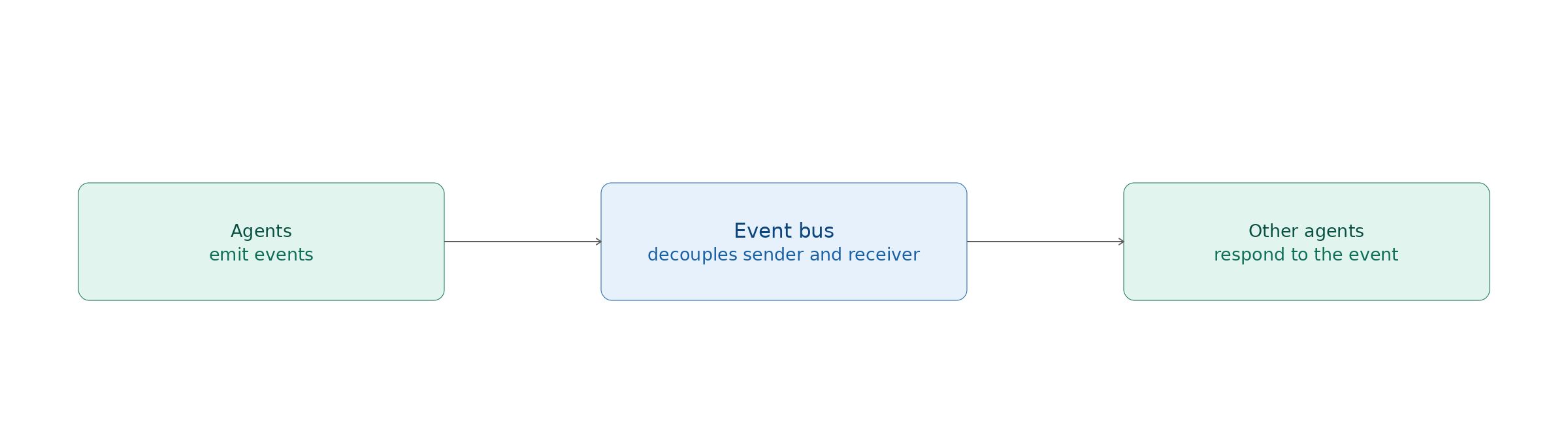
The Reactive Manifesto (Bonér et al., 2014), authored by high-availability systems architects across Twitter, LinkedIn, and Netflix, articulates four core properties required of reactive systems. Each directly informs agent swarm engineering:
1. Responsive: The system responds in a predictable, consistent timeframe, even under peak operational load. For an agent swarm, this mandates that no individual agent may block the global event bus. An agent suffering from cognitive degradation or upstream API latency does not merely miss its own SLA; it cascades degradation across the entire topology if downstream peers block on its output. The reactive countermeasure is the asynchronous timeout: if an agent fails to emit within T_max, the bus fires a timeout event, allowing subscribed peers to degrade gracefully, fall back to cached heuristics, or escalate to a supervisory agent.
2. Resilient: Component failure does not cascade into systemic collapse. Within a swarm, resilience demands that agent failures are strictly isolated, detected, and remediated without contaminating surrounding state. The classic microservices circuit breaker pattern finds direct application here: when an agent experiences repeated reasoning failures or tool exceptions, the circuit breaker trips “open,” rerouting pending events to a fallback agent or deterministic rule engine while the primary agent recovers. This directly mitigates the Tired Programmer Anti-Pattern (cf. Vol. 3, Ch. 13): an agent experiencing context rot trips the circuit breaker before corrupting collective consensus.
3. Elastic: The system scales compute resources up and down proportionally to fluctuating load, avoiding both idle overprovisioning and load shedding. For swarms, elasticity means worker agent instances scale dynamically based on topic backlog. A swarm processing 100 inbound documents per hour requires a vastly different execution topology than one processing 10,000. Agentic elasticity is implemented via distributed consumer groups and horizontal auto-scaling triggered by queue depth.
4. Message-driven: All inter-component communication is asynchronous and mediated via explicit channels (the event bus). Components never invoke each other directly; they publish and subscribe to topics. This decoupled messaging substrate is the prerequisite enabling the other three properties: without it, resilience requires complex synchronous coordination; elasticity requires dynamic socket rebalancing; and responsiveness demands ad hoc timeout implementations across every integration boundary.
Technical Implementation: The Event Bus for Agent Swarms
Section titled “Technical Implementation: The Event Bus for Agent Swarms”► TECHNICAL TRACK
Selecting the event bus architecture represents one of the most consequential decisions in reactive swarm engineering. The three primary options in 2025:
Apache Kafka: The industry standard for high-throughput, partitioned distributed commit logs. Its persistence model guarantees events are durable, strictly ordered within a partition, and replayable from arbitrary offsets. For swarms executing mission-critical business transactions (where event loss is fatal), Kafka represents the default enterprise substrate. The tradeoff is operational complexity: running a production Kafka cluster (via KRaft or ZooKeeper) requires dedicated topic management, retention policies, and partition rebalancing oversight.
Redis Streams: Significantly more lightweight than Kafka, ideally suited for medium-scale swarms (< 100,000 events/second) where microsecond-level latency outweighs extreme multi-terabyte log retention. Redis Streams provides native consumer groups, message acknowledgments, and backpressure telemetry (XLEN). For rapid prototyping and mid-tier enterprise swarms, it frequently offers the optimal balance of performance and operational simplicity.
Cloud Pub/Sub (Google Cloud) / Amazon SNS + SQS: Fully managed serverless messaging primitives that eliminate operational overhead in exchange for cloud vendor lock-in. Ideal for organizations prioritizing velocity over infrastructure portability.
The following architectural matrix synthesizes the trade-offs:
| Criterion | Apache Kafka | Redis Streams | Cloud Pub/Sub |
|---|---|---|---|
| Scale (events/sec) | > 1,000,000 | 10,000–100,000 | 10,000–1,000,000+ |
| Durability | Maximum (persistent commit log) | High (AOF / RDB snapshots) | High (managed replication) |
| Latency | 5–20 ms | 0.5–5 ms | 10–50 ms |
| Operational Complexity | High (cluster operations) | Medium (memory management) | Minimal (fully managed) |
| Native Backpressure | Yes (consumer group lag) | Yes (XLEN inspection) |
Partial (queue depth alerting) |
| Event Replay | Yes (arbitrary offset reset) | Yes (stream ID replay) | Limited (ephemeral retention) |
Why Reactive Architecture Is the Native Grammar of Asynchronous Agents
Section titled “Why Reactive Architecture Is the Native Grammar of Asynchronous Agents”The convergence between the reactive paradigm and agentic AI is neither coincidental nor aesthetic; it is structural. Autonomous language agents are, by design, asynchronous, non-deterministic entities exhibiting three characteristics that imperative architectures cannot efficiently accommodate:
First, agents reason with unpredictable, variable latency: An agent resolving a complex multi-hop question may require 3.5 seconds; the identical agent processing a trivial lookup may return in 150 milliseconds. Under a synchronous imperative model, the caller blocks for the worst-case scenario. In a reactive model, the caller emits the payload and immediately processes unrelated tasks while the worker reasons asynchronously.
Second, agents exhibit stochastic, isolated failure modes: An agent’s failure rate is not uniform; it fluctuates based on input ambiguity, retrieval quality, tool availability, and upstream provider throttling. The imperative paradigm demands brittle nested try/catch blocks at every call site; the reactive model centralizes fault tolerance within the bus fabric via circuit breakers, exponential backoff retries, and dead letter queues.
Third, agents emit heterogeneous multi-part outputs for a single input: A document processing agent can emit a primary structured extraction, a confidence score event, an audit trace event, and an execution cost metric event from a single invocation. The imperative model requires cumbersome wrapper objects or multi-stage callbacks; the reactive model naturally fans out distinct typed events across separate topics.
Backpressure and Flow Control in Agent Networks
Section titled “Backpressure and Flow Control in Agent Networks”Backpressure—the capability of an event consumer to signal upstream producers to throttle emission velocity—is one of the most critical and under-engineered mechanisms in agentic architecture.
Absent backpressure, a swarm where producer agents generate events faster than downstream reasoning consumers can process them experiences unbounded queue accumulation: latency compounds exponentially, memory exhaustion triggers out-of-memory crashes, and the system fails catastrophically. This failure mode is insidious because early symptoms (rising queue depth, minor latency drift) appear benign before sudden systemic collapse.
Backpressure implementations across the primary bus architectures:
- Kafka: Consumer group lag (the delta between partition head offset and the consumer’s committed offset) serves as the primary backpressure metric. When lag crosses configured thresholds, upstream producers are automatically throttled or consumer groups are dynamically scaled.
- Redis Streams: The
XLENcommand inspects active queue depth. Producers monitoringXLENthrottle emission when depth exceeds safety limits, whileMAXLENenforces hard stream caps. - RxPY / RxJava: Operators like
throttle_latest,debounce, andbuffer_with_countregulate emission rates and batch items according to downstream consumer throughput.
For swarms where every event represents a high-cost LLM API invocation, backpressure is not merely an engineering detail: it is a financial circuit breaker. An unthrottled swarm experiencing a traffic spike can burn an entire monthly LLM API budget in minutes.
Mitigating Emergent Complexity: Event Storms
Section titled “Mitigating Emergent Complexity: Event Storms”The architectural power of reactive swarms introduces a unique vulnerability absent in imperative systems: event storms. In an event-driven system where every event can trigger multiple reactions, and each reaction can emit further events, a poorly bounded orchestration loop can trigger a positive feedback cycle where event volume cascades exponentially until the bus saturates and workers crash.
The canonical failure loop: Agent A emits a validation failure event → Agent B catches it, attempts remediation, and emits a retry event → Agent A consumes the retry, fails again, and emits a new failure event → cycle repeats ad infinitum. Without a circuit breaker and retry bounds, this loop generates tens of thousands of runaway API calls in seconds.
Three structural defenses prevent event storms:
1. Mandatory Handler Idempotency: All event handlers must be strictly idempotent (processing the identical event ID multiple times produces the identical outcome as processing it once). This guarantees retries can execute safely and terminates circular failure cascades.
2. Dead Letter Queues (DLQ): An isolated holding queue where events failing processing after N retries are immediately sequestered. The DLQ halts toxic error propagation across the primary bus, enabling forensic inspection and offline remediation without degrading operational throughput.
3. Hop Limits (Event TTL): Every event payload carries a monotonic hop_count header incremented at each downstream processing step. When hop_count exceeds a configured ceiling (e.g., 5 hops), the event is halted and routed directly to the DLQ. Analogous to the IP Time-To-Live (TTL) field, this strictly bounds runaway feedback loops regardless of the underlying root cause.
Observability in Reactive Multi-Agent Systems
Section titled “Observability in Reactive Multi-Agent Systems”Observability—the ability to infer internal system state strictly from external telemetry—is vastly more challenging in reactive systems than in imperative architectures, because causality is asynchronous and indirect. In an imperative codebase, a stack trace delineates the exact sequential call path. In a reactive swarm, an unhandled exception may result from a chain of events initiated minutes earlier by an entirely separate microservice.
The three pillars of reactive agentic observability:
Correlation Tracing: Every inbound transaction is assigned a globally unique correlation_id injected into event metadata headers and propagated across all derived downstream events. When an anomaly occurs, the correlation_id enables full reconstruction of the causal event tree across all hops and agents.
Real-Time Bus Metrics: Partition lag per consumer group, event throughput per agent role, and error rates per event type represent the minimal operational telemetry required to detect cognitive degradation before it impacts end users. These metrics must feed into centralized dashboards (e.g., Prometheus / Grafana or CloudWatch).
Distributed Tracing with OpenTelemetry (OTel): Instrumenting agent runtimes with OpenTelemetry spans allows unifying LLM-specific telemetry (inference latency, token consumption, financial cost) with event bus metrics (queue duration, consumer latency) into a single distributed trace graph. This transforms an opaque agent swarm into an auditable, enterprise-grade system.
Executive Perspective: Operational Considerations for Reactive Swarms
Section titled “Executive Perspective: Operational Considerations for Reactive Swarms”■ EXECUTIVE TRACK
For technology leadership, adopting reactive agentic architectures introduces strategic operational requirements that must be factored in prior to production deployment:
Infrastructure Operating Cost: Maintaining an enterprise-grade Kafka cluster, managing partitioning strategies, and tuning log retention involves substantial operational overhead. For smaller-scale swarms, managed cloud primitives (Cloud Pub/Sub, AWS SQS) frequently deliver a lower Total Cost of Ownership (TCO), even at higher nominal per-event pricing.
Engineering Mental Model Transition: Reactive architectures demand a fundamental shift in developer mindset. Engineers must transition from thinking in sequential function calls to asynchronous event flows; from pure deterministic functions to idempotent message consumers; and from synchronous timeouts to explicit backpressure mechanics. This learning curve is non-trivial and must be factored into enterprise transformation timelines.
Testing Reactive Topologies: Validating reactive swarms under load, edge-case failures, and backpressure requires specialized testing methodologies: chaos engineering, event injection frameworks, and stochastic latency simulation must be established before production cutover.
Alternative Version (Higher Academic Density):
The adoption of the reactive programming paradigm as the architectural substrate for multi-agent artificial intelligence resolves the fundamental engineering tension between the stochastic, variable-latency nature of large language models and the deterministic, traceable fault tolerance demanded by enterprise high-availability systems. The formal model of asynchronous message passing via immutable events distributed over a partitioned append-only commit log—canonically demonstrated by Apache Kafka at throughputs exceeding tens of millions of events per second at LinkedIn and Netflix—provides the mathematical guarantees of delivery and total order within partitions necessary to rigorously reason about swarm behavior under adversarial conditions. Absent such guarantees, multi-agent observability and distributed auditability remain unachievable engineering aspirations.
Key Takeaways from Chapter 4
Section titled “Key Takeaways from Chapter 4”- Swarm orchestration requires designing asynchronous reaction topologies, not sequential imperative call chains. Agent concurrency is a structural property, not an accident.
- The Actor Model (Hewitt, 1973) and ReactiveX provide formal foundations; the Actor model maps directly to autonomous agents maintaining private contextual state.
- The four Reactive Manifesto principles applied: Responsive (asynchronous timeouts), Resilient (agentic circuit breakers), Elastic (scaling driven by consumer lag), and Message-driven (decoupled event bus).
- Kafka (> 1M events/sec, maximum durability), Redis Streams (10K–100K, microsecond latency), and Cloud Pub/Sub (serverless managed) embody distinct architectural trade-offs.
- Backpressure acts as a financial circuit breaker: without it, unexpected traffic bursts can consume monthly LLM token budgets in minutes.
- Event storms are mitigated via three structural controls: mandatory idempotency, Dead Letter Queues (DLQ), and propagation hop limits (Event TTL).
- Reactive observability rests on three pillars: distributed
correlation_idpropagation, real-time bus telemetry, and end-to-end OpenTelemetry distributed tracing.