Chapter 9: MCP: The Protocol Unifying the Agentic World
The USB-C of Artificial Intelligence
Section titled “The USB-C of Artificial Intelligence”The Model Context Protocol (MCP) is the open standard published by Anthropic in late 2024 that formalizes how autonomous AI agents interface with external systems: databases, internal microservices, filesystems, and developer tooling Anthropic, 2024b. It serves as the foundational integration contract of the agentic era, with ecosystem adoption rapidly transcending its original author: throughout 2025, major developer tooling vendors, cloud platforms, and open-source frameworks adopted native MCP support, solidifying its status as the de facto industry standard.
The architectural challenge it resolves is the classic $M \times N$ integration bottleneck: prior to MCP, connecting $M$ generative applications to $N$ external systems demanded $M \times N$ bespoke, point-to-point integrations governed by incompatible proprietary schemas. MCP reduces integration complexity to $M + N$: every client application implements the client specification once, and every enterprise system exposes its capabilities once via an MCP server. This mirrors the economic efficiency that standardized physical interface ports (hence the “USB-C of AI” industry moniker) and, decades earlier, established HTTP as the universal protocol of the web.
Architecturally, MCP is an open protocol built atop JSON-RPC 2.0 that standardizes three core primitives:
- Tools: Executable functions an autonomous agent can invoke to cause side effects or query systems: executing database queries, provisioning Jira tickets, or dispatching API calls.
- Resources: Read-only contextual data payloads that agents can inspect: documentation files, server logs, or database schemas.
- Prompts: Parameterized prompt templates exposed by the server to guide the client agent’s execution.
Design Justification: Component Diagrams for Modular Architecture
The Model Context Protocol is, above all, a modular ecosystem: heterogeneous client applications connecting to distributed external servers via an open standard interface. A component diagram illustrates precisely that: client components, MCP servers, typed port interfaces (Tools, Resources, Prompts), and decoupled network transports.
A class diagram models internal object composition; a sequence diagram captures temporal message traces. Here, systems design demands the modular topology of the ecosystem—how independent distributed components integrate without tight compile-time coupling.
Component diagrams appear in Chapter 8 (multi-agent orchestration topologies), where decoupled modular integration similarly serves as the governing architectural pattern.
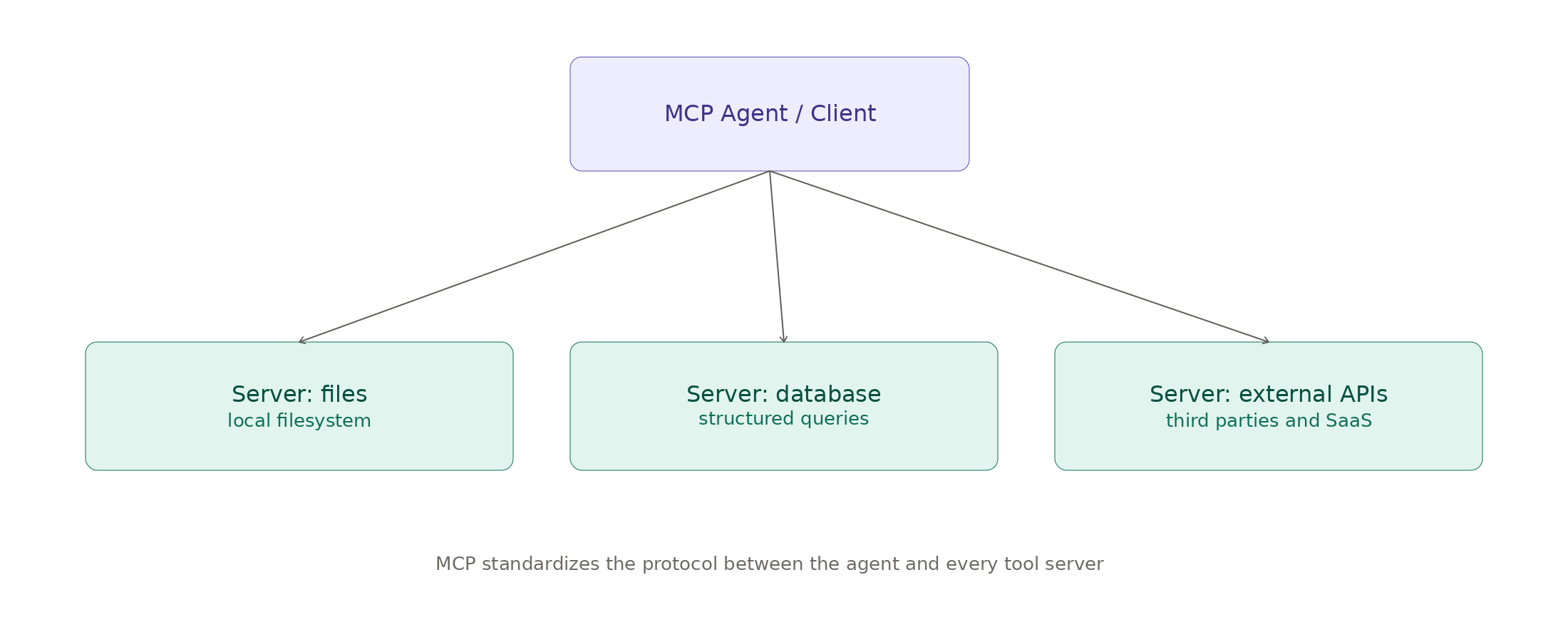
► TECHNICAL TRACK: Authoring a Production MCP Server
# Production MCP Server exposing internal enterprise tools to autonomous agents.# Requires: pip install mcp
import asyncioimport json
from mcp.server import Serverfrom mcp.server.stdio import stdio_serverfrom mcp.types import Tool, TextContent
server = Server("enterprise-system-v1")
# Tool Registry: A tool's semantic description IS its prompt@server.list_tools()async def list_tools():    return [        Tool(            name="query_ticket_status",            description="""Queries the live status of an issue in the project management tracker.            USE when the user asks about the status of a task, issue, or support ticket.            Returns: Current state, assignee, last update timestamp, and active blockers.""",            inputSchema={                "type": "object",                "properties": {                    "ticket_id": {                        "type": "string",                        "description": "Unique ticket identifier (format: PROJ-123)",                    }                },                "required": ["ticket_id"],            },        ),        Tool(            name="execute_readonly_db_query",            description="""Executes a strictly READ-ONLY SQL query against the enterprise database.            PERMITS SELECT ONLY. Rejects INSERT, UPDATE, DELETE, DROP, or multi-statement payloads.            USE for: data verification, state auditing, and production defect diagnostics.            DO NOT USE for: data mutations (use the REST API for state changes).""",            inputSchema={                "type": "object",                "properties": {                    "query": {                        "type": "string",                        "description": "Read-only SQL query (SELECT statement)",                    },                    "database": {                        "type": "string",                        "enum": ["production", "staging", "analytics"],                        "description": "Target database environment",                    },                },                "required": ["query", "database"],            },        ),        Tool(            name="get_system_metrics",            description="""Retrieves real-time infrastructure performance telemetry.            Includes: endpoint latency percentiles, error rates, CPU/memory saturation,            and active firing alerts. USE for live incident diagnostics or health checks.""",            inputSchema={                "type": "object",                "properties": {                    "service": {                        "type": "string",                        "description": "Target service identifier (e.g., 'api-gateway')",                    },                    "window_minutes": {                        "type": "integer",                        "description": "Time window in minutes (default: 15)",                        "default": 15,                    },                },                "required": ["service"],            },        ),    ]
@server.call_tool()async def call_tool(name: str, arguments: dict):
    if name == "query_ticket_status":        ticket_id = arguments["ticket_id"]        # Production integration with Jira, Linear, or internal tracker        ticket_data = await ticket_service.get(ticket_id)        return [TextContent(            type="text",            text=json.dumps({                "id": ticket_id,                "status": ticket_data.status,                "assignee": ticket_data.assignee,                "updated_at": ticket_data.updated_at.isoformat(),                "blockers": ticket_data.blockers or [],            }, indent=2, ensure_ascii=False),        )]
    elif name == "execute_readonly_db_query":        query = arguments["query"].strip()
        # Security Guardrail: Enforce SELECT-only on the SERVER side.        # Never rely on the foundation model to respect tool descriptions:        # the description guides, the server runtime enforces.        if not query.upper().startswith("SELECT") or ";" in query.rstrip(";"):            return [TextContent(                type="text",                text="ERROR: Only single SELECT queries are authorized. "                     "To mutate state, invoke the system REST API.",            )]
        database = arguments["database"]        # Defense-in-depth: read-only DB connection credentials + query timeout        results = await db_service.execute_readonly(query, database)        return [TextContent(type="text",                            text=json.dumps(results, indent=2, default=str))]
    elif name == "get_system_metrics":        service = arguments["service"]        window = arguments.get("window_minutes", 15)        metrics = await metrics_service.get(service, window)        return [TextContent(type="text", text=json.dumps(metrics, indent=2))]
async def main():    async with stdio_server() as (read_stream, write_stream):        await server.run(read_stream, write_stream,                         server.create_initialization_options())
if __name__ == "__main__":    asyncio.run(main())
Registering the MCP Server in Client Configuration:
// .mcp.json (Project Configuration){ "mcpServers": { "enterprise-system": { "command": "python", "args": ["mcp_enterprise_server.py"], "env": { "DB_CONNECTION_STRING": "${DB_CONNECTION_STRING}", "TICKET_API_KEY": "${TICKET_API_KEY}" } } }}MCP Security Is Enterprise Security
Section titled “MCP Security Is Enterprise Security”An MCP server is, by definition, an architectural bridge connecting a non-deterministic probabilistic model to live production systems. Four non-negotiable security invariants, anticipating Volume 4, Chapter 4:
- The Server Enforces; the Description Suggests. All permission boundaries (read-only validation, rate limits, role-based access) must execute deterministically within server code. A tool’s description is merely natural language prompt context, and prompts are inherently vulnerable to adversarial manipulation Greshake et al., 2023.
- Principle of Least Privilege by Construction. The read-only query tool connects via a database user that physically lacks
INSERT,UPDATE, orDELETEgrants; write credentials do not exist in the server process environment. - Tool Payloads Are Untrusted Input. Content returned from external systems (scraped web pages, third-party ticket descriptions) may harbor indirect prompt injection payloads engineered to hijack the model. Volume 4, Chapter 4 formalizes threat models and defenses.
- Third-Party MCP Servers Must Be Audited as Dependencies. Mounting an external MCP server grants the agent runtime the execution capabilities of that server; the software supply chain of third-party MCP servers demands the identical scrutiny applied to open-source packages.
■ EXECUTIVE TRACK
For technology leadership, MCP transforms an unstructured recurring inquiry (“How do we integrate AI into internal system X?”) into a disciplined catalog governance decision: Does an enterprise-grade MCP server already exist for system X, do we build it in-house, or do we defer? The strategic recommendation is treating MCP servers as first-class platform products (Chapter 3): an internal, curated service catalog backed by assigned engineering owners, published SLAs, and automated security scanning. The alternative—allowing product teams to author ad-hoc, unmonitored integrations—reconstructs the exact $M \times N$ chaos the protocol was engineered to eliminate.
Clean MCP Tool Design
Section titled “Clean MCP Tool Design”The four security rules above possess direct design counterparts in Synthetic Clean Code (Chapter 4), because an MCP server is fundamentally a public software contract: and public APIs must be engineered for their consumers—which here comprise two distinct entities: the foundation model (which parses tool descriptions) and the software engineer (who maintains the server runtime):
- Self-Documenting Identifiers.
query_ticket_statusis reliably selected from a catalog of thirty tools;query_v2forces the model to guess blindly. In extensive enterprise catalogs, identifier precision represents the boundary between deterministic execution and stochastic hallucination. - Single Action per Tool. The temptation to author a generic
execute_operation(operation_type, payload)tool violates the Single Responsibility Principle and, critically, strips the execution harness of its ability to enforce fine-grained, per-action permission gates: you cannot enforce read-only policies on a tool that does everything. - Actionable Errors for the Model, Not the Console.
"ERROR: Only single SELECT queries are authorized. To mutate state, invoke the REST API"instructs the model on how to self-correct within the same iteration turn. Returning a raw400 Bad Requestleaves the agent guessing, burning compute budgets on blind retries. - The Schema Is the Contract. Strict types, bounded
enumlists for closed domains, and minimalrequiredparameters: every unnecessary degree of freedom in a tool schema represents an unhandled failure mode that engineering will ultimately debug.
Worked Exercise 9.1: Implement a Production State-Mutating Tool
Section titled “Worked Exercise 9.1: Implement a Production State-Mutating Tool”Problem Statement. Extend the enterprise MCP server by implementing a state-mutating tool, create_incident_ticket, enabling autonomous agents to file production defect tickets. Architect its defensive guardrails: what failure modes exist, and how does the server deterministically block them?
Walkthrough Solution. The tool schema adheres to the canonical template; the critical engineering lies in runtime guardrails, as this represents the server’s first state-mutating write tool:
Tool( name="create_incident_ticket", description="""Creates a production incident ticket in the issue tracking system. USE when the user reports a verified, reproducible defect and explicitly requests registration. DO NOT USE for: general queries (use query_ticket_status), nor to file duplicate tickets.""", inputSchema={ "type": "object", "properties": { "title": {"type": "string", "maxLength": 120}, "description": {"type": "string", "maxLength": 4000}, "severity": {"type": "string", "enum": ["low", "medium", "high"]}, }, "required": ["title", "description", "severity"], },)Within the execution handler, the server enforces defenses that JSON schemas cannot express: (1) Idempotency Keys: A SHA-256 hash computed over title + description across a rolling 10-minute window rejects duplicate submissions, preventing an agent stuck in a retry loop from spawning fifty duplicate tickets; (2) Per-Session Rate Limiting: Capping submissions at $N$ tickets per hour per agent session, using spend budgets as security controls (Volume 4, Chapter 4); (3) Exclusion of critical Severity from the Enum: Escalating an incident to business-critical severity mandates human approval, enforcing high-consequence gating (Volume 3, Chapter 1) directly within the server schema; (4) Immutable Provenance Auditing: The generated ticket payload tags metadata establishing it was synthesized by an agent, recording the session ID for end-to-end auditability. Notice that none of these four defenses live in the prompt: the natural language description guides proper usage; the server runtime enforces compliance.
The Enterprise Catalog Admission Protocol
Section titled “The Enterprise Catalog Admission Protocol”The governance question that concludes this discussion (“By what formal criteria is an MCP server admitted to the corporate catalog?”) must never remain ambiguous in an organization running production agents. This work formulates a standardized evaluation scorecard, verifiable within a one-hour architectural audit, unifying the security and design rules of this chapter with the dependency tracking and degradation budgets of Volume 4:
| Evaluation Dimension | 0 Points | 1 Point | 2 Points |
|---|---|---|---|
| Maintainership | Unidentified author / abandoned repo | Individual developer maintainer | Enterprise vendor or foundation with long-term economic incentives (Chapter 2) |
| Schema Hardening | Zero server-side validation | Partial validation | Full four-defense suite: idempotency, rate limiting, exclusion of critical enum actions, provenance logging |
| Contract Versioning | Undefined versioning | Versioned without formal deprecation policy | Explicit SemVer + documented deprecation windows + consumer-driven contracts (Volume 4, Case 8) |
| Distributed Traceability | Zero structured logging | Proprietary, non-standard logs | Full OpenTelemetry span schema compliance (Volume 4, Chapter 8) |
| Degradation Strategy | Zero fallback plan | Hard failure only | Formally documented, staged degraded mode tested in QA |
Decision Gates: Scores of 7 to 10 admit the MCP server to production unconditionally; scores of 4 to 6 restrict deployment strictly to read-only shadow mode in QA environments until remediation milestones are met; scores below 4 are rejected from the enterprise catalog without exception. Emergency waivers are prohibited: unvetted exceptions are precisely how organizations accumulate the catastrophic governance debt measured in Volume 3, Chapter 1.
Contract SemVer Rules: Semantic versioning for MCP tools eliminates ambiguous upgrades: MAJOR bumps when a tool is removed or its inputSchema introduces breaking changes (mandating a 90-day concurrent deprecation window); MINOR bumps when new tools or optional parameters are added (backwards-compatible, zero deprecation window); PATCH bumps when semantic descriptions are refined to optimize foundation model invocation accuracy (Chapter 2). Downstream consumer applications—never the server maintainers—determine when to migrate across MAJOR version boundaries, honoring consumer-driven contract autonomy.
Chapter 9 Takeaways
Section titled “Chapter 9 Takeaways”- MCP collapses distributed integration from $M \times N$ down to $M + N$: every client application and backend system implements the specification once Anthropic, 2024b.
- Three core primitives: Tools (actions), Resources (read-only data), and Prompts (templates), operating atop JSON-RPC 2.0.
- The server runtime enforces; the prompt description suggests. External tool returns must be treated as untrusted input Greshake et al., 2023.
- Clean tool engineering: self-documenting identifiers, single responsibility per tool, actionable error messages, and strictly constrained schemas.
- Enterprise MCP servers are managed as platform products: centralized catalog, explicit ownership, and mandatory security audits.
- The Catalog Admission Protocol scores maintainership, schema hardening, contract versioning, traceability, and degradation planning (0–10 scale); scores below 4 are rejected without exception.
Discussion Questions
Section titled “Discussion Questions”- Across the ten most critical internal systems consulted daily by your engineering teams (issue trackers, APM metrics, documentation, CRM), how many are accessible to autonomous agents via governed, audited interfaces today?
- Who holds the authority to approve a third-party MCP server for enterprise deployment in your organization? If you evaluated your five most frequently used tools against this chapter’s admission scorecard today, would they pass?