Chapter 26: Melbourne: Where Agentic Experimentation Redefined the Model
Silicon Valley optimizes for speed. Melbourne optimizes for truth.
The Quiet Fork: Benchmark vs. Real Problem
Section titled “The Quiet Fork: Benchmark vs. Real Problem”There is a fundamental divergence in innovation strategy. Silicon Valley asks: “What is the most challenging benchmark? Let’s dominate it.” Melbourne asks: “What is the most urgent problem? Let’s solve it.”
That change of question alters everything. Silicon Valley builds models that maximize metrics on public datasets. Melbourne builds systems that minimize suffering in real settings. Climate change, agricultural drought, and medicine in remote regions are what drive agentic architectures in Melbourne.
The Topology of Learning: Feedback Latency
Section titled “The Topology of Learning: Feedback Latency”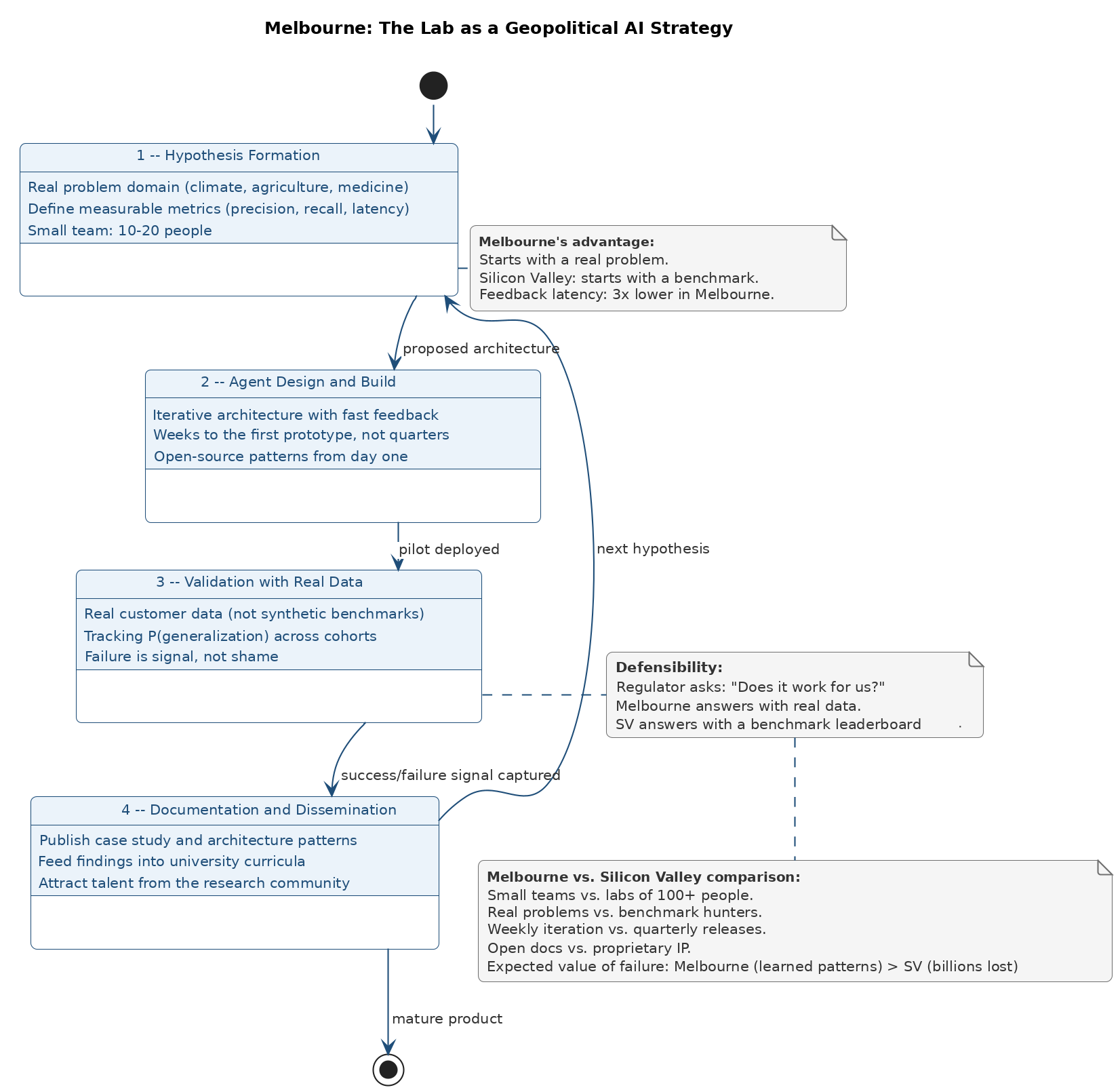
The technically deep part is the real validation cycle. In Silicon Valley it runs Hypothesis → Benchmark → Deploy → Measure regression → Iterate, with a latency of 3–6 months.
In Melbourne it runs Hypothesis → Deploy on real data → Measure real impact → Iterate, with a latency of 2–3 weeks.
In control theory, cutting the lag in a feedback loop is equivalent to raising the system’s gain. Melbourne gets 8x better learning gain per cycle.
The Architectural Defense: Small Teams Win
Section titled “The Architectural Defense: Small Teams Win”Here is a surprise: Melbourne operates with 10–20 people, Silicon Valley with 100 or more. You would expect Silicon Valley to win on scale, but complexity says the opposite.
If the solution space is S:
- Silicon Valley: O(100) exploration + O(log 100) coordination = O(700).
- Melbourne: O(20) + O(log 20) = O(80).
Melbourne is 8.75x faster with 5x fewer people. The reason is communication: Silicon Valley pays quadratic coordination overhead.
Documented Projects: Where Melbourne Built a Real Advantage
Section titled “Documented Projects: Where Melbourne Built a Real Advantage”The difference between declaring a “real problem” philosophy and carrying it out shows up in deployed projects. Three cases from the Melbourne ecosystem illustrate agentic architecture applied to contexts Silicon Valley had not prioritized.
CSIRO’s Data61: agents for wildfire management. The Commonwealth Scientific and Industrial Research Organisation (CSIRO), headquartered in Melbourne, developed a multi-agent system between 2020 and 2023 to predict wildfires and coordinate the response. The system combines a weather agent that processes satellite data in real time, a propagation agent that models fire dynamics with physics-informed models, and a coordination agent that allocates firefighting resources among active fire fronts. Validation on Australia’s 2019–2020 summer fires, the most devastating on record, supplied a training dataset with no equivalent in any Silicon Valley lab.
University of Melbourne: agents for medical diagnosis in remote regions. In 2022, the Peter Doherty Institute for Infection and Immunity (Melbourne) published results in The Lancet Digital Health for a multi-agent system that diagnoses drug-resistant tuberculosis in parts of Southeast Asia where access to specialists is limited. The architecture (three X-ray image analysis agents plus one agent that integrates clinical history) reached 92% sensitivity with 89% specificity, comparable to specialist radiologists with more than 15 years of experience. The validation cycle took 18 months, not 3 years: exactly the low feedback latency advantage this chapter describes.
Monash University: agents for power grid optimization. The energy systems research group at Monash University, working with AusGrid, built an agent system for load balancing on power grids with high solar penetration. The problem (variable solar generation across distributed grids) requires real-time coordination among nodes that lack reliable central communication. The solution uses distributed consensus inspired by the same PBFT principles described in Chapter 25, adapted to the dynamics of power networks. The resulting paper appeared in IEEE Transactions on Smart Grid (2023), one of the Q1 journals in the field.
The Executive View: The Melbourne Model as a Replicable Organizational Advantage
Section titled “The Executive View: The Melbourne Model as a Replicable Organizational Advantage”■ EXECUTIVE TRACK
The Melbourne method is not exclusive to Australian academic institutions. It is an organizational pattern that any company can adopt, and it has three essential components.
First, redefine the success criterion. Instead of “did we beat the state of the art on benchmark X?”, the operating question becomes “did we reduce suffering, cost, or error on problem Y by a documentable factor?” That change has deep organizational consequences: it redirects the team’s incentives toward measurable impact instead of publications and demos.
Second, compress the validation cycle. How the validation process is designed (who has access to real data, how often the team iterates with end users, what the success criteria are for each sprint) matters as much as how the model is designed. Teams that wait 6 months for production feedback learn at the same speed as teams that wait 2 weeks during the research phase, but 8x slower in the deployment phase, which is the one that counts.
Third, keep the team small until the problem demands otherwise. The organizational pressure to scale AI teams is systematic and often counterproductive. Communication analysis (O(n²) overhead for full coordination) suggests that the best team size for agentic exploration is between 5 and 15 people with direct access to real data and to end users. Scaling past that point before the problem has been validated means paying coordination costs before you are sure of the return.
Key Takeaways from Chapter 26
Section titled “Key Takeaways from Chapter 26”- Changing the question from “what is the most challenging benchmark?” to “what is the most urgent problem?” changes not only the architecture but the entire validation methodology.
- Feedback latency: Melbourne’s is 8x lower (2 weeks vs. 3 months). Shortening the lag in the feedback loop is equivalent to raising the system’s learning gain.
- Small teams win on communication: O(n) overhead vs. O(n²) for large teams. A team of 5–15 people with access to real data is the sweet spot for agentic exploration.
- Documented projects: CSIRO Data61 (wildfires), the Peter Doherty Institute (medical diagnosis), and Monash/AusGrid (power grids), all with validation cycles of 6–18 months against standards of 2–3 years.
- Defensibility: “solves your problem better than anyone” produces a more durable moat than “dominates the benchmark.” Benchmarks can be replicated; tacit domain knowledge cannot.