Chapter 2: The Future, the Orchestrator Engineer
The New Social Contract of Software Engineering
Section titled “The New Social Contract of Software Engineering”The future does not belong to the programmer who types fastest. It belongs to the Orchestrator Engineer, who has mastered the art of getting multiple specialized intelligences to work together toward a business goal with maximum economic efficiency and minimum technical debt.
This transition is comparable to the one civil engineering went through when it moved from manual to computer-assisted calculation. Today’s structural engineers don’t work out a bridge’s loads by hand; they design, model, verify, and answer for the result. Nobody would say they are less of an engineer than their predecessors; they are engineers working at a higher level of abstraction. Software engineers in the coming decade won’t write most of their loops; they will design the systems that write, validate, and deploy them, and they will answer for the result.
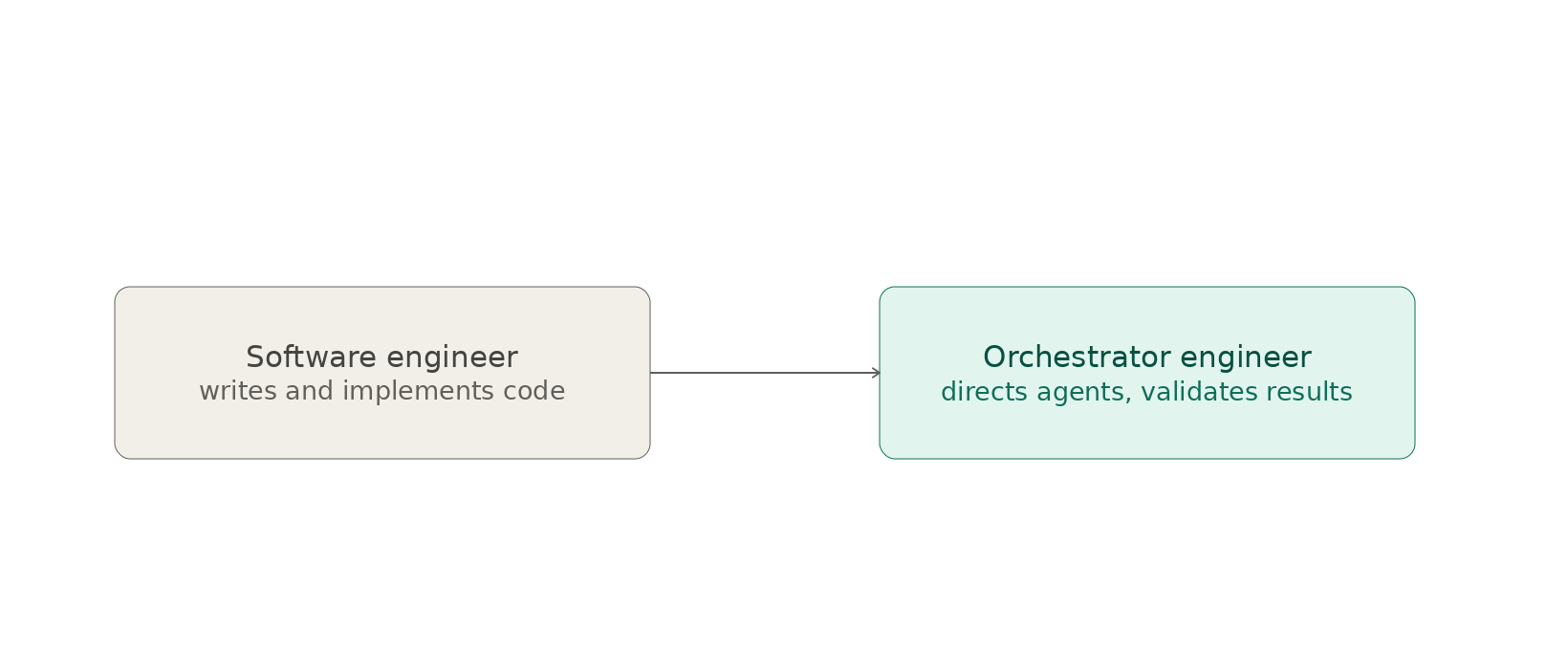
The available evidence points to a transformation of the role rather than a replacement. Productivity studies show AI amplifying engineers’ output (Peng et al., 2023; Ziegler et al., 2024); benchmarks of real tasks show that full autonomy is still far off on the problems that matter (Jimenez et al., 2024); and evaluation research insists that the value of agents depends critically on the human harness around them (Kapoor et al., 2024). The historical pattern is familiar: abstraction did not eliminate programmers. The compiler, the garbage collector, and the cloud multiplied them. What each leap in abstraction does eliminate is the competitive advantage of the skills it automates.
The Five Competencies of the Orchestrator Engineer
Section titled “The Five Competencies of the Orchestrator Engineer”Design Justification: Class Diagram for the Competency Hierarchy
The Orchestrator Engineer’s competencies form a hierarchy: knowledge that builds on other knowledge (architecture → tokens → evals → security → business). A diagram that shows that relationship (here, a pyramid or a layered structure similar to a class hierarchy) reveals exactly that: the stacking of concepts, none of which is sufficient without the others.
A component diagram would show where those competencies live in a system; a sequence diagram would show how they are applied in order. Here we need to see the structure of concepts, the static taxonomy that defines the Orchestrator Engineer.
This is the last place where the class diagram reappears: you learned the notation in the first UML section, you saw it in Chapters 5 (roles), 6 (DDD), and 16 (Clean Architecture), and now you recognize that the same structure (classes, relationships, hierarchies) is what lets you think about systems.
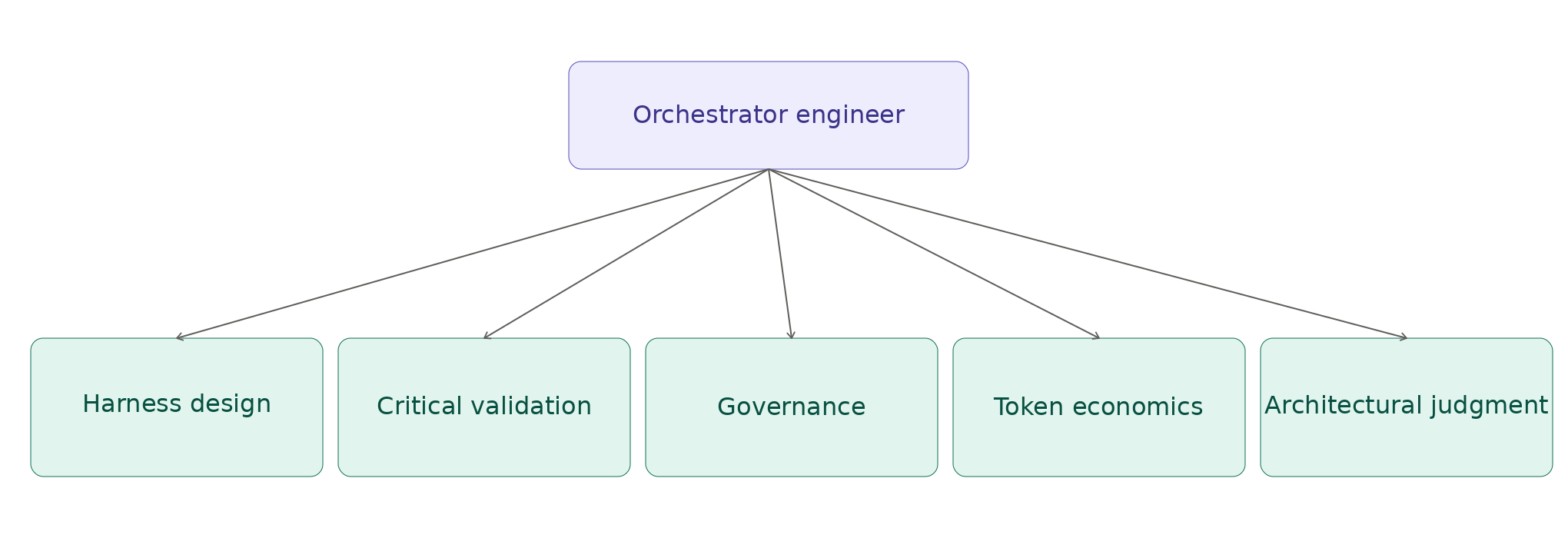
- Architectural thinking about cognitive systems. Designing agent topologies (Chapter 8) the way service topologies are designed today: with explicit contracts, budgets, and failure modes.
- Applied token economics. Treating inference cost as a first-class design variable (Chapters 11 and 12).
- Evaluation engineering. Building the harnesses that turn a nondeterministic system into a governable one (Chapter 13).
- Security and governance by construction. Least privilege, auditing, and human oversight (Chapters 14 and 19) as reflexes, not appendices.
- Business-to-machine translation. The domain’s ubiquitous language (Chapter 6) turned into the agents’ operating context. It is the oldest competency on the list: understanding the problem before the solution, and the one no leap in abstraction has ever automated.
The Proactive Horizon: From Agents That Respond to Agents That Anticipate
Section titled “The Proactive Horizon: From Agents That Respond to Agents That Anticipate”If the reader keeps just one direction for the future from this book, let it be this: the line of advance for agentic systems runs from reacting to anticipating. Almost everything built in these chapters assumes a reactive agent, one that waits for a prompt, an incident, or an event, and then acts. The frontier, by contrast, is proactive agents: those that observe continuously, infer a latent need before anyone states it, and propose (or execute, under guard) the action that meets it. The industry has already given them a commercial name: ambient agents that run in the background and call on the human only when they detect something worth their attention (Chase, 2025), and which the big platforms have made their declared bet for the second half of this decade. The technical capability that makes this possible is not new. It is the event-driven architecture of Chapter 17: a well-built proactive agent is a consumer of the log, triggered by facts, not by people.
This is where this book parts ways with enthusiasm. Where the market sees an idea, the serious engineer sees an agent that would have to carry it out, and asks first what control is being given up and what could go wrong. The most useful critique in the field is also the most uncomfortable: the more control a human hands to an agent, the more risk is introduced for people, and proactivity is, by definition, a delegation of control (Mitchell et al., 2025). It follows that research should be framed, not held back: the engineering answer is bounded proactivity, not total autonomy. That means an agent that anticipates within a narrow boundary, proposes instead of executing anything irreversible (Chapter 19), and operates on a deterministic skeleton (the sector case in Chapter 15). Proactivity does not repeal any discipline in this book; it demands all of them more strongly, because an anticipated error at scale gets made before anyone asks for it.
And here the frontier becomes concrete, and socially useful. Combine the proactive agent with two technologies that already serve society: the Internet of Things, which spreads sensors across the physical world, and drones, which reach where humans cannot. NASA has for years combined satellite data and ground sensors to detect and respond to natural disasters (fires, floods, earthquakes) in near real time (NASA, n.d.). Humanitarian agencies use drones to search for survivors after an earthquake, re-map minefields displaced by a flood, and carry supplies to isolated areas (World Food Programme, n.d.). In all of these scenarios, the bottleneck is not capturing the data; it is getting a human to look at it in time. This is where the pattern this book has already formalized fits precisely: a proactive enriching agent on the telemetry stream (CDC → economic agent → consumers (Chapter 17)) that classifies, prioritizes, and alerts on the sensor or the drone, without touching the source systems and without ever making the irreversible decision. The backbone stays deterministic, and the human decides (Chapter 15). The how is not science fiction; it is a composition of pieces the reader already has in hand. An agent that anticipates a flood an hour ahead of time, or that narrows the search area for a rescue team, is not a demo: it is engineering in the service of peace and of life.
This direction deliberately opens more questions than it closes, and that is its value as a research program. How do you evaluate proactivity, when success is a well-timed interruption and failure is an annoying intrusion? Rigorous measurement of proactive agents is a field that has barely been born (the first evaluation suites specific to it date from 2025), and it inherits, in a worse form, the problem from Chapter 13. What is the economics of an always-on agent? A proactive consumer without a budget or backpressure (Chapters 11 and 17) is permanent Token-Burn by design; the proactive frontier does not repeal the token frontier, it tightens it. And how do you govern trust in a system that acts before it is asked? These are the veins the next decade will have to dig into, and this book leaves them marked on purpose: not as smoke, but as a map. Where others promise agents that will do everything, we leave in writing the method for building the ones that will do something (well, cheaply, and under control), which is the only honest way to get there first.
Closing the Volume: The Art of Conducting the Orchestra
Section titled “Closing the Volume: The Art of Conducting the Orchestra”When I started writing these pages, the debate about AI agents was split into two camps: those who promised that code would write itself and those who argued it was all smoke and marketing. Neither was right, but the first sold better.
It took us twenty chapters to articulate the third position, that of the engineer who neither gets swept up in enthusiasm nor is paralyzed by skepticism: the position of the one who builds. It is the only one that produces systems in production.
The path has a deliberate logic. We began with the foundation: understanding what an agent really is, not the marketing version, but the control loop that reasons, acts, and observes. We then applied principles that have been tested for decades on complex systems: SOLID, clean architecture, cohesion, low coupling. There is no reason to abandon serious engineering when the model enters the picture; on the contrary, its flaws demand it more strongly. We went through orchestration patterns: the council of agents, controlled delegation, the hierarchy with a budget. We faced the real economics of the token: the CIU metric, the hidden cost that doesn’t show up on the balance sheet, because building well means knowing what it costs to build and to keep running. We explored the modern stack: event-driven architecture, the observability that turns the reasoning loop into a readable trace, and the LLMOps that tells an experiment apart from a living system. We arrived, finally, at the horizon: ethics as guardrail design and bounded proactivity as the next engineering frontier.
What you have now is not just knowledge: it is a set of tools you can take to the code and build with. Eight demonstration repositories. An evaluation harness. A six-case playbook. A complete observability cycle. All tested, with bilingual READMEs, under an MIT license.
One honest warning before closing: this technology will move. The models we named in Appendix B will have successors within months; some pattern that looks definitive today will mutate when the context window grows by another order of magnitude. What will not change are the principles we use to design, evaluate, and control. That is what this book tried to teach: not the API commands, but the judgment to use it well.
The rest is up to you. The best agentic systems that exist five years from now will be built by people who today are reading exactly what you just read.
Intelligence has become abundant; judgment is still scarce. The Orchestrator Engineer who masters these disciplines in this decade will be where the web developer who mastered JavaScript and REST APIs was in 2010: at the crest of a wave that will lift everyone who decides to surf it seriously.
The orchestra is already tuning. The baton is yours.
Key Takeaways from Chapter 2
Section titled “Key Takeaways from Chapter 2”- The evidence points to a transformation of the role, not a replacement: AI amplifies (Peng et al., 2023; Ziegler et al., 2024), but full autonomy is still far off on real problems (Jimenez et al., 2024).
- Every leap in abstraction multiplied programmers and eliminated the advantage of the skills it automated.
- Five competencies of the Orchestrator Engineer: cognitive systems architecture, token economics, evaluation engineering, security by construction, and business-to-machine translation.
- Intelligence has become abundant; judgment is still scarce, and it has its own methods, metrics, and discipline.
- The frontier runs from reacting to anticipating: proactive/ambient agents (Chase, 2025) built on the event log (Chapter 17). More proactivity means more control ceded and more risk (Mitchell et al., 2025); the answer is bounded proactivity, not total autonomy.
- Proactive agent + IoT + drones = engineering in the service of society (early warning, rescue, humanitarian aid), using the CDC → enriching agent → consumers pattern (Chapter 17) and a deterministic backbone (Chapter 15). Evaluating proactivity and the economics of “always-on” are the open research veins.